

Influencer (2023)
Directed by Kurtis David Harder
Screenplay by Harder & Tesh Guttikonda
Starring Emily Tennant, Cassandra Naud, Rory J. Saper, Justin Sams, Sara Canning, & Paul Spurrier.
Horror / Mystery / Thriller
★★★1/2 (out of ★★★★★)
DISCLAIMER: The following essay
contains SPOILERS!
You’ve been warned.
 We’ve started seeing a wave of horror films about online life over the past few years, from the recent Deadstream, to Cam, to the Joe Keery-starring Spree, and more. Now we’re also getting films like Kurtis David Harder’s Influencer—the story of a social media influencer named Madison (Emily Tennant), who meets a woman called CW (Cassandra Naud) and quickly finds her carefully curated life, both on/offline, turned upside down after she’s left stranded to die on a remote island. CW then inserts herself into Madison’s life, enjoying all the influencer perks. It isn’t long until CW’s new stolen life starts to unravel and she’s forced to take more extreme measures if she wants to hold onto it longer.
The fluidity of identity online is given terrifying form in Harder’s film, as CW figuratively mows through the vacuous, fake influencers, and influencer hanger-ons, who populate the story. Although CW is the villain of Influencer, she acts as a kind of corporeal warning about the precarious nature of living life—fabricated or not—online. She likewise represents, albeit darkly, a form of karma coming back to bite all those influencers who do nothing but “sell products to little girls,” or those who get tons of things for free just to post some pictures on Instgram while often visiting places where the working-class locals must look after them. CW doesn’t quite taste victory in Influencer, but what she does to Madison, as well as others, is a horrific reality check for those lost in the monetised sauce of the internet’s digital fakery.
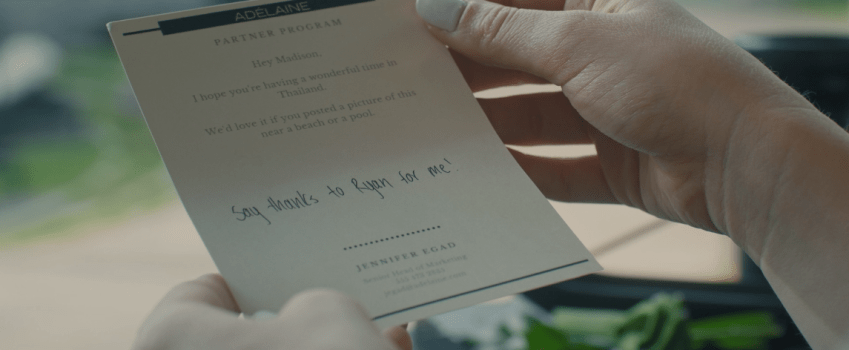 The immediate theme of Influencer is the privilege of influencer life. Madison has to pay for little-to-nothing, she’s given free trips and all the swag that comes along with them, too. She eats and drinks expensive things. But all the money inherent to influencer life is set in stark contrast with the emotional void behind all the free commodities and the pretty views on vacation. One scene depicts Madison taking photos with a fake smile on her face while actually unhappy beneath the posed facade for social media; once the photo’s taken, her smile wears off, fading back into the emptiness inside her. Here, we visibly see the purposeful disconnect between Madison’s two lives: her real, unsatisfied life in the real world versus her constructed, happy influencer life online.
Influencers are largely a vacuum of identity; they’re carbon copies of people, to the point their faces become a mosaic on our phones, as we flip past one after another after another who all look vaguely alike. This makes their identity fluid enough for someone else to take in a day and age of advanced technology, especially the further we move towards AI programs. In Influencer, CW’s main method of slipping into Madison’s life involves seriously advanced photo/video editing, allowing her to seamlessly superimpose Madison’s face over her own. This brings to mind specifically the use of deepfake technology, which can make any of us look like we’re saying anything. Yet again, something such as deepfake tech makes identity in general feel more fluid online than it does already. CW’s just taking on influencers, but her deviousness coupled with newly available tech actually makes her a threat to anybody’s identity; in this light, she represents the increased threat of identity theft for those of us with any modicum of an online presence. So, the implications of Harder’s film actually go far beyond just influencer culture.
 In a scene where CW takes Madison back to her place we see she has a copy of Mark Twain’s The Innocents Abroad sitting on the table. One recurring theme in Twain’s book is how he finds himself bored and even angered by places where history is exploited for profit. In Influencer, CW herself is a symbol of societal revenge pushing back against influencer culture and its exploitation, whether it be exploitation of locations or of people. Perhaps the worst of all the characters, in terms of exploitation, is Ryan (Rory J. Saper), Madison’s kind-of-boyfriend. It’s in Ryan that we see exactly how devious the online world of influencing can be because his perception and treatment of Madison illustrates his true colours as a capitalist pig. We’re treated to a flashback at one point during which we see Ryan and Madison coming together, after Ryan tells CW: “I brought out who [Madison] really was.”
If this bit of male chauvinism isn’t enough, Ryan doubles down with capitalist logic, telling Madison she’s “unique” and that people online “are all about that these days.” Ryan prides himself on branding women like gendered commodities, or digital cattle. He groomed Madison into an influencer, which is something we see a lot of today; so many young people (i.e. the kids of YouTubers) and women have been coerced into an online life, and Madison is one of them. Although CW does something horrible to Madison, and she doesn’t know how Ryan groomed Madison into an influencer, her act of violence against Ryan is a little catharsis for the audience, who are privy to Ryan’s exploitation.
Madison is controlled entirely by other people throughout Influencer, from the backstory of Ryan moulding her into an online personality, as well as stalking her digitally, to CW leaving Madison stranded and stealing the latter’s life. In a horrific way, CW forced Madison to disconnect from online life and influencer culture, then Madison had to, for the first time in so long, actually fend for herself in the real world without all the free vacations and perks and commodities at her fingertips. CW violently thieving Madison’s life is, underneath all the terror, a liberating experience that breaks Madison away from the digital illusion of her influencer lifestyle.
The real hope is that when Madison eventually makes it back to the rest of the world following her unwilling isolated island vacation she will embrace a more authentic life, on/offline, however, there’s a version of the story that ends predictably with Madison returning to her online following with a new story to exploit. Maybe Madison won’t learn anything and she’ll become a self-proclaimed survival expert, milking every bit of money and every free vacation she can out of her tragedy; for some online personalities, the grift is never ending, even after reality comes crashing down violently on their head.
 Father Son Holy Gore
Pingback: This Week at the Movies (Jun. 23, 2023) – Online Film Critics Society