
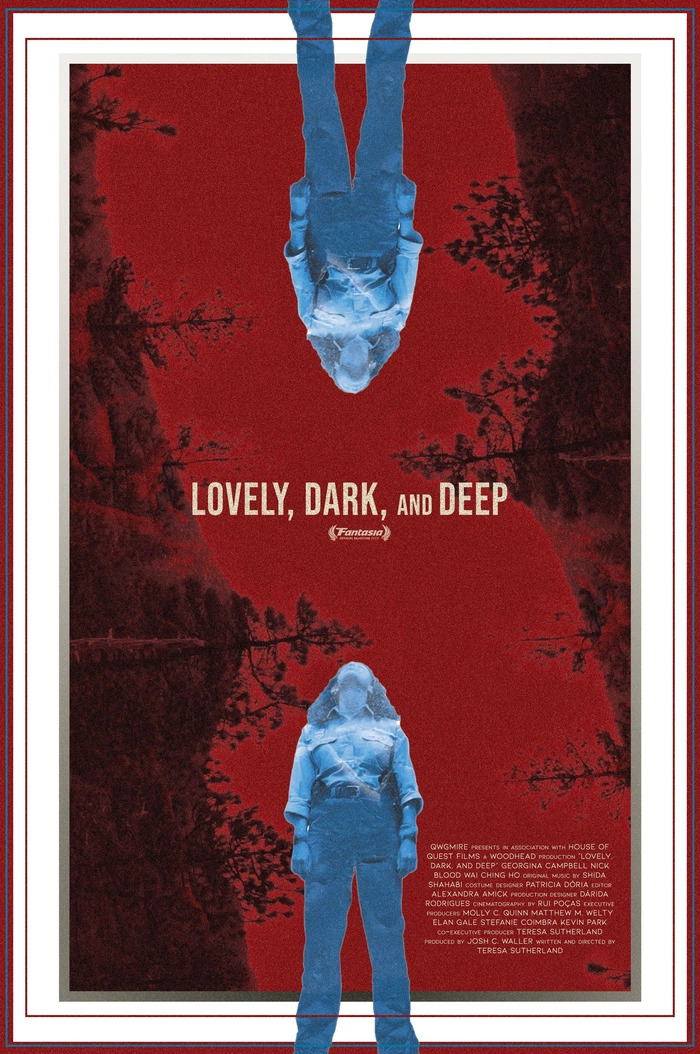
Lovely, Dark, and Deep (2023)
Directed & Written by Teresa Sutherland
Starring Georgina Campbell, Nick Blood, Wai Ching Ho, Maria de Sá, Soren Hellerup, & Ana Sofia Martins.
Horror
★★★★ (out of ★★★★★)
DISCLAIMER:
The following essay contains
SPOILERS!!!
Run. Look Away.
Or be spoiled forever.
Teresa Sutherland previously wrote The Wind (2018), a fantastic, deeply Gothic story of what life was like for many women in the American West nearing the end of the nineteenth century. She’s now written and directed her debut feature, another Gothic tale that premiered at Fantasia 2023: Lovely, Dark, and Deep. The film centres on Lennon (Georgina Campbell), who’s taken a job as a new backwoods ranger at one of America’s national parks. Lennon has to go deep into the woods of the park, nearly all alone, which is frightening enough. But she isn’t entirely alone. Not when she has haunting memories to bring along with her; memories connected to the park, to a deep loss. Once it’s just Lennon with her trauma amongst the trees, things become deeper, darker, and decidedly not lovely.
Sutherland uses gothic elements like the uncanny and the grotesque to portray Lennon’s haunting experience in the woods, as a traumatic past disrupts the present and Lennon searches for answers to a mystery that will not let her rest. There’s even a little sprinkling of Postcolonial Gothic in Sutherland’s story that comes with Lennon’s ultimate understanding of the phenomenon involving countless missing people occurring in the park’s deep woods. What Lennon discovers when she’s lost in the trees is that certain things are beyond our comprehension, and some things, like the land and nature itself, are so ancient that they command respect from humanity, no matter the cost.
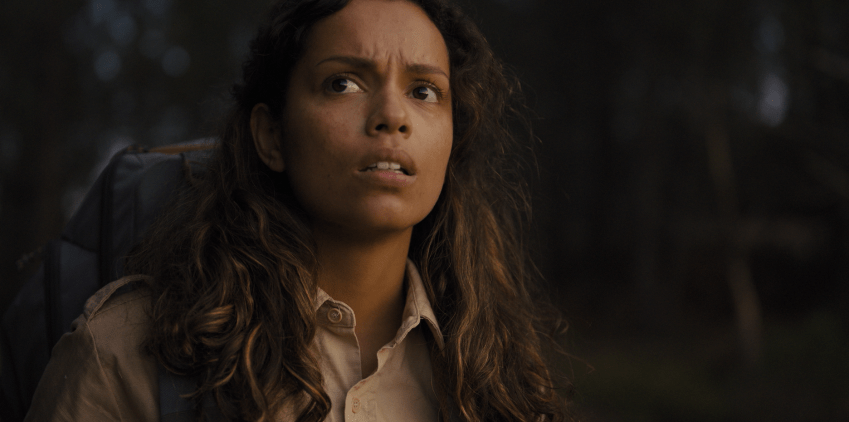 One unsettling scene in Lovely, Dark, and Deep depicts an uncanny double image of Lennon whom she sees in the forest with an elderly couple. The double takes on an idealised version of a park ranger, like a scene from a training video, explaining certain rules for being a ranger with slightly creepy smile on her face. Then the double takes a gun and kills one of the old people. Lennon runs off into the woods, where she eventually comes upon strange images, like the apparition of Missing posters everywhere, including a face she knows, or the grotesque scene she runs into when the old couple first appear to maybe be doing something sexual and it’s revealed that the old man is between his wife’s legs eating the organs out of her split, bloody body cavity. At one point, Lennon sees her boss Zhang (Wai Ching Ho) in an image from the past with her mother, in which Zhang’s face appears like bloody tree bark; a singularly unsettling image.
The most haunting uncanny moment in the film is when Lennon’s psychological space out in the deep woods takes on the appearance of her childhood home, reaching back to Freud’s Uncanny, or ‘unhomely.’ Lennon’s in a familiar space that looks like her home, only it’s full of horrors. The entire place is flooded with water just as much as it’s flooded with memory. It’s her home, but not quite entirely. It’s through this uncanny place where Lennon comes to find out the truth of her haunted past, as well as gets as close as she can to understanding what’s happening in the park’s backwoods.
An outdated criticism of American Gothic is that America has no past, which is an erasure of Indigenous peoples and their respective histories that existed long before European colonialism landed at the shores, whereas in Lovely, Dark, and Deep, Sutherland manages to touch on postcolonial issues, even if unintended. One of the first lines of the film is from the ranger who goes missing: “I owe this land a body.” Later on, after Lennon has fallen headlong into the national park’s surreal depths, she comes to accept that the forests within those parks contains an entity, or entities, far older than America. She has to reckon with the fact that part of living with/amongst the wilderness means accepting its workings, no matter if that means the forest ‘takes’ people.
Lennon recognises the forest’s natural cycle, as well as that it must remain undisturbed, because, either way, the forest will get what it wants. A dark recognition, but one that honours the land. Lennon breaks the cycle of her personal psychological haunting by confronting the past, and though she doesn’t quite receive the answers she wants out in those woods, she gives herself up to something greater than herself and humanity as a whole. Lovely, Dark, and Deep is, in the end, about our human recognition of natural cycles, entities, and processes that existed before we did—cycles, entities, and processes that will continue long after we’re gone, like it or not.
 Father Son Holy Gore