

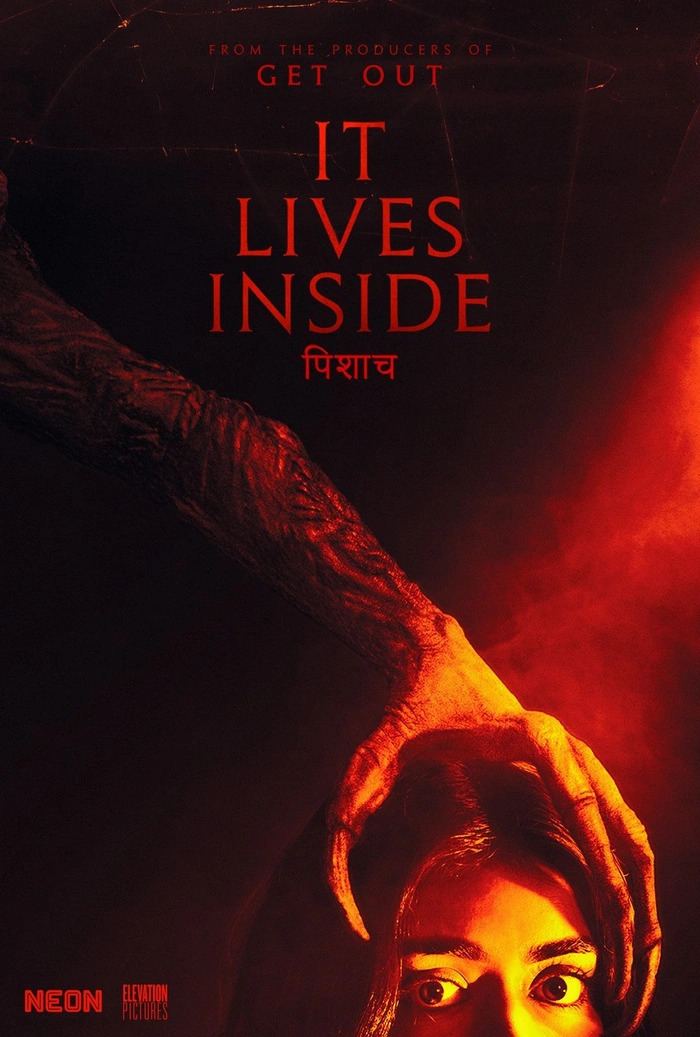
It Lives Inside (2023)
Directed by Bishal Dutta
Screenplay by Dutta; Story by Ashish Mehta
Starring Megan Suri, Neeru Bajwa, Mohana Krishnan, Betty Gabriel, & Vik Sahay.
Drama / Horror / Thriller
★★★★1/2 (out of ★★★★★)
DISCLAIMER:
The following essay
contains SPOILERS!
Horror has been desperately white ever since the beginning when the Gothic novel emerged, and still was later when the Gothic became extremely popular again in the 19th century, which is why, today, now that the barriers to filmmaking, and storytelling in general, have been somewhat broken down, we’re finally getting fresh stories emerging from many different ethnicities and their cultures. Director and screenwriter Bishal Dutta’s debut feature film, It Lives Inside, is the story of Samidha (Megan Suri), an Indian-American teen who’s trying to become more and more American all the time but gets pulled back towards her culture when a childhood friend, Tamira (Mohana Krishnan), descends into a dark place. Samidha typically keeps her Hindu roots separate from her Americanised identity, however, she’s forced to face the darkness threatening to consume Tamira by relying on the same culture she’s been attempting to reject this whole time.
Dutta’s film, which played Fantasia 2023 this summer, is an unsettling tale about the damage inflicted by whiteness upon people of colour in America who are trying to hold onto their ethnic cultures. Samidha’s haunting, inherited from Tamira—previously inherited from another teen who immigrated to America from India—is the allegorical terror felt by so many real people of colour, across many cultures, making America their new home. Sometimes people never get free of America’s monstrous whiteness and are perpetually haunted, no matter how long they live in the U.S. It Lives Inside depicts Samidha’s struggle to survive America with her cultural soul intact, and the lengths to which she must go to contain the whiteness growing inside her like a fungus.
 Right from the start of the film, Samidha tries to subtly reject pieces of her culture, starting with her own body. She shaves her arms to fit in with a white American perspective of a proper female body. After that, she looks at a picture she took of herself on her phone and uses a filter to make her skin lighter; a digital version of the real skin whitening that some people of colour have undergone. We hear people call Samidha by the shortened, more Americanised Sam, which even she tells Tamira to call her: “Y‘know, you can just call me Sam now, everyone else does.” She’s accepted her own Americanised identity and has lost a grip on her cultural origins. Maybe the saddest moment echoing this cultural self-hatred is when Samidha’s mother asks her why she wants “to become one of them” (become white), and she lashes out at her own mother, calling Poorna “another Desi housewife who cooks and cleans.” At the same time, some of the white people around Samidha have gone the opposite way from Americanisation and see Samidha through an Orientalist perspective. One white girl urges Samidha to say they’re best friends in Hindi, and when Samidha reluctantly agrees, the girl hauls out her phone to record, as we bear witness to the performances of culture white folks continually demand from people of colour.
An interesting inclusion in It Lives Inside is found within the lesson being taught in an early scene at Samidha’s school. You can hear in the background that the teacher references “Arbella” and the Winthrop Fleet, which essentially formed the core of the Massachusetts Bay Colony. The fact that the Winthrop Fleet—one of the most prominent, early visions of what became American capitalism, by way of European settler-colonialism—is being taught during a scene in a film that takes on the ramifications of whiteness on immigrant families and their children is a fantastic nod to the Gothic hauntings of ethnicity/race and culture in Western fiction.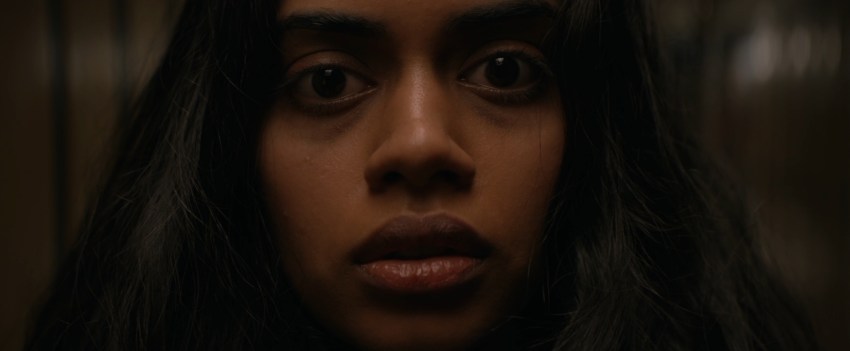 The path towards defeating the evil that has wrapped itself around Samidha, and anyone close to her, is in Samidha embracing her own culture; a return to her cultural roots. In the scene where the demonic influence breaks free from Tamira’s containment, Samidha and the discomfort she feels regarding her roots is the reason it escapes. Samidha’s finally able to battle the evil haunting her by embracing Hindu culture, and does it by first re-embracing her mother, whom she shunned out of deep cultural self-hatred.
Samidha and Poorna recite Hindu prayers. They pray to a statue of Durga, a major Hindu goddess. Two of the (several) things Durga symbolises is protection and motherhood, which connects to the protection of Hindu spirituality and Poorna herself as the two things Samidha requires to combat her violent haunting. But the film’s ending makes the viewer question whether Samidha was able to fight and contain the evil, or if her cultural self-hatred has actually encompassed everything and destroyed her entire reality.
It Lives Inside is about the terrors of turning your back on your culture, though especially in a context of people of colour all too often crushed by the nefarious powers of whiteness. Like the demon that terrorises Samidha and Tamira, whiteness is “a devourer of souls” that feeds off “anger, hatred, loneliness” to do its damage. Not everybody makes it out of America alive. At the end of the film, we’re left to wonder if Samidha’s gotten out relatively unscathed and is now left to contain the monstrous whiteness with which America has infected her. There are no guarantees. Whatever’s really happened to Samidha, she tried to reconnect with her culture and her mother, and if the worst has happened, she at least recognised the fault in rejecting her Hindu roots before the worst potentially ate her alive.
 Father Son Holy Gore