
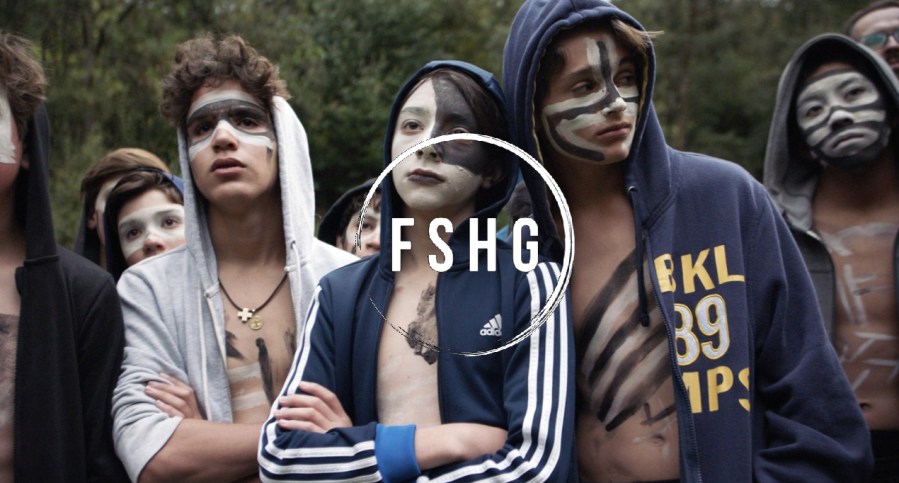
El Hoyo en la Cerca [English title: The Hole in the Fence] (2022)
Directed by Joaquin del Paso
Screenplay by del Paso & Lucy Pawlak
Starring Valeria Lamm, Lucciano Kurti, Yubáh Ortega, & Erick Walker.
Drama / Thriller
★★★★ (out of ★★★★★)
DISCLAIMER:
The following essay
contains SPOILERS!
Turn away,
lest ye be spoiled.
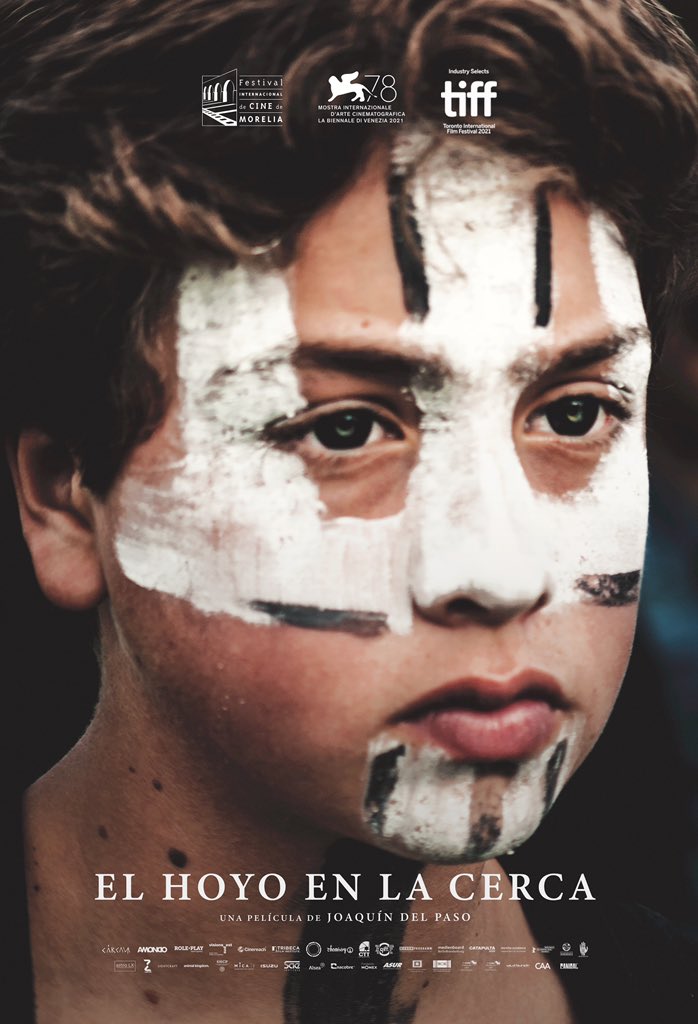 Joaquin del Paso’s The Hole in the Fence depicts the youth of the powerful, wealthy Mexican elite being trained up at an all-male religious camp. The children are taught by older men, some of them priests, how to become physically and morally strong. This means learning the roles of men and women, of those who don’t conform, and plenty of other life lessons for those who hold all the power in society. Everything takes a turn after the boys come upon a hole in the fence around the camp. The hole becomes a broken boundary puncturing the strictly defined perimeters of the camp’s bourgeois world. Soon, everything unravels.
The Hole in the Fence deals with power/wealth, gender dynamics, class, and race, all mixed with a heavy dose of religion. The film is a scathing criticism of the worst at work in Mexican society, and, at times, feels like an allegory about the Catholic Church itself, especially near the end when Catholicism’s forgiveness washes away all the awful sins of terrible men to form a community amongst sinners of the worst kind. Above all, del Paso attempts to get at the biggest problem in most societies: men; the root from which so much evil grows. The Hole in the Fence is a quietly disturbing and powerful critique of how boys are groomed by men to become the masters of society, the next generation of patriarchal monsters who’ll terrorise the world.
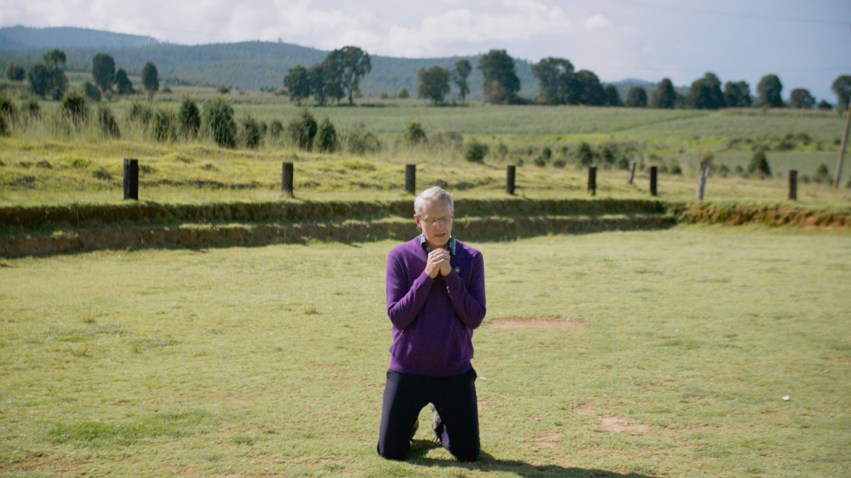 One of the earliest things we see in The Hole in the Fence is how the boys at the camp are misogynists in training under their patriarchal elders. The men lead the boys in a prayer to Mary, mother of Jesus that reveals a creepy obsession with the constructs of conservative womanhood, especially the perceived purity of virginity: “Mother of Christ … Mother most pure … Untouched Mother … Mother most chaste … Faithful virgin … Mystical rose … Queen conceived without original sin.”
During one scene, the camp is called “Los Pinos” and this is significant because Los Pinos is a metonym for the Presidency of Mexico. Just the camp’s name is a strike at the heart of Mexican society and since, at the time of this writing, Mexico has never had a woman as president it’s a simultaneous strike at the patriarchy wrapped around its society’s core. The heteronormative structure of patriarchal society is also laid out for the boys in The Hole in the Fence. The boys trick a lifeguard into nearly doing mouth-to-mouth on a boy, then chase him, teasing him saying “Kill him!” Once again, an act of play reveals the prescriptions being laid down for these boys. Two boys are teased for spending time together and called gay: “Did you know being gay goes against school rules?” It’s a training camp for a lot of things; heteronormative bigotry’s one of them.
In one scene, the group are talking about “something intangible that will protect our order from harm” and one kid says “Money” immediately before they move on to discussing religion. At this camp, money is the second religion after Christianity itself. Money and the status it affords allow the boys a figurative distance to separate themselves from the nearby mortar shells dropping and the local village’s sociopolitical chaos. It’s a picture of the economic stratification in Mexican society; rich and poor in such close geographic proximity while vastly separated by economic power.
When the boys at camp play a rally the flag game it acts as another form of indoctrination that makes visible the workings of class: peasants are “infected” and there is a protective circle around “the elite.” Here, ‘play’ is used to reinforce and prescribe certain hierarchical beliefs of the bourgeois class; sinister, but nowhere near the most sinister acts in The Hole in the Fence. A little girl becomes the target of an attack late in the film, as the boys’ play turns into real-life violence while they burn houses and terrorise the local village. The boys from the camp scream at the girl: “This is your people‘s fault.” They bury her up to the neck, leaving her there. A final shot before the close of the film is a chilling reminder of the discarded bodies left behind after the powerful are done playing.
 Of course the wealthy and powerful of tomorrow’s training wouldn’t be complete with racism alongside the capitalism and misogyny. One of the camp elders tells the boys: “This land is made up of layer upon layer of Indigenous weapons, Indigenous shit, Indigenous blood, Indigenous bones. And who knows? Perhaps their descendants are still around.” A flippant attitude especially at the end, as if the bourgeois, religious elite think they eradicated all the Indigenous people in Mexico. Their disrespect of Indigenous history is a form of erasure. There’s otherwise a general air of racism at the boys’ camp.
One kid named Eduardo is called “brownie” by the white kids. When Eduardo eventually winds up in a fight with one of the racist boys, breaking the kid’s nose, this leads to a look at the racial division intersecting with class in Mexican society. We discover that Eduardo is a “scholarship kid” and he’s then called a “little savage” by the other mother’s boy. The way the racist boy and his family are treated with care versus the way Eduardo’s treated with disdain is a reminder that even when those of the lower classes, or those not of a dominant ethnic/racial group, climb the ladder by pulling up their metaphorical bootstraps and making it into centres of power, they are still seen as not belonging.
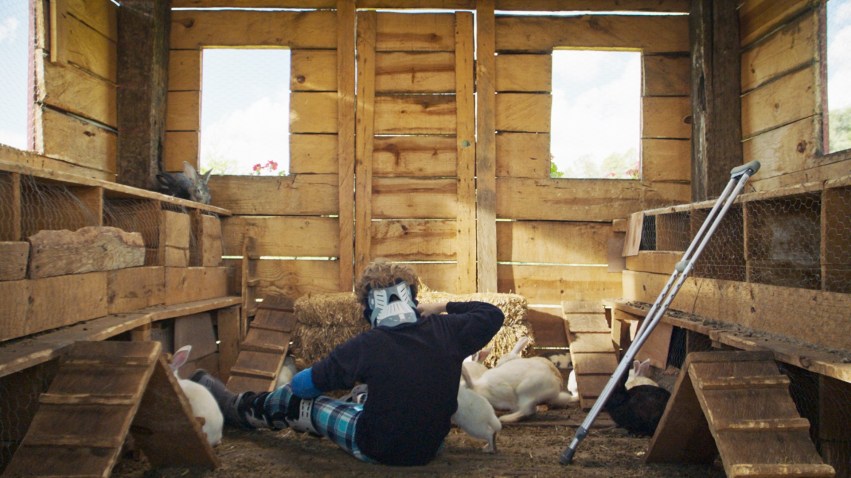
At a certain point we hear about the “Turdus albocinctus,” otherwise known as the white-collared blackbird. One of the camp elders mentions that “the Turdus steals, kills, and also rapes.” The boys are told how the Turdus have lived for centuries in the forest and have “formed an impenetrable male–only society.” The birds and their behaviour become a mirror of men and patriarchal society. More than that, in an age when queer and trans people are being irresponsibly labeled as groomers, The Hole in the Fence confronts the actual grooming forever at work in a heteronormative, patriarchal society. When one boy complains to the elders, one of the older men replies: “That‘s why we’re grooming you.” We later see the older men using binoculars to watch the young boys, like a perverse subversion of birdwatching; the boys are the young Turdus albocinctuses being turned into stealing, killing, raping machines. In fact, The Hole in the Fence urges that homosexuality is not the force driving grooming, rather men are the ones who groom, regardless of sexual orientation. One of the elders says that “in secret” the Turdus “males mate with each other” and even rape the youngest; again, just like the men at the camp, the men who run society. We see the men act just like the Turdus, perhaps even worse since an abused boy, Diego, who was raped by a man at the camp ends up being killed for trying to escape.
While The Hole in the Fence is focused on Mexican society, and there are references like “Los Pinos” which are directly connected to Mexico, the class division, heteronormativity, misogyny, and patriarchy Joaquin del Paso’s film exposes is characteristic of so many societies around the world in which the dominant culture oppresses the lower classes, queer and trans people, as well as women. The film is a horrifying reminder of how those dominant cultures work on the youth as soon as possible, and while bigots accuse queer and trans people of attempting to brainwash kids, it is those with wealth and power—typically the white men—who are brainwashing us all, but especially the kids, and those kids grow up to be powerful, wealthy monsters who remember everything last bit of hate they were taught.
 Father Son Holy Gore