
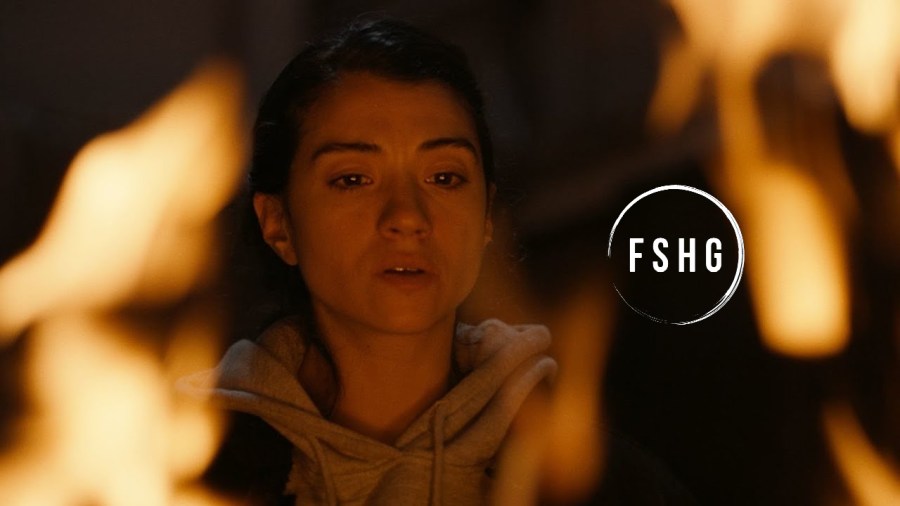
Ashkal: The Tunisian Investigation (2023)
Directed by Youssef Chebbi
Screenplay by Chebbi & François-Michel Allegrini
Starring Fatma Oussaifi, Mohamed Houcine Grayaa, Hichem Riahi, Nabil Trabelsi, Bahri Rahali, Oumayma Mehrzi, & Ghali Jebali.
Crime / Drama / Thriller
★★★★ (out of ★★★★★)
DISCLAIMER:
The following essay
contains SPOILERS!
Turn back lets ye be spoiled.
 Youssef Chebbi’s Ashkal: The Tunisian Investigation isn’t classified exactly as a horror film, yet it’s absolutely a Gothic story, and one that is Gothic in the most traditional sense because of the way it uses uncanny repetition, among other Gothic elements, to tell a haunting tale. The film opens by mentioning the self-immolation of Mohamed Bouazizi, a twenty-six-year-old street vendor who set himself on fire in protest of his treatment by municipal officials in Sidi Bouzid. The story follows two detectives, Fatma (Fatma Oussaifi) and Batal (Mohamed Houcine Grayaa), investigating another self-immolation that happened under less public, much more mysterious circumstances at a half-finished construction site. As Fatma and Batal investigate, more immolations occur, but the deaths all seem like someone else was involved. Beyond the investigation, Fatma and Batal navigate a changing police force and a changing nation, as the Truth and Dignity Commission investigate many abuses committed by the Tunisian state. In the midst of turmoil, the two detectives attempt to solve their connected cases before everything in their lives, and the nation, goes up in smoke.
Chebbi’s film is political Gothic that reckons with the present state of Tunisia by grappling with the past. Fatma and Batal represent two different generations of police, however, they remain representative of power and its many abuses. While Batal insists he only did what was necessary in the past as part of the old regime, Fatma tries to convince herself that things now are actually changing rather than staying the same, not unlike how people imagined the end of Zine El Abidine Ben Ali’s reign, following unrest sparked by Bouazizi’s self-immolation, was automatically going to end the corruption and violence of state forces; unfortunately, not the case in reality. Ashkal is a story about a haunting hope for legitimate change that has burned openly in the gut of Tunisian society for the past decade and less visible for even longer.
 In real life, Mohamed Bouazizi’s self-immolation set off an uncanny series of self-immolations across Tunisia, as well as other countries in the Greater Middle East and Europe, just like the film begins with a script referencing Bouazizi’s death and then various self-immolations occur throughout Ashkal, albeit these are fictional, not based on the other real incidents. The film’s immolations become uncanny in the Gothic sense because in this story there’s a man who seems to ‘give’ the victims fire, they’re not as simply understood as Bouazizi’s or as familiar as what has historically been viewed as a typical self-immolation. The repetition of the fires drives the film, but the uncanniness of the immolations is the entire point: these acts are at once so foreign and so familiar to society that they stun us; we recognise the pain that brings someone to the point of public suicide, especially as protest, yet it’s at the same time such a shocking act that our emotions are disturbed in a unique way. A self-immolation in real life is already a kind of uncanny act. In Ashkal, Chebbi increases the uncanniness through a mysterious, somewhat supernatural presence that grips society around it.
Most Gothic involves a core of themes (often we see sexuality, gender, class/property crop up in the Gothic), a major one being nation and national identity, which Ashkal confronts in its exploration of national Tunisian trauma. The trauma of nation is addressed in the film once again through an actual piece of real life: the Truth and Dignity Commission. “It is time to make up for the past and to reconcile citizens with our country,” the Commission states in the film. The Truth and Dignity Commission’s real role becomes a structure for the film to wrap around, as its revelations and later hastened end are catalysts for the Gothic terror of the fires. The way Batal tells his family “We were following orders” in response to what they hear on TV about the Truth and Dignity Commission’s findings feels like an echo of the nationalism that once horrifically gripped Nazi Germany, when so many Germans who became Nazis claimed they were only following orders; in this way, Ashkal is a postmodern Gothic because even without referencing the Holocaust, the film sits in the shadow of that awful historical event.
 The burned man whom Fatma closely investigates, particularly later when he self-immolates, and the discovery of his numerous immolations is representative of the constant need for the downtrodden in Tunisian society, or any society around the globe, to figuratively (and in the case of Bouazizi/others, quite literally) immolate and destroy themselves in order to be SEEN, to be HEARD, to be UNDERSTOOD. The most terrifying part of Ashkal is the gruesome violence that the immolated have done to themselves and the way it symbolises all the pain they’ve had to endure due to the oppressive society/societies around them. The fact that they stoically receive the fire ‘given’ to them by the burned man is another layer of commentary about the dignity of those who commit such fierce acts of resistance, a shocking image of the oppressed’s grim acceptance of an inescapable fate.
There’s major significance in “Carthage Garden,” the construction site which the film’s opening statements explains was “first built for dignitaries of the old regime” and was meant to be the start of a modern, wealthy city before Bouazizi’s self-immolation kicked off the Tunisian Revolution. Carthage was particularly important in the Ancient Mediterranean and was one of the most affluent cities of antiquity. Carthage’s history acts as a beacon of the Gothic themes in Ashkal. It represents the past and its influence on the present; the half-finished construction site is symbolic of how the ‘old ways’ in Tunisia are preventing the present from constructing a proper future. The contemporary greed and abuses of powerful men have created not a modern city but rather a city of ruins, like the actual ruins of Carthage, as is depicted in Ashkal and the construction site that’s been halted. Just the naming of Carthage Garden was an effort by the wealthy and powerful to reach back into the past, as if things were better back then, and in the process they ignored the present, all those in need during the contemporary moment, which has resulted in fire and ruins like when Rome destroyed the first Carthage.
The finale brings another kind of grim acceptance, this time from Fatma. She begins to see the futility of fighting against the old regime in traditional ways. In the last scene, she witnesses a large, growing fire in the ruins of the Carthage Garden construction site, and a bunch of naked people run towards it, seeking the fire, seeking its resistance; some even try to pull Fatma towards it. And before the credits roll, Fatma starts to reach out towards the fire. She’s giving in to the fire, however, it’s so much more than that: she’s giving in, she’s not giving up. She’s turning her back on the traditional methods of justice, which have, thus far, not brought a whole lot of meaningful, long-lasting justice to Tunisia, even with the prevalence of the Truth and Dignity Commission. Fatma’s potential final act shows the lure of such revolutionary acts as self-immolation, and how even those entrenched within the system see the power those acts hold. There is a hope at the end of Ashkal, a spark, and though the real self-immolations ceased in Tunisia, and elsewhere, at least in regular occurrence, there is a fire still simmering barely beneath the surface of Tunisian society, always threatening the need to break loose and consume the sins of the past.
 Father Son Holy Gore