
Stopmotion (2024)
Directed by Robert Morgan
Screenplay by Morgan & Robin King
Starring Aisling Franciosi, Therica Wilson-Read, Stella Gonet, Tom York, & Caoilinn Springall.
Animation / Horror
93 minutes
★★★★★ (out of ★★★★★)
DISCLAIMER: The following essay contains
SPOILERS!
You’ve been warned.
 Robert Morgan’s Stopmotion follows a woman named Ella (Aisling Franciosi), whose legendary filmmaker mother is deteriorating due to arthritis and needs her daughter to help complete her latest stop-motion film. After Ella’s mother winds up in serious condition at the hospital, she’s determined to be the good daughter and wants to finish the film herself. But soon, Ella’s making her own film—something far more personal, and far darker. She starts to get lost in her own mind as she isolates herself from everyone around her. Eventually, all that’s left in Ella’s world is Ella, her imagination, and her past.
Stopmotion is a mix of body and psychological horror that digs into the very human habit of codependency, though it specifically focuses on the codependent relationship that can and does develop between a child and a parent who takes them for granted. Most of all, Morgan’s film looks long into the abyss of trauma through the prism of a wounded person grasping in the dark for any sense of individual identity. Ella’s story is ultimately about how those of us with troubled minds can often distract ourselves from our own pain by dependence on another person. The film’s horrors focus on how this dependence can be dangerous to ourselves and others if we’re not only using it to avoid our pain but also living a life dictated by someone who’s really just controlling us, like a puppet—because when that person dies, or leaves us behind, the only thing remaining is the stain of their power over us, the pain, and a lack of control over our loosened strings.
 Codependence between mother-daughter is the centrepiece of Stopmotion. Ella recognises her codependent relationship with her mother already, and she eventually spells it out clearly: “She‘s the brains, I‘m the hands.” Later, it begins to trouble Ella somewhat, as she says: “I don‘t have my own voice.” But Ella goes along with the codependence. For instance, mother and daughter even wear the same clothes as they work in the first part of the film; if it weren’t for age and differing hair colours, they might be mistaken for the same woman. Their identities are wrapped up into a single identity, though clearly mom’s the dominant part of the compound identity here, which doesn’t take long to understand.
Emotional abuse, to some degree, becomes apparent between mother and daughter in Stopmotion, highlighted by the nickname mom gives her dutiful daughter: “Poppet.” This is an older spelling of the word puppet, which comes from the Middle English word ‘popet’ meaning ‘small child or doll.’ A ‘poppet’ is also related to witchcraft, similar to a voodoo doll. The traditional idea of a voodoo doll is a perfect representation for the way mom manipulates Ella, figuratively sticking pins in her, the emotional damage that clings to Ella. Linguistically, Poppet sounds cute, which belies a much more negative truth.
“I just don‘t have it in me, do I? Without someone telling me what to do…”
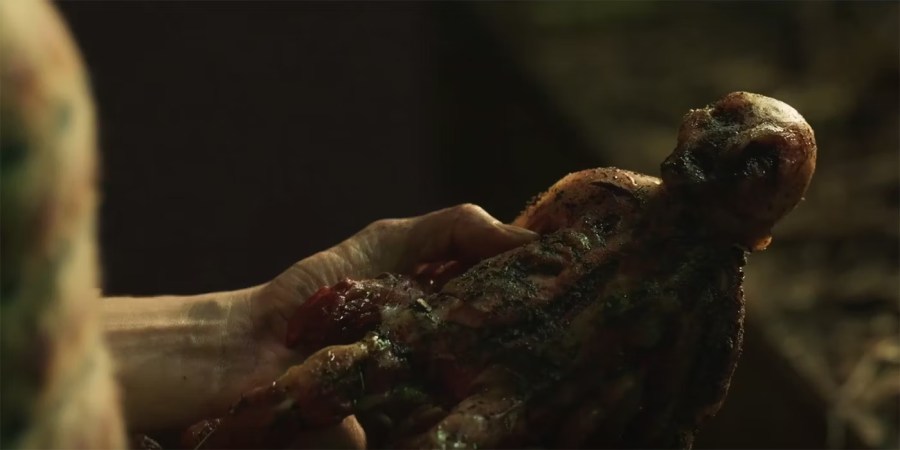
One reading of the film is that Ella’s suffered an awful trauma in her past—symbolised foremost by The Ash Man, as well as the meat-girl puppet—and that the little girl helping her with the film is her younger, traumatised self; the younger self shows up after mom winds up in the hospital because once mom’s dominance is no longer there to move Ella through life like a puppet, Ella’s traumatic past is the only thing left to guide her. We start to see The Ash Man actually coming to get Ella when Ella’s reality starts to blur between her as herself and her as the puppet girl in the woods.
This reading also really opens up the body horror elements of Stopmotion, if we consider that there’s some kind of analogous event in Ella’s young life that mirrors the Ash Man ‘touching’ the meat-girl puppet. Ella starts to not just see her own traumatic past mirrored in the puppet, she starts to see herself as a puppet; her flesh is just like the meat used to construct the puppet, and, near the end, her flesh winds up as actual material in the film. In one scene, Ella unstitches a nasty wound to use her own flesh and blood in her work. The wound appears very yonic, like Ella’s ‘giving birth’ to her art; she’s a ‘mother’ to her art, but instead of this being a transformative act that enriches her life, it’s another step towards destruction. Ella’s story is the epitome of psychological becoming physical, as all the emotional terror in her mind eventually winds up etched upon her body, as well as the bloodied bodies of others.
 Another wonderful part of Stopmotion is the way in which Morgan and co-writer Robin King’s screenplay has eerie fun with the concept of puppetry. Obviously there’s the overarching/overlapping themes of codependence and control. Beneath that, there’s a delightfully twisted comparison of people with puppets. A repeated line comes from Ella when she sees her mother in the hospital + from the little girl when talking about the puppet girl in the woods: “She doesn‘t look real.” One particularly effective and equally poignant scene occurs when Ella’s in the hospital with her mother, taking photos of her mother’s hands like she would a stop-motion animation, like she’s desperately attempting to make her mother come back to life by moving her the way she would a puppet. Ella hallucinates her mother succinctly summing it all up: “It‘s a wonderful medium, isn‘t it? Bringing dead things to life.” And we can further extend this second line beyond people—”Bringing dead things to life“—to the idea that Ella, unknowingly, has brought her past back to life.
Stopmotion is one of the most brilliant horror stories on the big screen in the 2020s. In the end, Ella never finds herself, or embraces a sense of identity. Her body becomes wax, and then her face becomes wax, which she claws off and offers to The Ash Man to eat. After that, she opens a big wooden trunk, steps inside, and closes the top, as if resigning herself to never being anything more than a puppet—a puppet at the end of her mother’s strings, a puppet at the end of her trauma’s strings. Stopmotion doesn’t dare try to look for a way out of Ella’s despair; this story is one of caution, a macabre fairy tale about the horrible things we can bring to life when we lose ourselves to the control of others or to the lure of our pains.
 Father Son Holy Gore
Pingback: This Week at the Movies (May 10, 2024) – Online Film Critics Society