
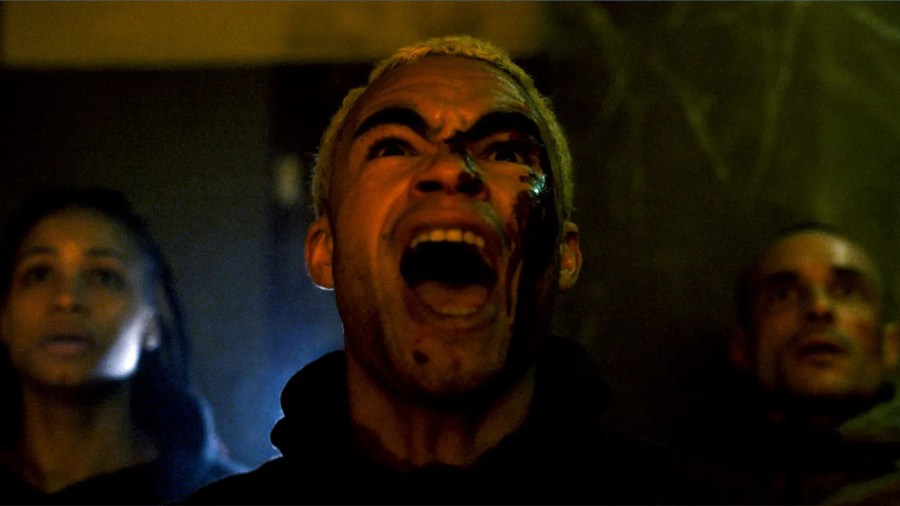
Infested (2024)
Directed by Sébastien Vanicek
Screenplay by Vanicek & Florent Bernard
Starring Théo Christine, Sofia Lesaffre, Jérôme Niel, Lisa Nyarko, Finnegan Oldfield, Marie-Philomène Nga, Mahamadou Sangaré, Abdellah Moundy, & Ike Zacsongo.
Horror
★★★★ (out of ★★★★★)
DISCLAIMER:
The following essay contains
a large web of SPOILERS!
 Killer animals, arachnids, and insects always make for an interesting horror film, though Sébastien Vanicek’s Infested is ahead of the pack, much smarter than most other films within the ‘nature gone awful’ sub-genre. The story follows a young man named Kaleb (Théo Christine), who lovingly collects all manners of creepy, crawly things in his apartment, except one day he brings back a strange spider that sets even the other creatures on edge just by its mere presence. When the spider gets loose and starts to multiply rapidly—and all of them seem to grow just as quickly—the apartment complex is overrun with crawling horrors, then Kaleb, his friends, and the building’s other residents have to fight for their lives.
What makes Vanicek’s Infested so smart is that in amongst the creepy arachnid terror lies a broader, heavier theme concerning social problems in France stemming from the country’s violent colonial history. The spiders, despite being a villainous presence in the film, become a parallel slightly juxtaposed against the various immigrant cultures living in France, specifically those in the building where Kaleb lives. Infested acts as a metaphor about the ramifications French colonialism has had not just on other countries and cultures but on the current state of France itself today.
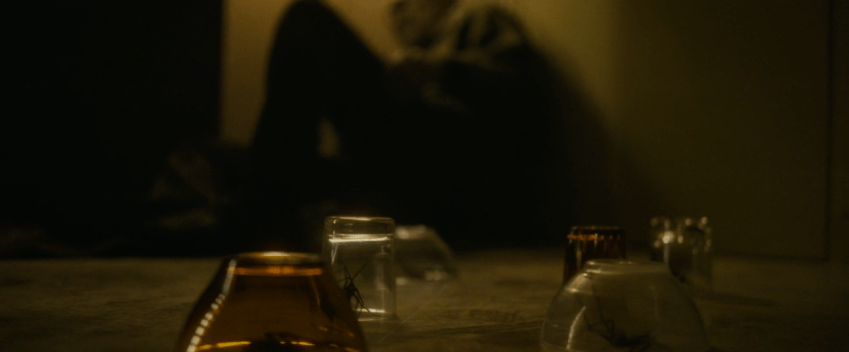 It’s incredibly important that the film’s opening sequence features spiders being driven from their home in the desert; some of them are killed, others are taken in captivity to be sold. They’re smoked out of their hole in the name of making money off exotic arachnids. Here, the human world’s capitalism and commerce takes shape as an allegory of colonialism, which is where the spiders and immigrants find common ground in the film’s thematic landscape. Just like the humans drive the spiders from their home as human interest encroaches on natural territory, so did the French colonial empire expand into the Caribbean and India, as well as the Americas, subjugating some and eradicating or displacing others. And when people whose heritage originates from the Caribbean, India, and elsewhere fight back against having their rights infringed upon by the French state, it’s seen as terrorism, or hatred of white people, and so on, when it’s merely the cause-effect relationship of treating people like animals, or, as Infected suggests, vermin. It’s fitting, then, that the exteriors used for the apartment complex where Kaleb lives are Picasso’s Arenas in Noisy-le-Grand, France, which has a nest-like look with its round shape, as if the residents themselves are burrowed away together. The interiors are in a general state of disrepair with lights on timers, doorbells that won’t ring, near-dilapidated hallways, and rooms like mouse holes in a wall which only serve to pull the comparisons between a largely immigrant population living in the building and so-called vermin closer; not so much comparisons or parallels as they are images presented to be viewed in the same light as the nationalist mind wants to view them.
Throughout the film, we hear a mention of scorpions as an invasive species and “dictator scorpions,” both of which carry certain connotations and make us think a certain way about the species right at the basic level of language, which is just like the way language is used by many nationalists to brand immigrants and make others picture them in a negative light. And, of course, such names typically conceal reality; same with insect/arachnid names. For instance, ‘dictator scorpion’ might suggest that the arachnid is a ruthless, violent creature, when it’s really much more timid and would rather spend its time burrowing out of sight. Similarly, while white nationalists and racists of all varieties love to portray immigrants and non-white cultures as invasive species’, their rhetoric never takes into account the real nature of the vast majority of immigrants, nor does it consider all the reasons why people are typically forced to emigrate from their home countries in the first place, such as the historical fallout of violent colonialism and other practices.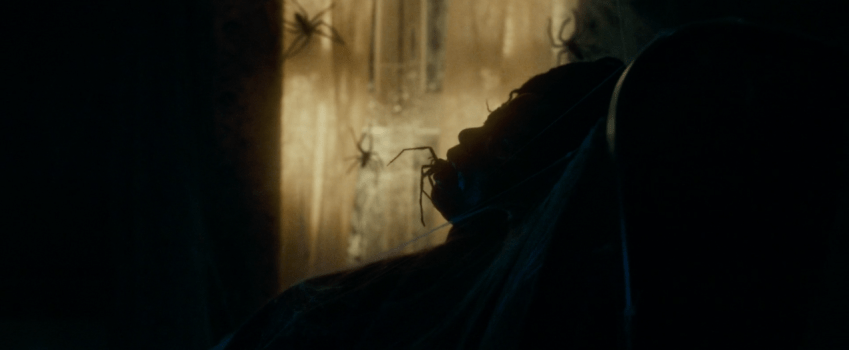 What Infested perhaps does best is subtly explore how French society, as well as plenty of other Western societies, has become infested with racism, from the overt racial violence that so many people face to the casual, everyday micro-aggressions white people constantly heap upon people from non-white cultures; in this sense, spider venom is not the true poison, rather it’s racism. One of the men who lives in Kaleb’s building is a consistent source of racism. He initially treats Kaleb like a drug dealer when Kaleb’s actually just handing off a pair of sneakers to a friend. His racism gets worse when a Black guy in the building dies, due to the spiders; he calls the man a junkie, accusing Kaleb of selling heroin that must have caused the guy’s death. Later when chaos begins erupting in the building, the guy remains convinced Kaleb is dealing drugs, however, his racist hubris winds up putting him fatally in the way of all kinds of big, nasty spiders. A fitting end for a racist creep.
More importantly, in one of the film’s subplots, Kaleb’s own (white) friend once told the cops on him when they were kids and it split their friendship up for many years. While this may have split up a lot of friendships up, there’s an extra layer of hurt here for Kaleb since it’s a far different experience when you’re not white and you’ve got to deal with the cops/the law. This further illustrates it’s not only the whiteness built into our societies that must change, it involves everybody; sometimes that includes your neighbours, even your own friends.
In the end, the cops become the villains of Infested, then Kaleb and his friends have to use the spiders to escape from the state’s clutches. One intense moment features a cop nearly choking Kaleb’s friend to death before Kaleb makes the save; it evokes horrifying images we’ve seen of cops, in America and elsewhere, kneeling on the backs of subdued, unarmed people, sometimes moments before those people died due to excessive force. Vanicek accomplishes an expert bait-and-switch to fully reveal that his killer spider film is far more than a horror story about arachnids run amok. The real enemy of Infested from the very opening sequence was the figure of the State, in particular the French state, and the cops are another arm of it, an extension of its force. Kaleb and the others, along with the spiders, have to finally battle the cops in order to escape the horrors and terrors of their conditions. Infested‘s visual scares come from the horrifying spiders, yet its lingering terror comes from a skin-crawling dissection of France’s contemporary racial and cultural issues which are perpetual effects of French colonialism’s displacement and violence.
 Father Son Holy Gore