

Hell Hole (2024)
Directed by John Adams & Toby Poser
Screenplay by John Adams, Toby Poser, & Lulu Adams
Starring Olivera Prunicic, John Adams, Petar Arsic, Toby Poser, Maximum Portman, & Anders Hove.
Horror
★★★★ (out of ★★★★★)
DISCLAIMER:
The following essay contains
SIGNIFICANT SPOILERS!
Avert your eyes (& your holes).
Oh, the Adams-Poser clan are at it again!
Hell Hole takes place on a hopeful fracking site in Serbia, as a crew are preparing to break ground for new work when they uncover a still-living relic of history buried in the earth: a soldier who served under Napoleon in 1814. Gnarly horror ensues following a further discovery that the timeworn soldier is eating for two. Not in a cute expecting mother way, more like a genuine monstrous birth. Once the thing incubating inside the soldier comes out to play, the fracking crew, led by their boss Emily (Toby Poser), have to deal with an ancient creature desperate to survive in today’s world. Hell Hole is a clever, nasty, and, at times, riotous take on the monster movie that doesn’t skimp on an ecofeminist message about how human beings have gravely mistreated, and used, both the Earth’s body and the bodies of women.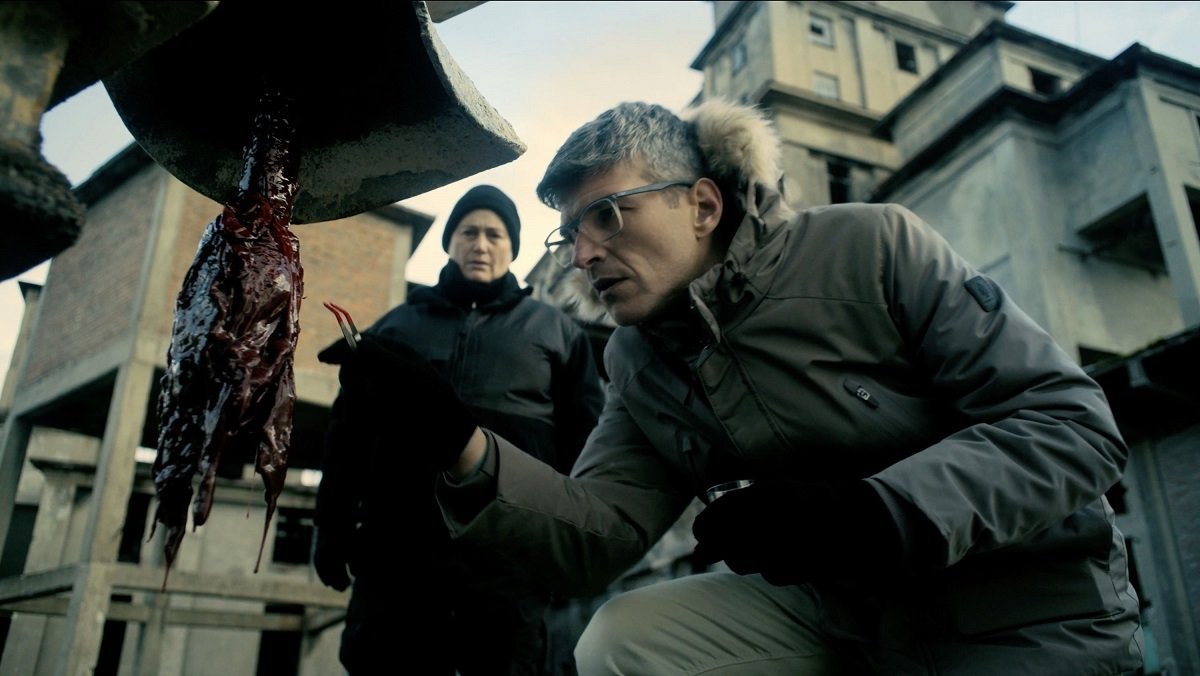 As always at Father Son Holy Gore, there’s historical context needed to begin an analysis of Hell Hole. Since 1814 is specified and we open in Serbian territory, this means we’re in the midst of 1814’s Hadži-Prodan’s rebellion, a Serbian rebellion against the Ottoman Empire, and also at the tail end of the Peninsular War (1807-1914), part of the larger Napoleonic Wars (1803-1815). [The history of Serbia itself has continually been the subject of change and turmoil related to land for centuries, right up to its Soviet-era and post-Soviet history.] What’s so important about any of this apart from the fact Hell Hole features a reawakened, freshly preserved soldier from Napoleon’s army in current-day Serbia? The aforementioned conflicts/wars were all about land, and the effects of the Napoleonic Wars had major repercussions for the way land was divided in Europe. And so much of Hell Hole’s thematic concerns lies in our terrible (mis)treatment of the land.
The film realises fears about the way we treat the earth by locating those fears in horrors of the body, as a strange creature that crawls—or, better put, bursts—out of the Napoleon-era soldier begins systematically invading new (male) bodies in search of the resources it needs to keep on growing/reproducing the way humans invade the Earth’s body. From the start of Hell Hole, the natural world is treated like a trash bin, quite literally. When there’s garbage needing to be dumped, Emily scoffs at so much trouble over something she sees as simple, telling the crew to just “dig a garbage pit and bury the fucking trash.” While the crew are working to extract valuable resources from the ground, they fill the holes they leave in the ground back up with literal garbage. Humans are portrayed in the film as the parasites, which is darkly funny once they stumble onto an octopus-like parasite that treats humans the same way that humans treat the environment. More eloquently put in the film by Sofija (Olivera Prunicic): “This thing is sucking off of this poor guy just like this fracking site is going to suck off the earth.”
Hell Hole goes even further than the human-environment connection by connecting the environment, which we often name as Mother Nature, with women’s bodies specifically through a few early lines from John (played by co-director/co-writer John Adams). He talks in a disparate way about women’s bodies and the process of birth. First he mentions how having a baby is “like a growing a monster” inside a woman’s belly for nine months, then goes on to say that “the beauty of being a woman [is that] you get to do something magic” like grow/give birth to a child. John’s fears are clear later when faced with the prospect of an invasive mollusk using him as its next nest, though doesn’t quite recognise a connection between his fears and women’s fears about pregnancy: “I don‘t want some kind of parasite crawling in and out of my holes.” We also hear one of the Serbians, impregnated by the mollusk, refer to having a “bun in the oven,” as other men discover what it is to be with child, albeit in the most monstrous sense. And while the men deal with a mollusk trying to impregnate them, many of them continue to treat women like shit: Emily’s called a “cunt” and treated with doses of misogyny/sexism by male workers, even the mollusk is referred to as the typical female pejorative “bitch.” The world expects women to go on dutifully reproducing, just as they expect the Earth itself to continue producing, and reproducing, natural resources, no matter how badly people routinely treat them.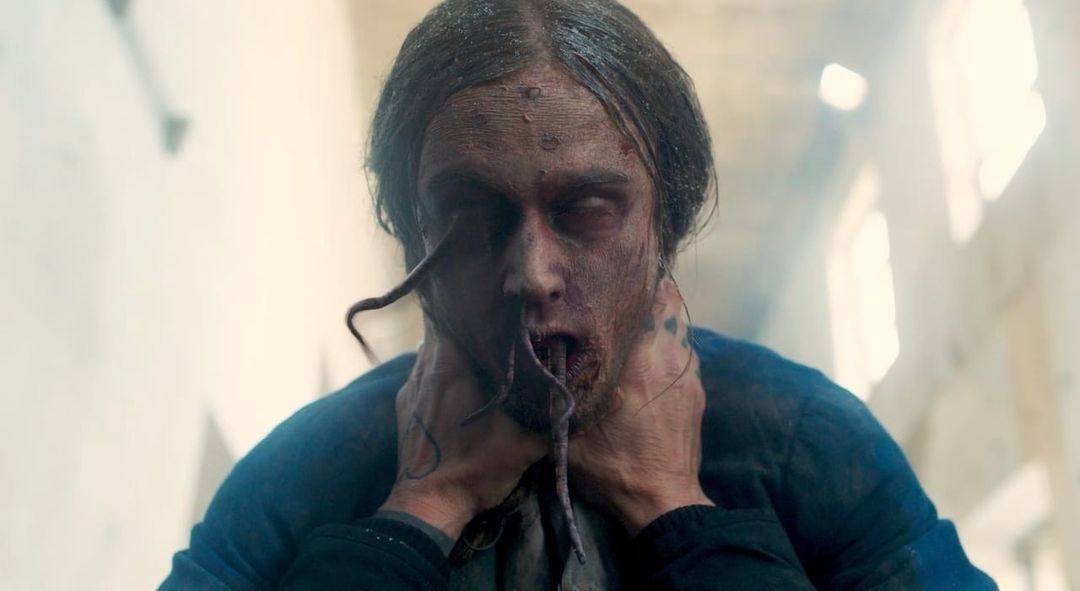 Hell Hole is like The Thing but less science fiction-horror, more speculative sci-fi with a Gothic horror twist. The film isn’t subtle about its message, and why should it be when, despite hilarious ‘hole’ wordplay throughout, the themes are so important? At the base of all the hole-centric horror is a reality that we’ve destroyed the natural world meant to sustain us: “We are ungrateful, we are terrible, we are selfish. We are the monsters.” Hell Hole is about how human beings have mistreated the earth and women, both of whom give/sustain life; not just men, either, as Emily leading the fracking crew illustrates. The film’s monster is a metaphor that crawls right out of history’s obsessions with violently claiming land and into the contemporary world’s obsession with draining the land dry, its own iteration of (ecological) violence, hoping to teach humankind a lesson about what it truly means to give/create life. If there’s one glimmer of perfectly horrible truth to take from Hell Hole‘s ending, it’s that human monstrosity never ends, but neither does nature’s ability to continue adapting and taking revenge against us for our careless transgressions against it.
 Father Son Holy Gore