
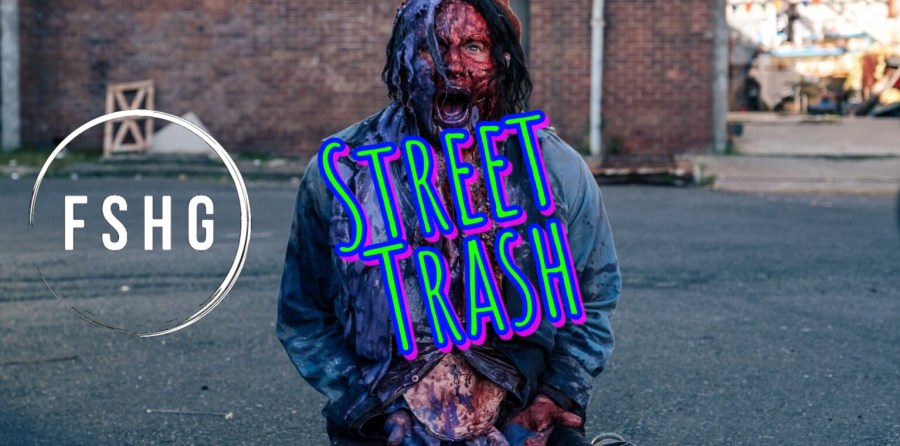
Street Trash (2024)
Directed by Ryan Kruger
Screenplay by Kruger & James C. Williamson
Starring Sean Cameron Michael, Donna Cormack-Thomson, Joe Vaz, Lloyd Martinez Newkirk, Shuraigh Meyer, Gary Green, Warrick Grier, Andrew Roux, & Ryan Kruger.
Horror
★★★1/2 (out of ★★★★★)
DISCLAIMER:
The following essay contains
SPOILERS!
Turn back, or be melted into neon goo.
If anybody’s fit to remake or do a sequel to the gloriously sleazy 1987 horror Street Trash, it’s certainly Ryan Kruger, whose 2020 film Fried Barry, among other things, showed that the director has a knack for tackling social issues through genre film. In the original Street Trash, the houseless were being disintegrated by a strange, violent liquor called Viper. Kruger takes it even further to update his story for a contemporary society that still seems to absolutely loathe people living on the street, as Cape Town’s crooked Mayor is busy weaponising Viper via drones patrolling the streets looking to exterminate houseless people.
1987’s Street Trash was already a very social-minded horror, despite a lot of people only waking up to ‘social horror’ post-Get Out, yet Kruger’s little changes to the plot make his film even more focused on the social issues that continue to plague us. Class war is afoot in Kruger’s Street Trash. A group of houseless heroes come together while the Mayor works to eradicate them and they fight back against the bourgeois ruling class, as well as the cops. South Africa’s Cape Town is a perfect setting for the film since the spatial dynamics of apartheid still linger in the city, often referred to by some researchers as ‘the most segregated city in this already unequal and segregated country.’ One thing this version of Street Trash does even better than the original is take a direct, very deliberate stand on the side of the oppressed against those who all too often violently oppress them. Many of the things mentioned in the early parts of Kruger’s film, such as the power cuts, are already a part of the crumbling infrastructure in Cape Town. Also, in real life, there are nearly 15,000 people living on the streets of Cape Town. Just like the people who hate the houseless in Street Trash, so can go on Reddit right now and find a lot of people who live in or frequent Cape Town talking about how much houseless people anger them; mostly it’s because they see the houseless as ruining businesses and other similar things, though they never once stop to think about how capitalism has created all this human horror. So while the themes in Street Trash are heightened with gory, oozing violence and an extreme vision of how far governments would go to ‘solve’ a problem like masses of unhoused people, it’s all essentially taken straight from real life.
“Everything’s going to be better now,
everybody’s gonna be happy.”
There’s a funny, somewhat running joke for a while in Street Trash, as two of the houseless men, Chef (Joe Vaz) and Ronald (Sean Cameron Michael), discuss various children’s stories like Peter Pan and Pinocchio and how they’re not actually how they appear on the surface level of reading. But it’s more than that, because you can actually think about it as the character talking about narratives and what the media—or the government/political parties/big business, et cetera—wants us to believe, such as the narratives about the houseless. Chef insists that Peter Pan himself was the villain, seeking to keep the Lost Boys infantilised and banishing Hook/trying to kill him after he gets too old. He also tells Ronald that Geppetto was actually a pederast who enjoyed Pinocchio’s lying nose a bit too much, and that the boys being sent to Pleasure Island in the Pinocchio story was actually a “metaphor for child sex trafficking.” Sure, it’s a good laugh, and it might seem like a bit of nonsense, but beneath that is a truth about how we’re sold narratives that aren’t necessarily true, and an insistence that we must think critically about the narratives we buy. Maybe that’s also why there’s a character named Society who’s a drug dealer to the other houseless folks. While a lot of Street Trash is certainly not subtle, there are a few subtle pieces that make the film more complex than most will expect.
Today, it’s sweeping houseless encampments to leave the vulnerable even more vulnerable than before, and the ungodly advent of anti-houseless architecture. Tomorrow, it’ll be purposeful attempts to sterilise the streets of houseless people. We already see vulnerable people on the streets being shuffled into the shadows when the Olympics, the British royals, or Taylor Swift come to town. Only a handful of months ago, Cape Town cops and other traitors to humanity removed houseless people from the city centre. Here in my own city of St. John’s, Newfoundland, we witnessed a forceful removal of a similar encampment during which so many people living on the street had their belongings thrown out, including things that had been donated to help them. Why is it so far fetched to think that some of these politicians, on either side of the political aisle, won’t someday suggest we round up the houseless and gas them like Kruger depicts here in Street Trash? It’s not, only to the ignorant, blissful or not.
Again, the best thing Kruger does in Street Trash is take a firm stance against the wealthy and their economic oppression (that typically takes a very real, physical form). He goes so far as to put himself in the film as a character named Offley who remains behind the camera, occasionally giving a thumbs up to his fellow houseless friends; a subtle gesture that, if it wasn’t already clear, Kruger has no love for politicians who ignore the root causes of houselessness, nor the cops who enforce the bourgeois class’s hatred of those who have not.
 Father Son Holy Gore
Pingback: This Week at the Movies (Nov. 22, 2024) – Online Film Critics Society