
Animale (2024)
Directed by Emma Benestan
Screenplay by Benestan & Julie Debiton
Starring Oulaya Amamra, Damien Rebattel, Vivien Rodriguez, Claude Chaballier, & Pierre Roux.
Drama / Horror
★★★★1/2 (out of ★★★★★)
DISCLAIMER:
The following essay contains
SPOILERS!
Go no further,
or be spoiled forever.
Emma Benestan’s second feature Animale, co-written with Julie Debiton, is a disturbing and potent body horror about Nejma (Oulaya Amamra), the sole young woman amongst a bunch of men learning the art of bullfighting. One night while Nejma and a couple of the men are out partying, she winds up past the fences in an area where the wild bulls roam free and gets attacked. After this she starts to feel more deeply for the bulls. There are also a couple men who wind up killed by what the community are sure is a rogue bull. And it may all be connected.
Animale deals with issues of toxic masculinity within a male-dominated world like bullfighting in Camargue, France. When Nejma begins to relate closely to the bulls following her attack, Benestan compares the plight of animals and women, juxtaposing the different violences done to them. In the end, Animale is about how far too many men see both animals and women as consumable for their entertainment and satisfaction.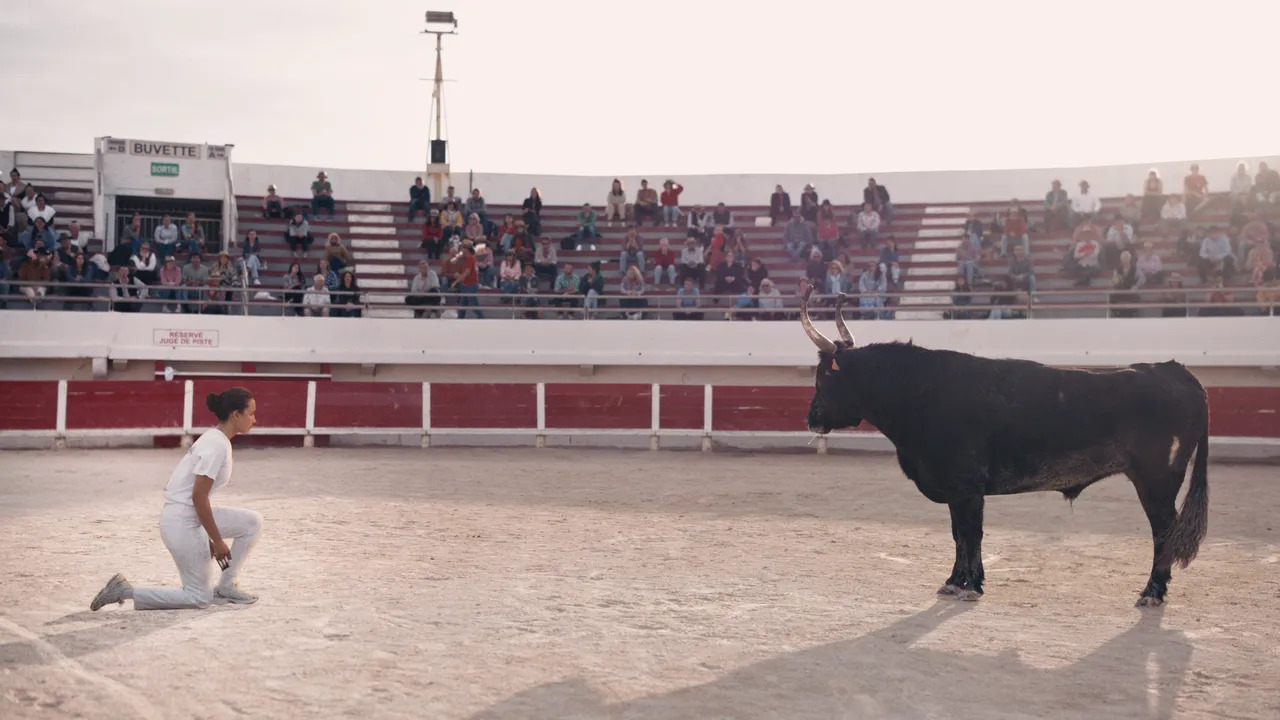 Benestan portrays the link between an abuse of women and abuse of animals through images of Nejma becoming the bull, as the viewer witnesses her experience similar things as the bull. An early scene depicts the men on the ranch pinning a bull to the ground while Nejma brands its leg, the bull moaning in pain while one of the men, Kylian (Vivien Rodriguez), kisses and caresses its face. After Nejma’s attack, she pictures herself vividly in the same situation, feeling the sear of her skin under the hot metal and feeling herself being branded. When one of the bulls, Thunder, is killed after the men all believe he’s the culprit of the killings, Nejma later tells Tony: “I can feel the bulls. Back in the bullpen, it felt like they were killing me.” She soon starts to wake up, not remembering the previous night and having to wash blood off herself. After a while, she notices her feet beginning to web together like hooves. This all leads to her remembering exactly what occurred the night a bull apparently attacked her in the wild, which further joins the abuse of women and animals thematically. Yet it isn’t only Nejma who’s compared to an animal. Whereas the bulls and Nejma are connected in a melancholy way, the men at the ranch become animalistic, in a deeply menacing sense, to Nejma post-attack. In one scene not long after the attack, Nejma’s at the dinner table with everybody and each of the men seems to have a turn staring at her with questionable eyes, their mouths chewing and chomping with sinister mood.
The only comfort Nejma finds is outside the traditional confines of heteronormativity and masculinity, as well as outside the boundaries of the human. First, she’s able to find comfort in Tony (Damien Rebattel), who’s gay. He’s the one she later confides in about the truth of what happened to her the night of her attack. She also eventually returns to the comfort of her mother. And finally, most of all, it’s the bulls in whom Nejma finds comfort. In one scene she communes with the bulls after her attack, lying over top of the pen where they’re caged, as if listening to them, as if they speak to her without words like they speak to each other. Later in the bullfighting ring, Nejma uses her new understanding of the bulls to win without having to inflict any pain on the bull. She feels no fear of the bulls anymore, symbolically wearing a bright red dress at one point. Traditional hetero-masculine men offer nothing but terror for Nejma, whereas those outside those confines offer comfort, understanding, and, in the case of the bulls, a method for revenge against those who’ve terrorised her.
A lot of men wonder why so many women are angry at men as a whole. Benestan poses that question through the bulls. And it’s no wonder why a bull’s angry, just like women: their anger is created through their lived experiences at the hands of men, it’s not inborn in either bulls or women, it’s a product of how they’ve been used and abused. Women, like bulls, “usually only attack when provoked.” Nejma’s presence in a male-dominated world unjustly incurs the wrath of fragile, ugly men, and it’s only then that she lashes out with any kind of violence. Animale is a searing portrayal not only of how male violence can provoke even worse, though not unjustified, female violence in retaliation, it’s likewise an agonising body-horror metaphor about the ways in which traumatic violence can alter the makeup of a person’s body and soul.
 Father Son Holy Gore
Pingback: This Week at the Movies (Nov. 22, 2024) – Online Film Critics Society