
Topper (2025)
Directed & Written by Kevin McNamara
Starring Mark O’Brien, Mo Brings Plenty, Bryan Callen, Paul Johansson, Catherine Dyer, Erik Griffin, and Amanda Clayton.
Drama
★★★1/2 (out of ★★★★★)
DISCLAIMER:
The following essay
contains SPOILERS!
Being a recovering alcoholic and addict of 16 years now, I often read or watch fiction focused on alcoholism/addiction that doesn’t portray it realistically, whereas a film like Kevin McNamara’s Topper captures the despair many of us who’ve lived destructive lives know all too well. Topper follows a comedian of the same name, now just a shadow of his former self on the stage, as the darkness of his childhood creeps further back into his present-day life and threatens to destroy what little is left of him.
Like many of us alcoholics in the throes of our addictive destruction, Topper isn’t a particularly loveable person, though a large part of his abrasiveness is because his soul is buried underneath the rubble of all his trauma, and his once-loved stage persona, no matter how based it was on his troubled life, cannot breathe beneath that psychological weight. McNamara’s film tackles the depths of alcoholism by focusing not only on Topper’s trauma and its effects, it also focuses on how part of dragging yourself out of addiction of any kind is accepting personal responsibility—accepting that while you can’t erase the ghosts of your past, you can choose not to let them turn you into a ghost of yourself, or a monster.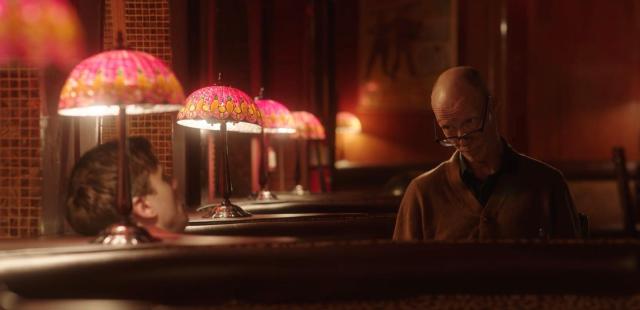 Every addict/alcoholic needs tough love at some point, no matter how hard it can feel when it lands, and Topper desperately needs it when we first meet him at the start of the film. He’s one step from being on the streets, drinking liquor from a bottle in a paper bag and arguing with the guy who sells him booze regularly. He’s hard to like, both on and off the stage. Topper receives tough love from club manager Benny, which is ultimately what probably saves his life. When the film starts, he’s caught in a cycle of believing that leaning into his trauma, while not actually working on healing, is his comedic strength, a darkness from which artistry grows. Those around Topper at the comedy club only see him as going through the motions of what amounts to “sad performance art,” as Benny eloquently puts it. Yet the tough love Benny gives Topper is only the tip of a massive iceberg that is Topper’s reluctance to confront his own behaviour. Topper later lashes out at one of his comic friends back home for the way he perceives his friend’s parenting, to which his friend responds: “At least I got a life, asshole. You‘re too busy blaming your father for you to have one.” Even after this moment, it still takes Topper a while to interrogate his issues seriously rather than trying to blame every last thing on everyone else. Although it’s hard to confront the things that haunt you the worst.
There’s a Gothic quality in Topper that comes from how McNamara portrays several of Topper’s memories, once Topper returns to his childhood home after so many years away and the old memories begin to trickle back. Topper’s haunted by the trauma of an alcoholic, abusive father, as well as a mother who left him behind with such a man. The ghostliness of Topper’s childhood trauma comes through in one scene particularly as a memory of Topper’s childhood plays out. We see Topper’s dad taking off his belt to beat young Topper, then when dad moves through the doorway, McNamara cuts back to Topper, who rushes in to grab a pillow, deciding not to sleep in his old bedroom so that he isn’t haunted all night long; he chooses the bathroom for a night’s sleep instead. In this single moment, trauma is portrayed through almost Gothic means. Topper continues to be haunted by memories from the past, too. In another scene, he slips away into more painful childhood memories, revisiting a moment when his mother and father were upstairs arguing about his father’s drinking, then a suitcase was tossed over the stairs before Eileen walked out saying, in reference to her own little boy: “Keep him. He reminds me of you.” The physical abuse from Topper’s father and the psychological damage from Topper’s mother have left the comic a shell of the man he might’ve hoped to be if he’d grown up in a different home, so it’s easy to see why he’s grown into a damaged man.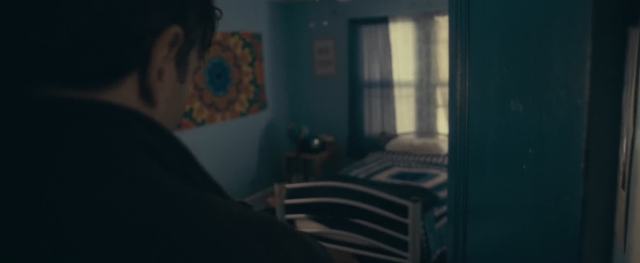 No matter the circumstances that brought it about in a person’s life, at the bottom of alcoholism and addiction lies personal responsibility. A pivotal moment in Topper occurs when Topper sees his father’s actions passing through his own in his brief relationship to his friend Allie’s son Matty. Matty accidentally knocks a Tonka truck off a closet shelf and gets frightened when Topper instinctually angrily shouts at him for it; the boy flinches as Topper grabs the truck, saying “Don‘t hit me.” The child’s reaction devastates Topper, who can almost feel his father’s blood flowing through his veins. From here on, Topper begins to see that he has to be the one to not let that cycle continue, in any way, shape, or form. It’s not enough to hate his father for what was done to him, he needs to actively be a better man—a better father figure, a better person, et cetera—than his father. And still, even after Topper’s epiphany moment with Matty, he doesn’t quite point his anger in the right direction. It’s only after he confronts both his mother and father truthfully that he’s able to come to a better understanding of how he has to change himself.
Topper is a heavy, at times dark drama about confronting and trying to survive the ghosts of your past, particularly when those ghosts have led to increasingly self-destructive behaviours like alcoholism and addiction. As we see in the film, it’s either deal with those ghosts, or let them haunt you into the grave. Topper also deals with the idea that art requires suffering; this is the headspace in which Topper seems to exist initially. Comedy may help deal with pain and it may make pain more palatable, but pain in comedy—like in all forms of art—is not a foundational necessity for a comic to be funny, nor groundbreaking, nor even memorable. It’s only self destruction to hold onto the idea that pain is what makes a person comedic, enabling cycles of self abuse. Though we don’t see Topper at the end go up onstage and kill a set, the feeling of seeing him looking like a sober man with an actual smile on his face suggests he’s about to return to glory as a stand-up comic, capturing the talent he once had but spent so long pouring down the drain the way he poured booze into himself night after night. He’s definitely dealing with his ghosts for once, rather than letting them consume him and turn him into one, too. In the end, Topper chooses life, and not just part of a life, a whole one—perhaps one that could be full of love instead of ghosts.
Topper is currently available to watch through AppleTV, Amazon Video, & other platforms.
 Father Son Holy Gore
Pingback: This Week at the Movies (Apr. 25, 2025) – Online Film Critics Society