
The Front Room
Directed & Written by Max & Sam Eggers from a short story by Susan Hill
Starring Brandy Norwood, Andrew Burnap., and Kathryn Hunter.
Horror / Thriller
★★★1/2 (out of ★★★★★)
The whole Eggers family is disturbed on a cinematic level few families could ever aspire to, as Max and Sam deliver The Front Room, a satirical psychological horror-thriller about a married couple, Belinda (Brandy Norwood) and Norman (Andrew Burnap), whose lives are warped into a waking nightmare after the husband’s father dies and his now widowed stepmother Solange (Kathryn Hunter) moves in with them. The stepmother from Hell arrives at the couple’s home with money to help them at a very crucial point in their lives, but the juice isn’t worth the squeeze, particularly after Belinda and Solange find themselves increasingly at odds. Solange’s manipulation eventually reaches a fever pitch and pushes Belinda over the edge. Yet the old woman’s control over Norman, reaching back to his childhood, leaves Belinda on a one-woman mission to save their family from Solange’s clutches.
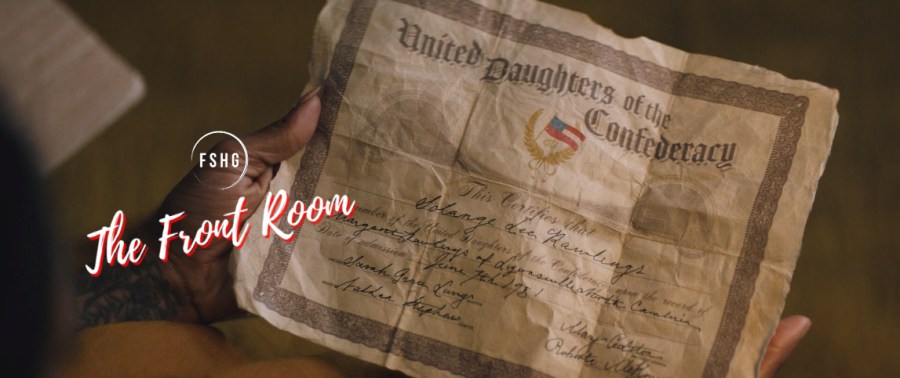
The Front Room goes back and forth from family drama to psychological horror to satire, as it explores and plays on a number of themes. While many viewers might see a negative representation of aging in Solange, her bodily fluids and her menacing powers of control are more indicative of how Confederate culture in the Southern U.S. has created monstrous visions of womanhood/motherhood. The Front Room is ultimately about a Black mother taking control of her family back from a painful historical legacy of whiteness that threatens their future. As Norman remains mostly pacified by his horrific stepmother, Belinda’s burdened with either letting Solange’s corrosive influence seep into their lives, or erasing Solange’s rotten branch from the family tree.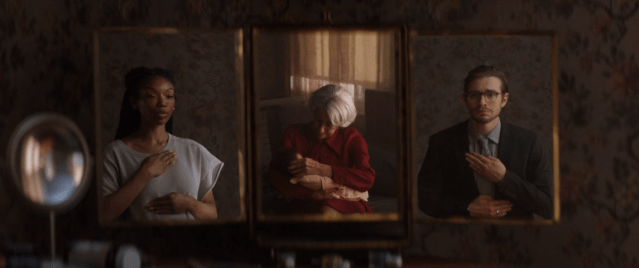 The importance of art and history in The Front Room is what makes the film’s themes so effectively powerful, and early in the film a triptych image appears to set the tone particularly related to Solange’s role and how she’s meant to be perceived. The triptych image, featured above, feels eerily similar to a number of religious triptychs throughout history featuring Mary and the Christ child, but in the film, Solagen is depicted playing the Virgin Mary’s role. The Front Room‘s triptych is deeply reminiscent of two specific religious triptychs: the Morrison Triptych and the Donne Triptych, each of which feature a depiction of the Virgin Mary and the Christ child in the centre panel. There’s also a Saint Anne altarpiece painted similarly; we’ll return to Anne momentarily, too. What’s the purpose here? The purpose hinges on the reveal of Solange being a member of the United Daughters of the Confederacy (UDC), and the group’s connections to white nationalism.
White nationalism itself is predicated upon a number of ideas, one of which is the importance of the family and part of that is the role of womanhood being equal to motherhood. The UDC’s appearance in The Front Room connects white nationalist ideology with Christianity through Solange’s depiction as not only the Virgin Mary, but also as Saint Anne, the mother of Mary. In the triptych image, Solange appears likened to Mary, then later, Belinda sees visions of Solange dressed like Saint Anne, including an eerie image of Solange with two rows of animal-like teats, breastfeeding Belinda’s baby. This all comes to bear on how The Front Room tackles the potential dangers in a religious creation of Mother—built in the image of patriarchy—which, like so many of religion’s creations, allows for tyranny.
Christian fascism/nationalism has appropriated the image of Saint Anne to their own revisionist ends as depictions of maternal authority. Southern U.S. Christian nationalism, as in the case with the UDC, is partly why America is at a critical juncture in its history right now with the Trump administration literally trying to rewrite the nation’s history by banning books and teaching related to slavery, the Confederacy, and more. White Southern women played a central role, largely through the United Daughters of the Confederacy, in the Lost Cause mythology and erection of monuments to the confederacy. This is somewhat reflected in The Front Room when Solange moves in and almost immediately takes down Belinda’s goddess statues, replacing them with Christian imagery, such as paintings like Joos van Cleve’s The Last Judgement. Solange sees Belinda’s research into goddess imagery across cultures as pseudo-history as opposed to her Christian version of history. In reality, Jesus Christ is an amalgam of previous figures throughout other cultures and religions. Through all this context, Belinda and Norman’s home becomes a microcosm of America with Solange attempting to reclaim the Confederacy’s legacy while Belinda tries to restore both sanity and reality to the nation/house.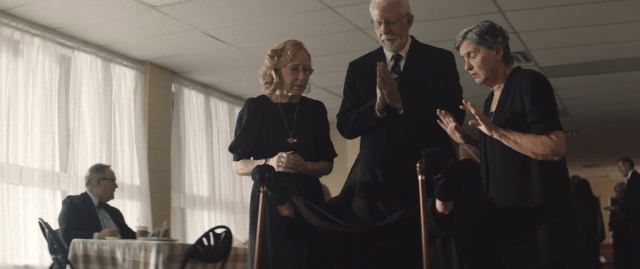
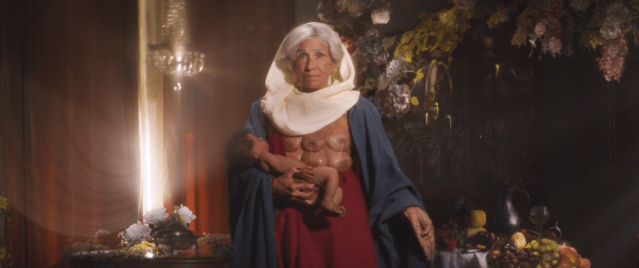 Again, some will interpret the fearful way Solange is portrayed, including her revolting spit-ups, or when she pisses and shits the bed, as negatively reflecting a fear of old people and the ageing body; however, Solange’s accidents are specifically shown to be, at least on a number of occasions, ways she uses her age to manipulate Norman and Belinda, more so the former. Belinda discovers later in the film that Solange doesn’t even need the canes she wields from the first moment she appears on screen, which means not only was Solange manipulating Belinda and Norman, she was manipulating anybody around her, using her age, and to an extent her gender, to lull people into believing she’s not actually a nasty old abusive racist. The Front Room is satirical and disturbing in how it pulls back the death veil of Solange, and in turn America itself, to reveal the dark, poisonous horrors beneath. It’s easy to get caught up in the film’s satire and its campiness, but don’t ignore the Gothic social commentary on white American nationalism embedded within. Just like in The Front Room, Black women like Belinda may be one of America’s few hopes left in the face of all the aging white structures, whether Confederate monuments or politicians, still left standing propping up the nation’s racist foundation and its historical revisionism.
 Father Son Holy Gore