

A Desert (2025)
Directed by Joshua Erkman
Screenplay by Erkman & Bossi Baker
Starring David Yow, Kai Lennox, Sarah Lind, Zachary Ray Sherman, Ashley Smith, & Rob Zabrecky.
Horror / Thriller
★★★★ (out of ★★★★★)
DISCLAIMER:
The following essay contains
SPOILERS!
You’ve been warned.
A Desert, the debut feature film from Joshua Erkman—whose previous 2019 short film Hidden Mother also deals with sinister things connected to history and photography—is a paranoid, existential horror-thriller about photographer Alex Clark (Kai Lennox) going on an American road trip that descends into chaos after he meets the pair of Renny (Zachary Ray Sherman) and Susie Q (Ashley Smith). When Alex doesn’t come home, his wife Sam (Sarah Lind) enlists the services of private detective Harold Palladino (David Yow). What Harold and Sam both stumble onto in their search for Alex is dark, depraved, and alters them all forever.
To play on Nietzsche, if you gaze too long into the dark heart of America, the dark heart of America gazes back. On one level, A Desert is a Gothic story, as it looks into America’s past while remaining focused on the present, neither of which are rosy views. Erkman sees the decay and ruin of America. His film depicts how past and present histories are interconnected in ways that sometimes even those of us who are experiencing events personally cannot comprehend. A Desert is an eerie examination of America’s decay, in the landscape and the population, as a photographer seeking the truth accidentally comes upon a horrific truth that will do anything to prevent being revealed.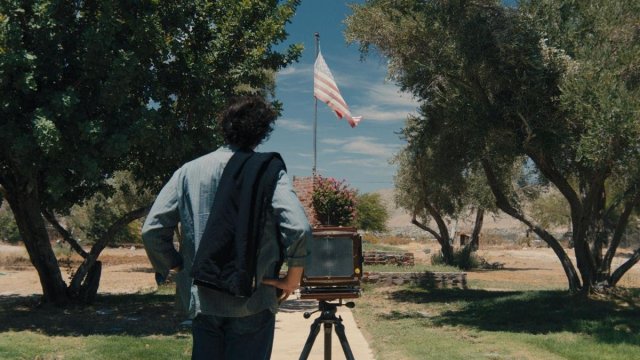 There’s a deeply American story being told in A Desert in between the spaces of its thrilling mystery plot. Early on, Alex is in an old military base—though not that old, itself a commentary on the disposability of resources in America—where he finds a book titled Guide to Military Drones and a blueprint for a military plane, amongst the general decay of time. Alex tells his wife on the phone that he wonders if he should be “shooting more people” and the language of ‘shooting’ film/photography has roots in gun metaphor; nothing more American than shootin, baby! He probably feels that way because the old landscapes of America are dying, from natural to commercial ones. He’s already well aware of this, having done a book 20 years prior called Death of the New West. There are old drive-in theatres all over America—one of them features prominently in the film’s plot—just collecting dust and harbouring the ghosts of old memories, just as there are many old buildings and structures doing the same. Alex eventually ends up at a pet cemetery where he stands looking towards a weather-beaten American flag, as beaten down as his own image of America, New West or otherwise. America’s steadily becoming a desert of itself, a once rich, natural landscape now scarred with abandoned buildings and people.
While Alex laments the decay of America, Renny is a force of decay himself, representative of the rot at America’s core. At one point, Renny calls Alex a “tourist.” He acts like Alex is somehow commodifying his home. Yet Renny’s living is made from making dark, dirty videos in an abandoned military base, a practice of commodifying bodies—and the videos are so dark and dirty, in fact, the whole reason he does what he does to Alex is because the photographer inadvertently stumbled onto the seedy, clearly illegal movie-making operation. Not to mention that the film’s action takes place largely in the Mojave Desert, which was the original home of tribes such as the Mohave. Renny might’ve been born in/around Landers, California, but he’s not Indigenous, so some might call him and other descendants of European tourists. Though he does have a long connection to the area through his family that he tells Alex about after bringing the photographer to see Giant Rock. Interestingly, he refers to his grandfather being shot in the desert due to making dynamite near the military base, which feels like an echo of real history: in the 1930s, Frank Critzer moved to Giant Rock and made an underground home, but died due to the self-detonation of dynamite; however, the ultimate problem with Renny lies at the heart of his story, and the problem is the truth.
Photography is so important in A Desert because photos can capture the truth of a moment in history and time: Alex is on the side of truth, even if that truth is in decay, and Renny wants to obscure the truth and all its darkness. Renny’s constantly obscuring or altering the truth, such as when he claims he and Susie Q are siblings. His behaviour towards her suggests it’s either a lie or they have an inappropriate brother-sister relationship. His story about his grandfather at Giant Rock is also an obfuscation of the truth, as he claims the police shot his grandfather but the real story of Frank Critzer is a self-inflicted death due to the detonation of dynamite in the underground rooms Critzer built. There’s also the questionable story, precipitating shocking violence, Renny tells Alex about being born in the shack that Alex comments looks like it was abandoned ever “since the Dust Bowl.” Alex questions Renny’s skewed version of history and suffers for it, too.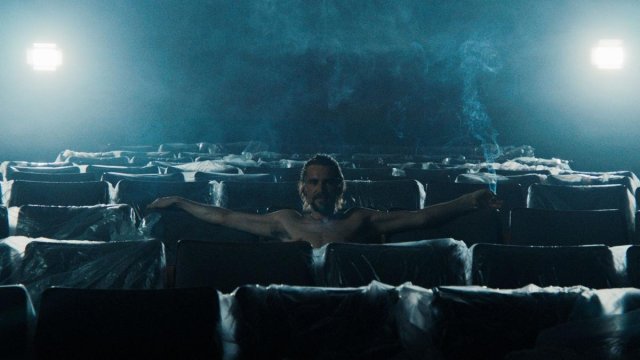
“Time. It’s slow, and then it’s not, right?”
There’s a lot of significance in Renny’s birthday being June 28th, 1992, the same day as the Landers earthquake in San Bernardino County. The significance is about the coincidences of life, which is what A Desert boils down to in the end. Renny reads something into the Landers earthquake occurring at the time of his birth, as if believing his life means something more than others, as if nature ruptured when he entered the world. There’s a reality to what Renny’s getting at here, but reality isn’t Renny’s forte, so it’s not exactly what he’s seeking; the reality is, as Erkman spends most of the film elaborating on, in the chaotic connections of life. First, Alex takes photographs in the abandoned military base, and this results in Renny stalking him which ends up terribly for him. Later the chaotic connections pile up: a photo in a private detective’s pocket helps Renny identify Sam, Sam ends up back at the military base; Alex, years ago in his book, takes a photo of an old drive-in theatre screen that Sam loves, Sam winds up at an old drive-in theatre location while the private detective bleeds out, and that same location is the setting for a flea market at which Alex’s old-school camera is sold on a table littered with random items.
Renny becomes the earthquake that ruptures Alex’s life; a coincidence that ruptures not only Alex’s life, but the life of his wife Sam and the private detective she hires. Renny is the garbage of America made sentient, just as he’s depicted in one scene laying in a pit full of junk like a landfill ditch. Yet this garbage is the result of America itself; it’s what the nation has produced. A Desert is an unsettling walk down the forgotten corridors of America where lost—or more often, discarded—people are left to carry out the fate of their legacies. Renny doesn’t end up too far from the fate his grandfather suffered; another generation of American trash producing nothing but destruction, from grandpa’s dynamite to Renny’s movies/murder. He’s the epitome of the nationalist American who cannot reckon with the nation’s history, let alone actually learn from it to prevent repeating historical mistakes. Alex, like so many witnesses to America’s decay, is caught up in a terrible, almost fateful coincidence after believing he was only photographing a ruined landscape but he was actually, accidentally, capturing the social ruination at work in the beating heart of America. A Desert operates as a crime-thriller with elements of horror, yet it can be read as a living autopsy of a nation in decline—a nation that cannot learn from its own history, no matter how many people must die, nor how many landscapes are ruined.
 Father Son Holy Gore
Pingback: This Week at the Movies (Jul. 4, 2025) – Online Film Critics Society