
Pins & Needles
Directed & Written by James Villeneuve
Starring Chelsea Clark, Kate Corbett, Ryan McDonald, Damian Romeo, & Daniel Gravelle.
Horror
★★★★ (out of ★★★★★)
DISCLAIMER:
The following essay contains
SPOILERS!
Turn back, lest ye be spoiled.
James Villeneuve’s Pins & Needles ratchets up the survival in survival horror, as Max (Chelsea Clark)—a diabetic and grad student in biology—is heading back from a wildlife survey for her brother’s wedding when she and her friends get a flat tire that put her in a fight for her life after it lands them next to the property of Frank (Ryan McDonald) and Emily (Kate Corbett), a couple of sick, greedy capitalists doing terrible things behind the walls of their vast home in the woods. Max doesn’t have much insulin left, but she also doesn’t have a lot of time left, either. She either has to fight, or die in a gruesome fashion to satisfy the elite’s most disturbing commodity desires.
Pins & Needles is a tense, suspenseful horror-thriller that’s carried well by the powerful performance of Clark. The film is likewise a smart, bloody take on the state of healthcare and class identity. In an age of extreme wealth disparity, America’s often a focus in terms of healthcare, as the country still refuses to support its citizen with free healthcare, and often refuses to promote things that are in the best interests of its citizens’ health, yet continues to allow the pollution of water, the egregious pricing of healthy foods, and all sorts of other bio-terrors. But Canada is not that much better, either. When it comes to diabetics like Max, they don’t get everything for free here in Canada. The idea of universal healthcare in Canada is somewhat a myth since the universality doesn’t extend to diabetes, aspects of women’s health, mental health, dental care, and more. And that’s all due to the ravenous nature of capitalism—no potential product goes untouched. Villeneuve’s film pits a young woman whose “bad genetic luck” in the lottery of birth forces her to pay simply to stay alive against two merciless, bloodthirsty capitalists who aren’t afraid to make their fatal disdain for the working class a reality; a match made in Marxist Hell.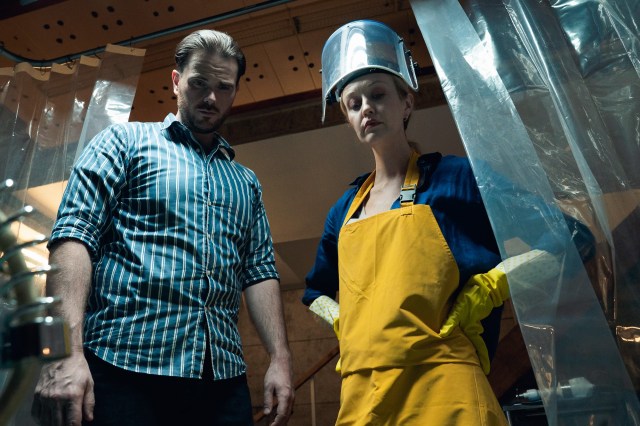 The film doesn’t wait too long before digging into Max’s situation as a diabetic in the context of healthcare issues. On what proves to be a fateful car ride, Max talks about the device she uses to check her blood sugar and refers to the classism inherent in even supposedly universal healthcare systems, as she longingly refers to “fancy automatic [insulin] pumps with little censors inside your body.” She says:”First job I get with health insurance I‘m going full cyborg.” In America and Canada, the level of your healthcare depends on your level of income. Diabetics with wealth/good private health insurance get the fancy pumps while working-class diabetics like Max must jab themselves repeatedly. Then, what about jobless and poor diabetics? How do they survive? Unfortunately, Max winds up in a situation where she barely has any insulin left, perhaps similar to many who can’t afford the proper dosages they need to stay healthy. But for Max, it’s not only a lack of insulin that could prove fatal, it’s her up-close confrontation with two bourgeois maniacs that could end her life.
Max’s battle with her blood sugar level while simultaneously battling bourgeois monsters intent on using the lower classes’ blood to increase the health of the upper classes is the horrifying epitome of everyday people struggling to deal with their own health as the real bourgeois monsters suck their blood (in a variety of figurative ways, from not paying enough/any taxes to polluting the Earth, and more). On top of all the bourgeois sickness involved in Frank and Emily’s blood experiments, Emily’s apparently been making… art. Yes, Frank and Emily aren’t only murdering working-class people so they can use their blood to create new-age health procedures, Emily’s using bits and pieces of bodies to create artsy photographs. When Max sneaks around the couple’s home, she stumbles onto a grisly tableaux of partly-burned eyeballs in an ashtray next to a cigarette. Who knows what other art pieces Emily’s been creating. It just reveals the extent to which Frank and Emily will go to commodify the bodies of the working class in order to create profit.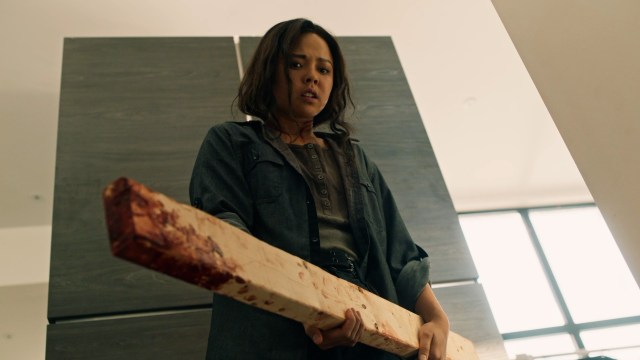 Frank and Emily both express the depravity of bourgeois capitalist ideology thoroughly at various points during the film. Early on, he and Emily are chatting about a business contact, whom Emily thinks is an asshole, and Frank tells her: “He has money—we don‘t have to like him.” Later, Frank admires the Pez business model, but also says “the fatal flaw in their plan” is not having a “subscription service for the hardware.” Capitalists like Frank see nothing except the hunger for profit, which is why he and Emily have literally ended up as serial killers in order to provide the bodies necessary for their experiments in blood health. Most unsettling is how Frank sees himself as a kind of master of the universe, exclaiming that he’s “a biohacker” who’s “disrupting nature.” He views anyone without significant wealth by the time they’re in their mid-twenties as “a fucking burden.” Following his and Emily’s actions, he obviously sees those who he believes are a burden as nothing more than fleshy kindling for capitalism’s ever-burning furnace. The end of the film is wonderful chaos. A great moment comes once Max has finally turned the tables. Frank whines “It‘s not fair” after Max lures him out so that she can then give him his just desserts; a laugh-out-loud moment due to the fact the bloodthirsty capitalist now finds himself, for once, in the disadvantaged position, albeit entirely due to his own hubris, believing he was smarter than a young working-class woman.
Pins & Needles isn’t soft-handed with its depiction of capitalism’s bloodlust—it bludgeons the viewer with bloody, gory commentary, as it should. Both America and Canada are a horror show, historically and currently, too; here in Canada, we simply have better PR as a nation. Villeneuve is clearly not afraid to take on sociopolitical ideas. Looking at the state of the world in 2025, horror storytellers and filmmakers need to lean into this kind of horror more than ever. Since the Gothic’s earliest days, horror has always been a way of confronting the economic, political, and social horrors of our given time. Pins & Needles entertains, though it wears its message proudly. Max represents a generation of young people who are sick—literally and existentially—from watching the upper classes devour the rest of us and are ready to watch the guillotines begin to fall.
 Father Son Holy Gore
Pingback: This Week at the Movies (Jun. 27, 2025) – Online Film Critics Society