
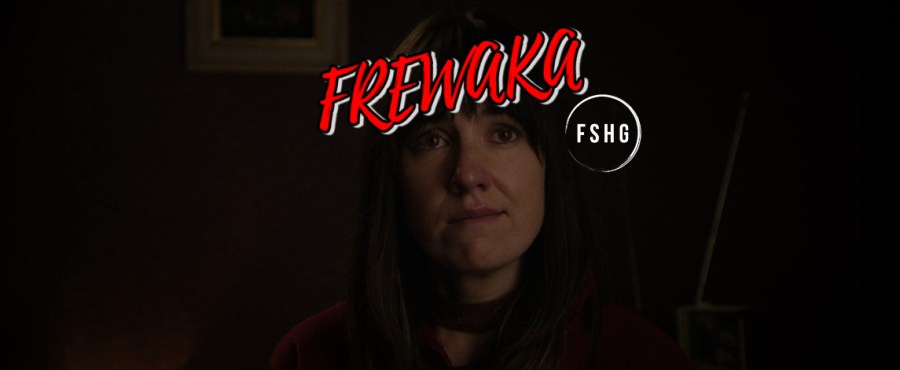
Frewaka (2025)
Directed & Written by Aislinn Clarke
Starring Clare Monnelly, Bríd Ní Neachtain, & Aleksandra Bystrzhitskaya.
★★★★ (out of ★★★★★)
DISCLAIMER:
The following essay contains
SPOILERS!
Turn back, lest ye’re spoilt.
Aislinn Clarke’s Frewaka brings a new dose of haunting folk horror combined with Irish Gothic. It tells the tale of Shoo (Clare Monnelly), a care worker who recently lost her mother, after she gets called to a rural town where she’s assigned to Peig (Bríd Ní Neachtain), an old woman potentially slipping into dementia and experiencing hallucinations. Shoo’s already dealing with her own deep, dark emotions. Once she arrives at Peig’s home, the darkness gets much deeper. She can’t tell whether the things Peig is afraid of are delusions, or if they might be real. The two women are forced to confront what haunts them most, which means looking into the past and all its ugliness.
The word “Fréwaka” is a phonetic spelling of the Irish word “fréamhach,” translating to “roots” in English, and Clarke’s film is certainly about digging down to the roots of ourselves, our histories, and our greatest fears. Frewaka isn’t only about Shoo, nor Peig, either; it’s about generational trauma that remains present in so many Irish lives. What Shoo and Peig come to confront together, once their shared roots come to light, is the darkness in their own lives and the darkness that has loomed over the Irish for centuries. It’s all about the past. As Faulkner famously wrote in Requiem for a Nun, “The past is never dead, it‘s not even past“; it is always with us, threatening to eat us alive. Shoo starts the film as someone who’d rather walk away from her past, specifically her dead mother. When it comes to all her mother’s things, she tells her fiancée Mila (Aleksandra Bystrzhitskaya): “Let them dump it all.” Memories weren’t much of a thing for Shoo or her mother. Mila comments that there are so many things in her mother’s home but “no photos of you, no sign of you at all” to which Shoo responds: “We weren‘t that kind of family.” Shoo’s mother is herself representative of the past in the form of tradition, and one tradition above all else: Catholicism. Later in the film, Shoo reveals she suffered abuse at her mother’s hands and shows Peig the scars. She says her mother used to lock her in a cupboard and make her repeat prayers. If she made a mistake, she was burned. In a couple scenes prior to this, Shoo hears the voice of her mother from the shadows, reciting bits and pieces of prayers such as the Salve Regina. Peig has her own scars, too. Her back is covered in brutal marks, indicative of whippings. Shoo later hears the rumours about Peig in town, that she was either “in an asylum or a Magdalene laundry years ago.” This is where Frewaka begins evoking the collective past of the Irish people.
Magdalene laundries are a blight on the modern era of Irish history. They were also a plight and trauma specific to Irish women. Peig represents one link in a chain of women who’ve been touched by mental illness, likely, at the very least, due to her own treatment in a Magdalene laundry. Yet it probably has roots in someone even further back down the family line long before Peig—maybe an Irish ancestor who survived the Great Famine by the skin of their teeth, perhaps forced to travel on one of the infamous coffin ships that crossed the Atlantic only to be left haunted on the other side. Generational trauma rears its head most when Peig warns Shoo about the terror downstairs. She says that “down there” is like “a madhouse, a famine village, a laundry house, a coffin ship, a field poisoned with blight, a street full of blood and bullets, hundreds of bodies piled into a septic tank. Punishment.” These are all references to generations and centuries of trauma, in various awful forms, experienced by the Irish. It’s almost as if the Irish as a people have been marked, forever followed throughout history by pain and violence. National trauma in Ireland reaches all the way up to the Troubles, lasting nearly until the new millennium.
An interesting addition to all the generational trauma referenced in Frewaka is the mournful song that reoccurs occasionally throughout the film sung by Shoo’s mother: “Éamonn an Chnoic” (“Ned of the Hill”). The song originated with Edmond O’Ryan, a folk hero and Irish guerrilla fighter from County Tipperary. O’Ryan represents resistance against English and Scottish settlers. He was beheaded by a friend who betrayed him hoping to cash in on the reward put out for him. It’s significant that Shoo’s mother signs a version of O’Ryan’s song before hanging herself, surrounded by Catholic religious idols. She becomes another Irish person succumbing to tragedy, bent by a powerful force beyond their control; for O’Ryan, the force was settler colonialism, and for Shoo’s mother it was generational trauma. Clarke’s previous film The Devil’s Doorway also took on the Gothic past of the Magdalene laundries but in a much different way, and Frewaka finds a very personal, intimate way into Ireland’s darkest historical moments. Shoo’s fate isn’t hopeful; there’s no real suggestion she’ll survive. When she heads into the basement—that Peig warned was akin to a psychological trip into Ireland’s most horrific historical traumas—she gets lost in the generational trauma of the Irish people. Can she ever come back? Who knows. For now, Shoo’s captured by the darkness left behind after centuries of trauma done to the Irish soul. Even if she can come back, she and Mila are due to have a child. A new generation comes with the possibility of passing along generational trauma once more. Frewaka is a chilling reminder that the past clings to body and soul; there’s no outrunning an extra organ.
 Father Son Holy Gore