
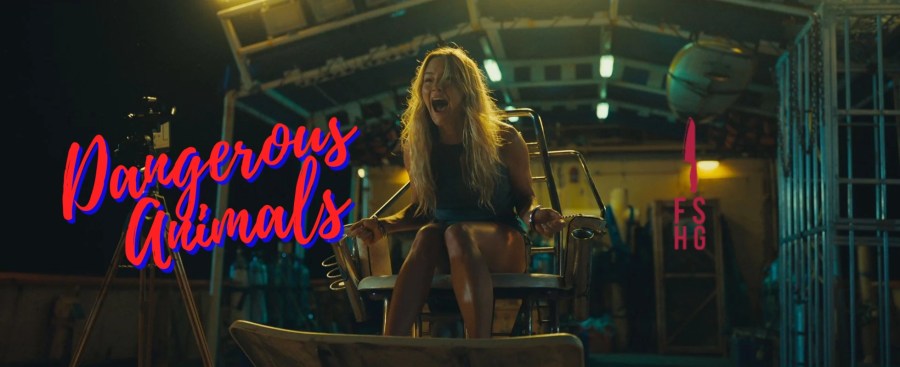
Dangerous Animals (2025)
Directed by Sean Byrne
Screenplay by Nick Lepard
Starring Hassie Harrison, Jai Courtney, Josh Heuston, & Ella Newton.
Horror
★★★1/2 (out of ★★★★★)
Sean Byrne’s first feature The Loved Ones was a unique piece of horror that also had a whole lot of heart, then six years later The Devil’s Candy was a haunting depiction of a tortured artist, and a whole ten years after that Byrne returns with Dangerous Animals, a fun, funny, and wild serial killer-meets-killer shark horror flick. Dangerous Animals charts the collision of Zephyr (Hassie Harrison), a young woman seeking good times and big waves, and Bruce Tucker (Jai Courtney), a serial killer obsessed with feeding women to sharks. They end up out in the middle of the ocean together with nothing but miles of open sea and rows of sharp teeth beneath. What began as an adventure for Zephyr turns into a watery nightmare.
It’s fun to see a serial killer-killer shark mashup in Dangerous Animals, not to mention the way Nick Lepard’s screenplay turns the man-shark dynamic into a larger theme about trauma and those who repeat their trauma unto others. Tucker’s painful past is a direct link to the way he kills—many serial killers revisit a foundational trauma through the violence they do to their victims in some form, though none as intense or as elaborate as this guy. But just because you’re victimised doesn’t mean it’s an excuse to go on victimising others. The statistics show, despite misinformation, that most people who’ve been traumatised do not go on to traumatise others. Yet men like Tucker use their trauma to justify the horrific things they do, creating new cycles of trauma in others. Men like him are dangerous human animals, indeed.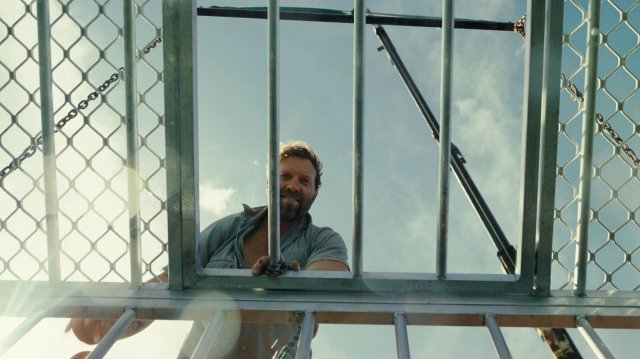 An interesting aspect of Tucker’s serial killer ritual is a gruesome act of voyeurism that’s resulted in a collection of VHS tapes he keeps to watch, often when he eats. The reason it’s so interesting is because Tucker aligns himself with the sharks, even saying both he and Zephyr are like sharks themselves: “Solitary creatures. We fend for ourselves.” Yet the VHS tapes and the voyeuristic enjoyment Tucker gets from rewatching the shark killings he’s set in motion distinctly separate man from animal. Very few animals engage in what’s known as surplus killing, which some believe indicates they’re capable of murdering for ‘fun’ or for sport; out of the few, sharks aren’t on the list. Man’s the animal who kills the most numbers for fun. Man’s also the animal whose glee over killing shows most, from serial killers to soldiers who each revel in keeping a running count of their kills. Tucker’s a prime example of such men, particularly when we watch him in front of a TV eating like a primitive specimen of man, eyes in a trance witnessing the old killings he’s taped, feeding two hungers at once.
Tucker descends into more animal-like behaviour as the film wears on. At one point, he describes men as if they’re helpless victims of their instinct, just like he views animals: “That‘s the thing about us men, we don‘t really know what‘s inside until it pops out. And once that happens, there‘s really no stuffing it back in.” In one scene, as a tiny dog barks angrily at him, Tucker breaks down into total animalistic behaviour when he snaps, gets on all fours, and barks repeatedly to scare the dog off. Thankfully, Zephyr knows how to deal with the animal in men. We see just how beastly Tucker is when Zephyr notices a woman’s name carved into the hull of his boat. In despair, Zephyr carves her and another female captive’s name into the hull too in case they perish, then discovers a bunch of other women’s names. She refuses to allow a man like Tucker to end her life. She goes so far as to bite off her own thumb to escape the handcuffs he put on her. In a wonderful twist of fate, Zephyr shoots Tucker with a harpoon, like an animal. He becomes prey in the water to a much larger predator, just another part of nature’s food chain, and his vicious death is captured on video, the final VHS tape for his collection; a little ecological justice, as a treat.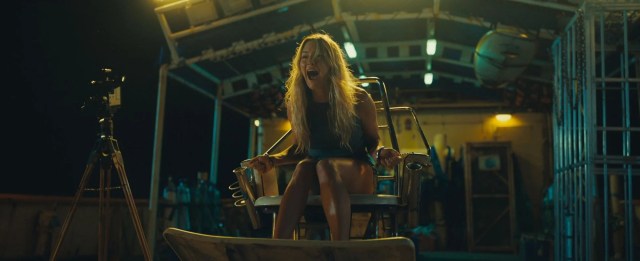
“What do you call the useless piece
of skin on a dick?”
“What?”
“A man.”
The brilliant part of Dangerous Animals is that it goes against typical shark horror where the so-called killer shark is the ultimate terror. In Byrne’s film, Tucker and the violence of man is the real monster. A pivotal scene occurs when Zephyr inevitably winds up in the dark water as a shark circles around her, yet she calmly floats right in the shark’s face and the creature moves on without attacking. Here, we see the myth of the malicious human killer dissipate in front of our very eyes. Zephyr’s no threat to the shark, so the shark doesn’t attack. Man is far nastier than any shark. Man kills without needing any reason, even if unthreatened. Man doesn’t kill to eat, either. Man frequently kills for pleasure. And men, like Tucker, often transform their own past pains into justifications for the new pain they cause in others. Dangerous Animals is actually a slightly incorrect title; it should be singular. The only true dangerous animal in this film is man.
 Father Son Holy Gore
Pingback: Reviews: Dangerous Animals (2025) – Online Film Critics Society