
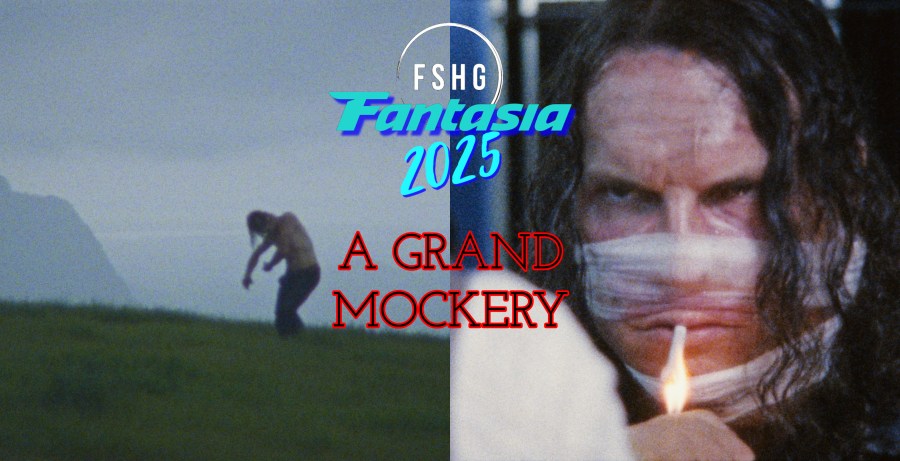
A Grand Mockery (2025)
Directed & Written by Adam C. Briggs & Sam Dixon
Starring Sam Dixon & Kate Dillon
Thriller
★★★ (out of ★★★★★)
DISCLAIMER:
The following essay may contain
what some consider
SLIGHT SPOILERS.
Adam C. Briggs and Sam Dixon’s A Grand Mockery hit Fantasia 2025 to give everyone a dose of 8mm-fuelled madness, as its protagonist Josie (Dixon) meanders through a depressing, mundane existence and continually isolates himself further from those around him while he longs for meaning, purpose, and an old friend. Josie’s days consist of working a dead-end job at a movie theatre, drinking endlessly, and traipsing through a graveyard where he and his friend Sal once spent their days dreaming of breaking free from their working-class cage. His reality unravels the more he spins headlong into addiction. He’ll either continue on without changing anything about his life, or he’ll make an irreparable choice.
At times, A Grand Mockery feels aimless, though that feels like part of the point: the viewer sits with Josie, sometimes uncomfortably close, through all the drudgery of his working-class existence until neither they nor Josie can take it anymore. The film’s 8mm visuals mirror the grittiness of Josie’s life, and the audio takes on a haunting quality that makes it feel like sitting right inside his head, dealing with a barrage of psychic violence turned entirely inward. A Grand Mockery is at times comical, yet never not bleak—a manifesto of loneliness, screaming out into the world’s darkness to no response.
 Josie’s world is thoroughly depressing right from the start and he seems to either welcome destruction or has fallen wholly into nihilism: “I think of bush fires, I think of our country going up in flames.” There’s little hope in Josie’s mind. He even spends a great deal of his free time outside of work in a graveyard, surrounded by “dead friends.” If he isn’t with his girlfriend, with whom he has a somewhat troubled relationship due to his emotional impotence, he’s with his father who’s gone non-verbal, potentially out of disdain for him. A sad moment happens when Josie puts his father to bed and asks to be told a story; it’s partly him trying to get dad to talk, partly him longing for that parent-child relationship that includes bedtime stories which, it seems, he never got long before dad stopped talking. Work is the cherry on top of Josie’s dreary life. He deals with one customer who appears not to realise the theatre has closed for the evening multiple times. After the last time, Josie watches the man wander away before standing like a zombie in front of one of the cinemas, as if the theatre and the graveyard Josie spends time in are not that far apart on an existential level. There’s barely any brightness, if any at all, for Josie, except for his clear fondness for an old friend, Sal, yet that’s tainted by his own mocking inner monologue.
A great piece of A Grand Mockery is that Josie might be questioning his sexuality, which may or may not extend from his feelings for Sal. When we hear the voice in Josie’s head mocking him, it makes several comments that suggest Josie may have deeply buried homosexual feelings inside him. The voice directly accuses Josie of having gay feelings for Sal. At one point, the mocking inner voice talks about the sun “peaking over the distant horizon like the head of some gargantuan burning phallus.” The voice continues on about a terrible existence that’s full of nothing but darkness and sex, suggesting that even if Josie’s not questioning his sexuality, he has deep-seated issues when it comes to sex. He goes to see some kind of psychotherapist-like figure who warns about the destructive powers of sexual energies. In another scene, Josie’s cleaning the theatre bathroom on his knees when the manager comes in for a piss and Josie can’t keep his eyes off the guy’s cock. There’s even a sexual experience Josie has with a slightly androgynous person that results in him being overcome by the voices in his head and so he hops out of bed. Sex ultimately feels like something uncomfortable for Josie, as if his own body attempts to isolate him from other people just like he seems to emotionally isolate himself from them, too.
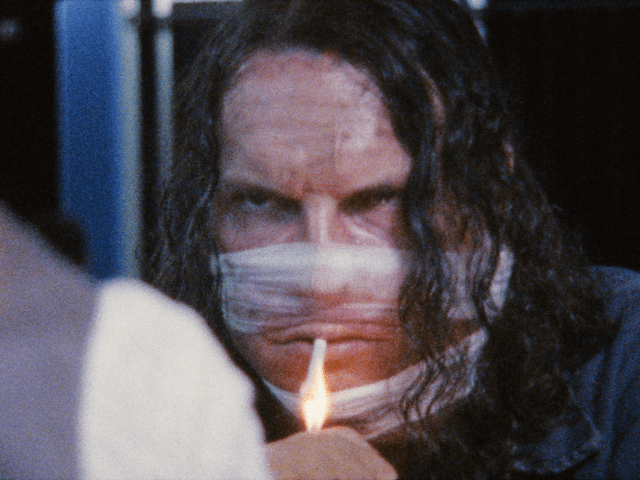 A pivotal moment mirrors the myth of Narcissus, though not in terms of narcissism, instead it’s a moment of clarity in which Josie accepts that nothing will ever get better; a self-fulfilling prophecy since Josie started in a bleak place. A Grand Mockery lives up to its title with the voice in Josie’s head mocking his entire life, from his complicated feelings about Sal to his excruciatingly monotonous theatre job to his relationship with his father, and the more the voice rattles on, the more Josie sees his entire existence as nothing but mockery. Briggs and Dixon have created one of the more depressing films in recent years. There’s not one second where it feels like Josie’s headed towards anything other than something awful, whatever that fate may be in the end. A Grand Mockery leaves an ugly feeling under the skin because so many people like Josie exist in every city across the world—people who want something bigger and better for themselves but can’t break free from the shackles of their own self loathing long enough to crawl out of darkness into the light.
 Father Son Holy Gore
Pingback: From Our Members’ Desks (Aug. 11, 2025) – Online Film Critics Society