

Coyotes (2025)
Directed by Colin Minihan
Screenplay by Ted Daggerheart & Nick Simon
Starring Justin Long, Kate Bosworth, Keir O’Donnell, Mila Harris, Brittany Allen, Katherine McNamara, & Norbert Leo Butz.
Horror
★★★1/2 (out of ★★★★★)
DISCLAIMER:
The following essay contains
VERY MINOR SPOILERS.
Another solid film out of Fantastic Fest 2025 was Colin Minihan’s Coyotes, a horror-thriller about a family caught between a rock and a hard place, except replace rock with murderous coyotes and hard place with raging fires. Scott (Justin Long), Liv (Kate Bosworth), and their daughter Chloe (Mila Harris) live in a luxurious home in Hollywood, but their dream house is besieged by both killer coyotes and fires. Suddenly, the family has to contend with the real world encroaching on their seemingly happy lives. This puts things into horrifying perspective for Scott, who tries his best to keep his family from literally going down in flames, or winding up coyote food.
Coyotes goes from dark to funny to sweet, crossing from horror to comedy to family drama. Beneath its exterior, the film looks at how the problems facing the working class are finally beginning to touch places like the Hollywood Hills, and people like Scott are not prepared to deal with them. It also takes near tragedy for Scott to understand how he’s been treating his family while relentlessly pursuing his bourgeois view of the American Dream. Whether he learns a lasting lesson is a whole other story. At the heart of Coyotes is an eco-horror story about the consequences of human progress, specifically its effects on the world of animals, and how those consequences can spill violently from the woods into the cities.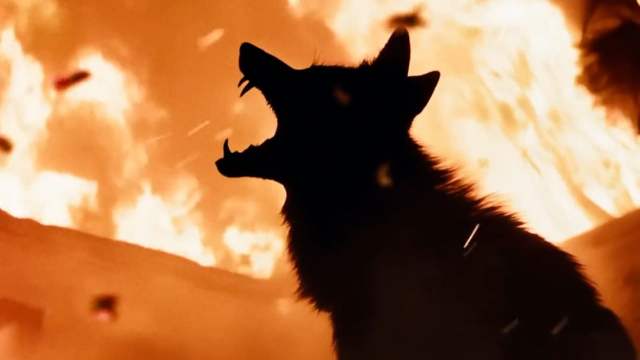 There are great instances in Coyotes where Ted Daggerheart and Nick Simon’s screenplay riffs on class consciousness. It’s no surprise since one of the film’s posters features the tagline “Eat the rich.” In one scene, Scott and Liv talk about his absence at home, even when he’s actually at home, due to his obsession with work and financial success. Scott refutes the idea that he’s neglecting his family, though frames it in a deeply consumerist worldview: “Everything I do is for you and Chloe—for this house, for this life.” He starts off with family then quickly shifts to property. He’s used to measuring happiness by price tags. He hates their old home, preferring their new bourgeois one, whereas Liv liked the old place because at least he was more present as a husband and father when they lived there. Scott is a classic bourgeois dad film character who’s forgotten the importance of the people in his home, in favour of the home itself and his purchased possessions in it. In the final scene, Scott still shows how obsessed he is with material possessions after he laments certain precious purchases that are likely burned up in the fire; he’ll never, ever learn.
“It’s wild out there.”
We can even interpret Coyotes on the level of eco-criticism when we consider the proximity of the coyotes and the urban landscape of Los Angeles. One scene is almost certainly inspired by Jurassic Park with coyotes substituted for raptors in a living room instead of a stainless steel kitchen. The coyotes’ homes have been reduced more and more as time goes by and people continue to insist on urban progress as the only marker of human achievement. In the city, coyotes are treated like pests; this is played on throughout the film via the exterminator character, Devon (Keir O’Donnell). When we discover the reason the coyotes have become increasingly aggressive within city limits, it only lends more credence to an eco-critique in the story. Minihan captures a perfect shot in a late scene with a coyote howling in front of a raging fire, a visual comparison of two natural forces raging out of control due to human disrespect of nature.
Coyotes is a lot of fun, no matter how you choose to watch it, either sitting back to enjoy a horror-thriller in the vein of a summer blockbuster, or analysing the film deeper to read it as a story with critical social ideas. Daggerheart and Simon move between horror-comedy and drama at various times in their screenplay giving equal weight to lightness and darkness. Overall their story is a hopeful one about humans learning to co-exist with the natural world, albeit not after suffering some consequences of a previous refusal to co-exist. Minihan’s film is smarter than it might appear on its face, but also doesn’t need to use its intellect to drift into preachy territory. Instead, the film is an exciting and at times heartfelt work that’s really, when it comes down to it, about what people and animals will do to protect their families and their homes.
 Father Son Holy Gore