
The Vile (2025)
Directed by Majid Al Ansari
Screenplay by Al Ansari & Johnie Alward
Starring Bdoor Mohammad, Sarah Taibah, Iman Tarik, & Jasem Alkharraz.
Horror
★★★★ (out of ★★★★★)
DISCLAIMER:
The following essay contains
SLIGHT SPOILERS.
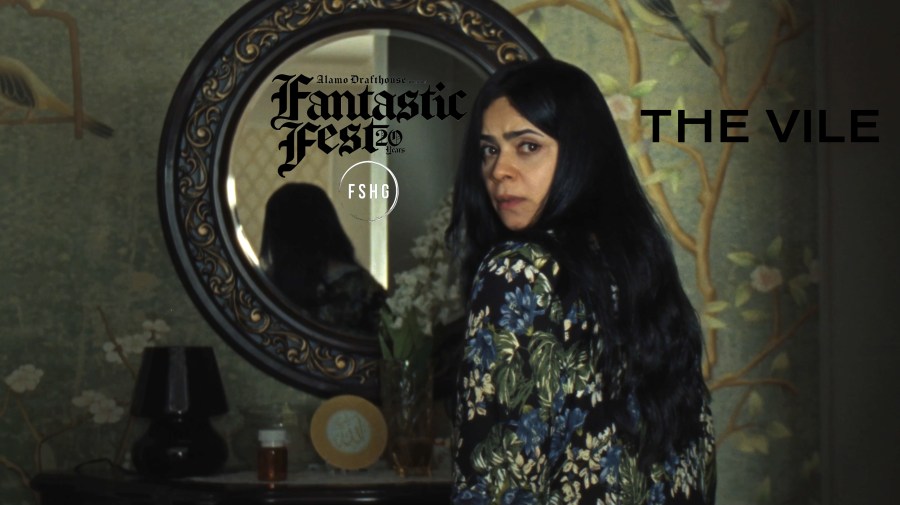
Another significant work of horror at Fantastic Fest 2025 was Majid Al Ansari’s The Vile, a film that centres on Amani (Bdoor Mohammad), a wife and mother whose world begins to cruelly shatter after her husband Khalid (Jasem Alkharraz) brings home a new pregnant wife, Zahra (Sarah Taibah), to live with them and their daughter Noor (Iman Tarik). This new change in the home begins like any other complicated development in a marriage. After a while, Amani starts to wonder if there’s something more sinister happening with Zahra, and she’s sure that the new wife isn’t bearing a child but rather bringing evil into their house.
While life for women in the United Arab Emirates has improved over the years, this change is mostly nominal, and the reality is that though the government can make changes, this doesn’t necessarily translate into change in the home. The Vile deals with one home where the husband treats his wife—or, better put, wives—like she’s nothing but a vessel for his child, and the only truly acceptable child to him is a male one. Khalid and Amani’s house is a space defined by misogyny, so much so that Amani seems to police herself even when Khalid isn’t around. The Vile is a terrifying story about the domestic and the national that plays out under a single haunted roof. The sociopolitical context of The Vile is important to understand. In the UAE, married women face a number of challenges if they wish to leave their husband. For instance, a woman only has right to custody up to certain ages (girls until 13, boys until 11), and if she chooses to remarry she must forfeit custody of her children. Not to mention that women who leave their husbands can sometimes be ordered to return to the marital home. One case in the UAE’s Federal Court actually sanctioned domestic violence so long as the husband didn’t leave physical marks on his wife. All this to say, The Vile plays out under a nation that has allowed the discrimination and exploitation of women, and continues to allow it. So, when Khalid comes home with a new, pregnant wife he’s moving in with the family, he gets little actual pushback from Amani, mostly because there aren’t many options available to her. Amani must endure the horrors to come. There’s no telling what horrors she my have already endured under Khalid’s patriarchal thumb.
The Gothic is at work in The Vile through Freud’s Uncanny. Zahra makes herself at home, paying no mind to Khalid’s misogynistic behaviour, going so far as to take a literal step into Amani’s shoes—slippers, to be precise. Khalid’s actions create an unsettling, uncanny space where Amani must fight against erasure. One very haunting moment features Amani and Khalid’s wedding video, as Zahra starts to digitally take Amani’s place in it. Amani soon pieces together bits of Zahra’s past when she visits someone previously connected to Khalid’s new second wife: “She‘ll make you feel like a stranger in your own home.” What we start to see when Amani follows these breadcrumbs is that women end up paying the price for their husbands’ betrayal and weakness, resulting in them being erased from their own homes and their family’s lives. Perhaps the saddest and simultaneously most horrifying moment in the film is when Amani has a nightmare in which she’s viewed as an intruder in Khalid and Zahra’s home, even to her own daughter, culminating in a violent hammer attack set to a soundtrack of Khalid’s maniacal laughter.
Khalid’s misogyny is a major aspect in The Vile since it precipitates the plot’s action and looms over the relationship he has with both his wife and daughter. The reason Khalid has begun a new relationship with Zahra is specifically because Amani seems not to be able to bear another child. Khalid sees Amani as a broken vessel no longer capable of giving him a male heir. The other disturbing piece of Khalid’s misogyny is that he clearly does not consider women as important as men because he’s obsessed with having a male child to carry on his bloodline, leaving his daughter Noor as a mere object to him, an ornament to be kept around the house until it’s given away to somebody (e.g. married off). Though, in the end, Khalid himself is rendered nothing but an object in his own home, too.
The Vile is a powerful work of cinema about the greed of patriarchal men. Horror is often about the unspeakable, and Majid Al Ansari speaks truth to power with this film. Amani’s battle to resist the misogyny of her husband, as well as the erasure it threatens, is the battle of many women in different places across the Arab states of the Persian Gulf where polygamy is accepted. The Vile, while specific to the UAE, has universal appeal in that misogyny crosses all kinds of cultural and social boundaries around the world. The mechanics of misogyny are the same everywhere, and Amani’s emotional/psychological experiences in the film will ring true to so many women regardless of their culture or geographical location.
 Father Son Holy Gore