
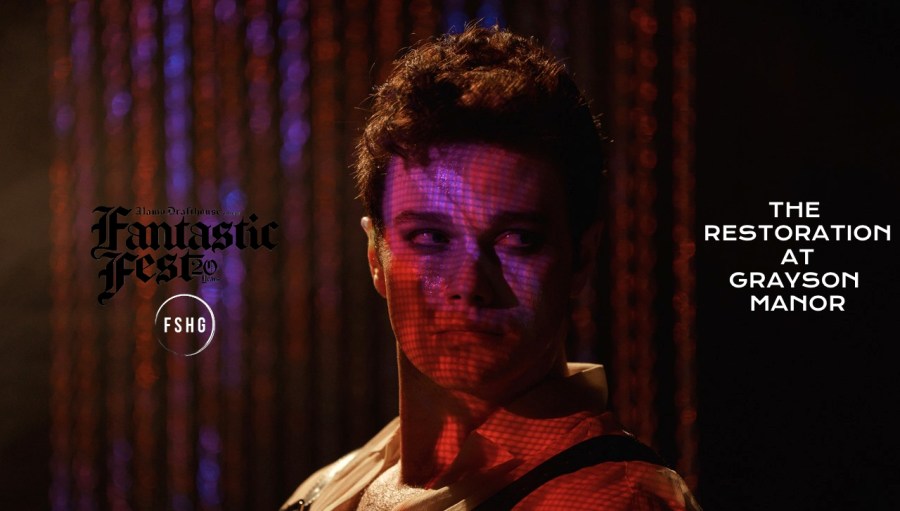
The Restoration at Grayson Manor (2025)
Directed by Glenn McQuaid
Screenplay by McQuaid & Clay McLeod Chapman
Starring Chris Colfer, Alice Krige, Daniel Adegboyega, Declan Reynolds, Gabriela Garcia Vargas, & Matthew McMahon.
Horror
★★★★1/2 (out of ★★★★★)
DISCLAIMER:
The following essay contains
VERY MINOR SPOILERS.
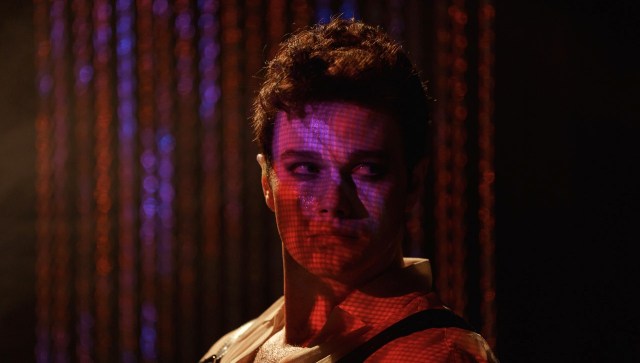
At Fantastic Fest 2025, Glenn McQuaid’s The Restoration at Grayson Manor brought a queer vision of the horrors intertwined with notions of legacy. The film involves the aftermath of an accident that leaves Boyd Grayson (Chris Colfer) without both hands and the lengths to which his mother Jacqueline (Alice Krige) goes in order to help him. After Jacqueline involves Dr. Jeffrey Tannock (Daniel Adegboyega), who’s working on a new technology that will allow Grayson the use of his hands again, she has everyone stay at their stately home until the procedure is finished. There are other ghastly things happening at Grayson Manor apart from a looming operation on Boyd, and all is eventually revealed, no matter the consequences. The Restoration at Grayson Manor leans heavily into melodrama, particularly Victorian melodrama, and it works well with the film’s Gothic style. McQuaid and co-writer Clay McLeod Chapman understand the Gothic, as well as how to pull it further into the twenty-first century since their story perfectly translates old Gothic ideas to contemporary life. The film looks long at how the heteronormative concept of legacy breeds resentment, and even drives some to madness.
 McQuaid’s film joins other Queer Gothic films over the past couple decades that have inverted the old depictions of queer people in early Gothic works, and even some later Gothic, as monstrous. The monstrousness in The Restoration at Grayson Manor comes from Boyd’s mother. Jacqueline’s obsession with heteronormativity makes her into a Gothic monster. Early on, Boyd calls his mother a “Gorgon.” He has a grotesque nightmare in another scene, dreaming of Jacqueline forcing a baby’s bottle of “mother‘s milk” into his mouth. It’s not until later in the film, when the full scope of Jacqueline’s plans are made painfully clear, that her monstrousness is understood in its entirety. What makes her such a monster is how she tries to brutally enforce heteronormativity, all in the name of carrying on her family’s bloodline and its legacy.
Grayson takes pleasure in not carrying on the biological family name simply because it bothers his mother so much, and he’s obviously gone through many indignities due to his mother being, in his words, a “homophobic cunt.” The lengths to which Jacqueline will go reveal just how far she’s been warped by a heteronormative worldview. There are also the added class dimensions of Jacqueline’s heteronormativity. She’s very concerned about their bloodline’s legacy because of their standing in society, further wrapped up in how she likely feels Boyd’s open homosexuality reflects on her and the family name. Everything in the lives of the Graysons winds up being affected by heteronormativity to gruesome ends.
The Restoration of Grayson Manor is a Victorian Gothic melodrama set in modern day: old hauntings are replaced by new psychological ones, and tired Gothic tropes become new critiques on the real causes of social monstrosity. McQuaid also uses melodrama, gruesome horror, and a dash of science fiction to turn The Restoration of Grayson Manor into a unique cinematic treat. Queer Gothic like this is particularly urgent at the current moment in time when the destructive desire for heteronormative legacy continues to haunt us all on national and global levels.
 Father Son Holy Gore