

Nosferatu (2024)
Directed & Written by Robert Eggers
Starring Lily-Rose Depp, Bill Skarsgård, Nicholas Hoult, Aaron Taylor-Johnson, Willem Dafoe, Emma Corrin, Ralph Ineson, & Simon McBurney.
Horror
★★★★★ (out of ★★★★★)
Robert Eggers’s Nosferatu is a brilliant, erotic update to the original 1922 film, as it welds F.W. Murnau’s not-quite-adaptation of Bram’s Stoker Dracula with major elements from Stoker’s novel, and, in the process, has created one of the best depictions of the Gothic treatment of sexuality, encompassing issues women faced in the 19th century—and to a degree, still do today—related to their desire, and the queerness of vampires that has existed since the first literary vampires reared their fanged mouths in the West.
In this telling of the familiar tale, Ellen Hutter (Lily-Rose Depp) is in the thrall of a dark, demonic entity, ever since she was a child. He’s returned now, some time after she and her husband Thomas (Nicholas Hoult) were married. When Thomas has to go away on business to complete a real estate deal in the faraway land of Transylvania, he meets Count Orlok (Bill Skarsgård) and falls under his spell. But Orlok is seeking Ellen; he is her dark spirit, the evil that refuses to let her go. The closer the Count gets to Wisburg, Germany where Ellen lives, the more terror enters her life, and she must make the most difficult decision of her life in order to free herself, Thomas, and Wisburg from the shadowy machinations of the dreaded vampyre.
The Queered Cuckolding of Thomas
 Thomas is cuckolded by Count Orlok when the vampire tricks him into signing a contract, written in the latter’s ancestral language, that he believes is related to their real estate contract. Thomas inadvertently signs over Ellen into the possession of Orlok. But he isn’t only cuckolded here, he’s seduced into Orlok’s rotten arms and teeth, queered by the vampire’s lustful appetite. A great moment comes when Thomas, on the road to Orlok’s castle, is enticed into a ghostly carriage; he literally floats into the carriage, as if a cartoon character in love fluttering along by powers of the heart.
Before Orlok feeds upon Thomas, Thomas sees a vision of naked, bloody Ellen on top of him, like they’re having sex; however, it’s actually Orlok, come to suckle at his heart and thrust into him; a similar moment occurs in Eggers’s The Lighthouse (2019) when Winslow (Robert Pattinson) is beating Wake (Willem Dafoe) and he sees Wake briefly take on the form of a seductive siren, whom Winslow kisses. The act of vampire feeding is sexualised in Nosferatu perhaps more than ever before in cinema, and, considering this moment occurs with Thomas, the feeding is queered, too. This is appropriate since Nosferatu was originally an illegal adaptation of Dracula and Bram Stoker’s Count in the novel was, indeed, queered, as well. In one curious moment from Stoker’s Dracula, the Count discovers his three brides about to feed on Jonathan Harker—the Thomas Cutter character in Nosferatu—and scolds the undead women, telling them: “This man is mine!” Again, Eggers accentuates the queerness of Orlok in the shot where the vampire lies atop Thomas, chewing on Thomas’s breast at the heart—a grotesque twist on the idea of love—and slowly thrusting into him as if mimicking the act of sexual penetration.
Ellen (& Women) as Property
 Orlok treats Ellen the same way he treats his new property in Wisburg, as he tricks Thomas into a deal that Thomas believes is related to real estate. When Knock calls out to his master, he refers to Ellen as “the object of thy contract”; both the real estate and Ellen’s body are viewed as forms of property. This fits well in the Victorian Age, Germany or otherwise, as most women in the Western world were not able to own property, nor did they have many rights when it came to how their husbands used their bodies, whether for labour in the home, or for sexual satisfaction and reproduction.
There’s wonderful woman-and-cat solidarity in Nosferatu, albeit only during a brief moment when Ellen admires her cat because she perceives the cat to be more free than herself, unbound by patriarchal control, or any control at all. She says her cat, Greta, “has no master, nor mistress.” There are two ways to further consider the cat’s name, Greta. The name comes from the Greek word ‘margarites’ meaning ‘pearl.’ And pearls have had great symbolism throughout history; three symbols particularly have relevance to Nosferatu. First, pearls have been associated with wisdom. We can consider this in the sense that the cat Greta has enough wisdom not to be tamed by anybody, of any gender. Second, pearls have been associated with love; an obvious fit for the film, as love, in various forms, is Nosferatu’s centrepiece. Finally, and most importantly, pearls have long been associated with purity and Ellen’s character is wrapped up in ideas about sexuality, sin, and purity. This leads to the representation of women’s sexuality in Nosferatu while Ellen struggles against Orlok’s lure and his insistence that she, and her desires, are responsible for the death he brings with him.
Orlok, more than other depictions of Dracula, has a demonic power of possession over Ellen, which has roots in two different figures from literature. The first is Svengali, a character from the novel Trilby by George du Maurier; a hypnotist and musician who seduces and exploits a young model. Svengali has become a catch-all name for people who manipulate and exploit women. But more than Svengali, Ellen’s erotic possession by the demonic Orlok resembles the story “Péhor” from Histoires magiques by Remy de Gourmont, in which a woman struggles with religious and societal expectations in the face of her non-normative desire. The possession angle in Nosferatu and “Péhor” deals with the idea of women as property through a demonic figure, and such demonic evil frames women’s sexuality as troublesome, wrong, and, especially in the case of Nosferatu, a deadly force.
Shaming Ellen/Women’s Sexuality:
Sexual Womanhood as Death
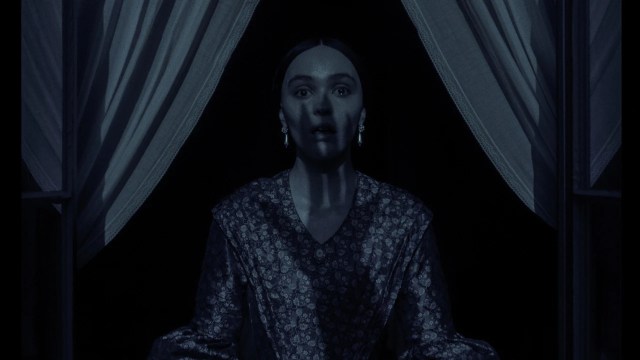 At the very beginning of the film, Orlok tells Ellen: “You wakened me from an eternity of darkness.” This feels like a way to link women, again, with the religious concept of original sin. Orlok is convinced that Ellen has pulled him out of existential darkness, convinced that she, a human woman, has somehow reached through time and space to call him forth. More than that, Orlok says: “You are not for human kind.” This is his Othering of a woman’s sexuality, marking her as inhuman because of her sexuality. Ellen pledges herself to Orlok, believing in the shame he heaps upon her, then feels him spiritually pleasuring her before witnessing the grisly vision of his true physical form and being invisibly ravaged. Orlok even turns Ellen on her side, invisibly having his way with her body, contorting her into different sexual positions and causing her to convulse as he spiritually ravages her mind and body. Sex and death are intertwined from the opening sequence in Nosferatu.
It’s fitting that Eggers places his film’s story in Germany during 1838, since, though the Victorian Age is often associated with Britain, Victorian morality didn’t stay hidden behind English borders. Nosferatu takes place only one year after the Victorian Age is understood to have begun in Britain, loading the story with all kinds of repressed sexuality and shame that’s centered on Ellen. Germany in the 1830s was still largely governed by conservative and restrictive norms, though modern ideas related to sexual orientation and attraction were beginning to emerge.
Every part of Ellen’s desire, not only her sexuality, is framed in such a way that she feels trapped and her sexuality becomes symbolically linked with death. When she recounts to Thomas a dream of their wedding, she says that Thomas wasn’t actually at the altar, instead it was Death all dressed in black. Once she and Death were wed, she turned to find the congregation of her family and friends were all dead, yet she was happy in her dream. Meanwhile, Friedrich Harding—HARD like a boner; yes, I went there—has two kids and another one on the way, and Thomas jokes with him: “You always were a rutting goat.” Then Freidrich makes a goat-like noise and uses his hands as horns. The word ‘rut’ relates to the annual period of sexual activity of mammals. This is most interesting because Friedrich isn’t judged by his sexuality, nor is his wife judged since her sexuality goes towards reproduction. But Ellen’s sexuality is always called into question and scapegoated. Later in the film, Professor von Franz says: “Demonic spirits more easily obsess those whose lower animal functions dominate.” Ellen is likened to an animal here because it’s believed that her sexuality and desire have, effectively, taken her over. Oftentimes, Ellen comes across as in the throes of an erotic, animalistic desire: we see her humping the air in her bed, writhing suggestively in the sheets, or legs spread by the water and her eyes rolling back in her head, shouting “He’s coming!” Her sexuality is one presented as not only out of control but one that’s inherent since it’s said she’s had her ‘spells’ (of eroticism) since childhood. Ellen continually blames herself for having, as she sees it, sinful desires, pleading with Professor von Franz when she meets him: “Does evil come from within us, or from beyond?”
Another curious moment related to women’s bodies and sexuality is when Thomas is in the small village before travelling further to Orlok’s castle and he witnesses the local folklore in action. Certain folklore tells that a virgin woman on a virgin stallion helps to locate a vampire’s grave. While this plays on the idea that vampires are sexual predators, a common thread in most vampire folklore and literature over the years, this also frames a virgin woman as a weapon; another way for men to use women’s bodies, by dangling them in front of a vampire. In all forms, women’s bodies in the 19th century were used by men as a means to an end; Immanuel Kant certainly would not approve. Even the virgin stallion itself plays into the symbolism related to women’s sexuality at work in Nosferatu since the horse is white, a colour traditionally linked with the tired patriarchal concept of purity.
Ellen and women’s sexuality is presented in Nosferatu as linked with death to the point that Orlok sends a plague to Wisburg as a punishment. But Eggers isn’t suggesting that this is reality, nor that women’s sexuality is meant to be feared. His film is about the patriarchal obsession with women’s bodies and their sexuality, and Orlok represents the deadly toxicity of such a reality; not only does Orlok threaten Thomas with deadly destruction, he infects an entire city—from the men, to the women, to the children—just to get what he wants from Ellen. And Orlok enacts gaslighting of epic proportions to convince Ellen that she is the problem, that her sexuality and desires are the reason for all this death. In one scene, Ellen, with disgust, tells Orlok: “I have felt you crawling like a serpent in my body.” Then Orlok begins to, as we’d call it today, victim-blame her for wanting him to invade and possess her body, telling her: “It is not me, it is your nature.” He turns things around on her and says: “You are my affliction.” Ellen continues to believe that she’s an unclean woman. In the end, she fights back against Orlok, and a Victorian society bent on shaming women’s sexuality, by turning her erotic power back onto the undead nobleman.
Woman’s Revenge & Reclamation of Power
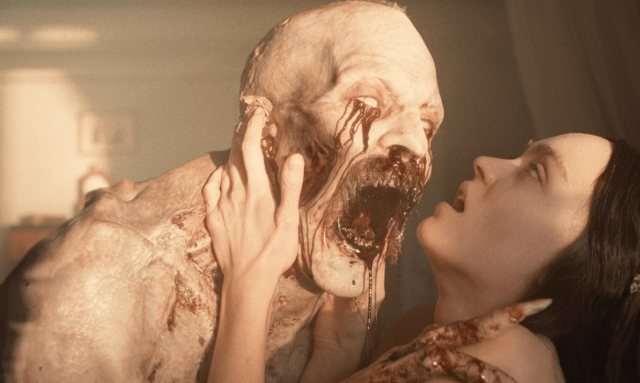 While the endings of Eggers’s Nosferatu and Murnau’s Nosferatu are the same, something about Eggers’s new version of the finale feels like it allows Ellen more agency than in the original film. Ellen’s sacrifice could be interpreted as her, a woman, being the victim of patriarchal terror, succumbing to the dark forces at work in her life while her husband escapes without much injury. But this robs Ellen of the agency she displays in Eggers’s film because she not only sacrifices herself by lying in bed, waiting for the vampire to come and feed upon her, she lets Orlok feed, yet she also offers her naked body to him; a step beyond her character’s lure in Murnau’s film. By doing this, Ellen sacrifices herself—remember, it’s to save more than just her husband, as Orlok would’ve kept on murdering—and she refuses to let shame define her, using her sexuality in a way, for once, that gives her power, instead of being an object of forced desire at the whims of Orlok’s sexual appetite. She reclaims the sexuality that Orlok, and society, made her believe was evil by using it to do an act of supreme good. Through sex, and in death, Ellen tells the world that women’s sexuality is not perverse, nor is it a force of destruction and upheaval as Orlok made it seem, it’s a powerful gift unto the world that could potentially deliver us from evil.
 Father Son Holy Gore