

Strange Circus (2005)
Directed & Written by Sion Sono
Starring Masumi Miyazaki, Issei Ishida, Rie Kuwana, & Seiko Iwaidô.
Horror
★★★★1/2 (out of ★★★★★)
Sion Sono’s Strange Circus is an uncomfortable piece of art because it deals with uncomfortable topics like the sexual abuse of a child, yet it’s just as much a transformative piece of art due to its presentation of a trans man’s narrative about his former life as a girl and his revenge against the parents meant to make home a safe place rather than a Gothic nightmare. The film is extreme at times, yes. Its extremity is never out of place in what amounts to a liberating body horror story about a trans man escaping the tortured female form he was forced to inhabit for so many years under the cruel thumb of both his incestuous father and his eventually brutally abusive mother.
Strange Circus’s Gothic scope is a personal one, diving into Yuji’s past when he was still Mitsuko, reconstructing truth out of lies and trauma. The film opens with a quote from Joris-Karl Huysmans’s À rebours (roughly translates to Against Nature) that sets the stage for what’s about to come in macabre fashion: “The skull was placed on a plate & given to a girl, who then presented it to her mother. Void of expression, the executioner stood there with a bloodstained long sword in his hand. She is a real woman. She has a burning passion within her cold exterior. That is her personality.” In Huysmans’s novel, the protagonist, disgusted by human society, isolates himself in the countryside of France where, among other things, he creates a garden in which he chooses real flowers that imitate artificial ones.
In Strange Circus, appearance does not represent identity, it’s only the flower of one’s heart, and the flowers of scars, that give life to our true self. The opening scene of the film takes place at the eponymous Strange Circus, where the artifice of drag takes centre stage before little Mitsuko appears. The protagonist, Yuji—formerly known as the young girl Mitsuko, whom we follow through the early part of the film—tears down all the artifice built up to conceal a horrifying truth, as he forces his mother Sayuri, now living as a novelist called Taeko, to confront it after trying to run away from it for so long. Sono’s film is a Gothic story not for the weak of heart, though one that uses some of the genre’s oldest conventions, from a disturbing reflection on the repressed past, to Uncanny doubles, to haunted houses, all focused on the tragic existence of a child caught in the web of her abusive parents.
The Womb & The Body as Doomed Houses
 Strange Circus explores a number of ideas, such as how the ghosts of trauma linger in the body. The incestuous abuse of Yuji’s father haunts the house to which Yuji eventually forces his mother to return, just as it haunts Yuji’s body. Palmer notes how the body in horror often deals with “exploring the limitations, excesses and absurdities of the human body.” Palmer further writes on how “the monstrous, its hybrid construction and the grotesque body” are often focal points of Gothic stories in which queerness/transness has typically been presented as dangerous, et cetera.
Sayuri takes on qualities of the devouring mother from Carl Jung’s therapeutic and psychological theories, particularly because she does nothing but hurt Mitsuko rather than protect the child from a rapist father. The devouring mother, or father, is an all-consuming force, a destructive and/or overbearing parent who doesn’t let their child grow, develop, or become independent. Sayuri is part of her husband’s abuse of their child and she further becomes jealous of Mitsuko which brings out a whole new level of terror. In a sense, Sayuri, as Taeko, devours the story of her daughter-turned-son, consuming Mitsuko’s tale and making it into her own instead. Best of all, later in the film, when Sayuri escapes into the author identity of Taeko, we see her laughing eerily, feeding pasta into the cello case we later discover contains her brutalised husband, and eating the pasta herself with a wild look on her face; she’s always devouring. At one point, Taeko’s editor warns Yuji: “She devoured us and then vomited us. We’re her vomit now.” Taeko is a general force of consumption because wherever she goes, she’s devouring someone or something.
The Gothic Doubles of Sexual Abuse: Mother & Daughter
 Dissociation & trauma are a centrepiece of Strange Circus. Mitsuko says, after her father’s abuse begins: “I layed down and became Mom.” Mitsuko becomes her mother visually, as she’s raped by her father, while the mother watches from inside the cello case. The little girl narrates her own dissociation: “I was Mom and Mom was me… Dad touched me, and I became Mom.” She begins to dissociate, imagining herself as her own mother so that she can trick herself into believing her father’s incestuous attacks feel good; a devastating psychological shield. After Mom dies, Mitsuko says: “When the hearse left, I was no longer a child.” This later proves to be part of Taeko f.k.a. Sayuri’s false narrative. Nevertheless, it does play into a general theme of death and rebirth that comes to bear on Yuji’s male identity. The scene depicting Sayuri in a coffin surrounded by roses, then Mitsuko in the same rose coffin on fire like the beginning of a cremation, is a perfect image that depicts a kind of death in Yuji’s process of fully inhabiting his male self. Mitsuko dies as Yuji’s born. There’s an additional layer of pain since Yuji dies a spiritual death while still living as Mitsuko after dissociating following his father’s continual heinous abuse. Thankfully, Yuji survives, despite it all.
Yuji’s escape from Mitsuko’s body into his later male body is his corporeal effort to entirely rip himself free of his mother, as well as all his mother did to him and allowed his father to do to him. Admittedly, the visual of Yuji’s mangled top surgery scars is a bit close to being for shock value, like a purposefully grotesque image we might expect to see in a much less empathetic portrayal of trans identity in the horror genre. In my opinion, Yuji’s breasts are visualised in this way because while his journey is ultimately a liberating one, it remains a deeply traumatic and ugly one, albeit one through which he’s managed to survive, if only by the skin of his teeth, or the skin of chest, rather.
Strange Circus is, as Palmer might write, a “postmodern narrative … [that] gives a new slant to uncanny motifs of the double and monstrous Other, transforming them, by means of play and parodic humour, into vehicles for the liberating power of fantasy.” While the subject matter of Sono’s film is deadly serious, there is an air of play and fantasy at all times, particularly given the kind of psychological space that is the titular Strange Circus where the carnival, its rides, and its games take precedence. Even the ending of the film finishes not in reality but within the Strange Circus’s tent where Yuji watches the final performance of his mother, clapping loudly, before she’s given the Marie Antoinette treatment.
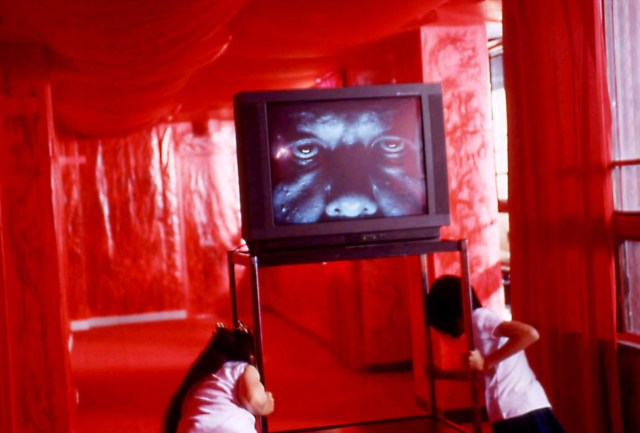 The beauty of Strange Circus lies in the centring of a trans man’s narrative about his body and its traumas. Palmer writes that “the transsexual, on account of his gender ambiguity and his recourse to reconstructive surgery, is vilified on occasion as erasing the division between nature and culture, and scarily heralding the emergence of a world of ‘indifferent creatures, androgynous and hermaphrodite.'” Usually, at least before the 2000s and more so in the 2010s, trans characters were either not explicit in horror or they were coded as monstrous. Julia Kristeva’s theory about abjection is useful here, too. She writes: “It is not lack of cleanliness or health that causes abjection but what disturbs identity, system, order. What does not respect borders, positions, rules. The in–between, the ambiguous, the composite.” In most horror films featuring trans characters up until the mid-2000s, trans bodies were the abject that disturbed identity, system, and order in heteronormative society, seemingly doing away with all the borders, positions, and rules prescribed by hetero-patriarchal values. Sometimes there weren’t even any trans characters and trans viewers had to find themselves, and their bodies, within the horror genre by way of decoding. Islay Burgess, paraphrasing Alice Collins writing for Bloody Disgusting, states that “trans viewers have been forced to learn to decode media because mainstream media has long told us that trans subjects were not welcome.” In Sono’s Strange Circus, there is no decoding necessary. Yuji is a trans man. The only mystery about him is the narrative’s twists and turns to get us to the big revelation near the end. He’s openly allowed to assert himself and to faithfully reconstruct the narrative of his life that his mother attempted to disrupt with her own false narrative.
Yuji tells the body modification group he visits that “scars are flowers” then goes on to say: “My body is a vase. My heart is a flower. I wanted my body to match it.” After this, he bears his top surgery scars, unseen to the audience, to his new friends in the group. Taeko, formerly known as Sayuri, uses her written narrative in order to construct a lie that makes her feel better considering everything she allowed her son to go through when he was still living as Mitsuko. Sayuri uses a new identity for the purposes of a nefarious concealment, whereas Yuji becomes the identity he wants in order to reinvent himself in the image he sees. Yuji’s body itself becomes the narrative. The importance of Strange Circus is in how Yuji’s allowed to properly reconstruct his family’s Gothic history to tell the truth and to tell the story of his true male identity’s foundation.
 Father Son Holy Gore
Pingback: Film Reviews: Classics & More (Nov. 4, 2025) – Online Film Critics Society