

Queer (2024)
Directed by Luca Guadagnino
Screenplay by Justin Kuritzkes; based on the novel by William S. Burroughs.
Starring Daniel Craig & Drew Starkey
Drama
★★★★1/2 (out of ★★★★★)
Luca Guadagnino’s Queer is an adaptation of the novella of the same name by literary American wizard William S. Burroughs, an author and man as complicated as the film’s protagonist, William Lee (played perfectly by Daniel Craig), who’s really Burroughs himself for better and for worse. The film takes place during the 1950s in Mexico City, where Burroughs once lived and studied, and where Lee spends his days amongst a small community of American immigrants doing little more than drink, take drugs, and lust after younger men. When Lee meets Eugene Allerton (Drew Starkey), a former American soldier, his world suddenly becomes a lot bigger. He starts to feel, for the first time, it might be possible for him to finally truly have an intimate bond with another person. The problem is Eugene doesn’t exactly see himself as queer in the way Lee does. Things are difficult for them. When Lee invites Eugene on a trip to South America, their relationship changes forever.
The atmosphere surrounding queerness at the time Burroughs was living in Mexico City, and for a long time afterwards, was that gay men were incapable of controlling their desire; in 2025, there remain people convinced of this, too. After Lee tries to get a straight guy he’s interested in to spend more time with him but winds up rejected instead, the man recounts to a friend that he doesn’t like to be alone with Lee though he feels Lee’s a nice guy: “That’s what I don’t like about queers. You can’t keep it on the basis of friendship.” Gay men were to be feared by hetero men despite how friendly they seemed because there was, in the hetero mind, always the ‘threat’ of queerness encroaching on the relationship. It’s within this climate of fear that Lee wrestles with whether he’ll ever find someone to truly be with and fall in love, or if he’s destined to forever be the lonesome, alienated, tragic queer society seemed hellbent on forcing him to become. In the end, Lee and Eugene drift apart physically. Lee’s left forever haunted by what they felt for one another, if only for a while. He spends his final days wrapped up in a Gothic dream of the past that may, at the very least, provide a slice of comfort as his soul leaves his body and wafts into the universe beyond.
The Centipede & Control
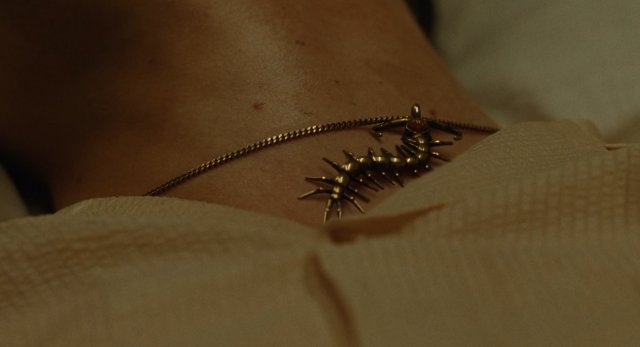 An important symbol in Queer, that appears on one the film’s more prominent posters, is the centipede, and its presence in Guadagnino’s film, in my mind, suggests that the film isn’t for the casual viewer, it’s for the Burroughs die-hards. The centipede is a recurring creature/symbol in Burroughs’s work over the years. In an article titled “William S. Burroughs and the Dead-End Horror of the Centipede God,” Mark Dery writes:
In Naked Lunch, the centipede is associated with depraved pleasures of the flesh, appetites so monstrous they make the mind heave … In The Place of Dead Roads, the centipede is the devolutionary fate of those who succumb to their basest impulses … Obsessively, compulsively, Burroughs returns to the motif of “Death in Centipede,” as he calls it: a victim, presumably a freethinker who dared to challenge the forces of mind control, is lashed to a couch, writhing in helpless terror; looming over him is a monstrous centipede, forcipules at the ready. Control, in Burroughs‘s private mythology, is a cosmic conspiracy, personified by the Mayan priesthood that, in his fabulist reading of history, held the populace in telepathic thrall. Death in Centipede first appears in Queer (written between 1951 and 1953) prompting the author to wonder, ‘Is this literal? Did some hideous metamorphosis occur? What is the meaning of the centipede symbol?’
Paul Wild writes that “the secret of the centipede symbol is that centipedes result from the death of affect, that people bereft of feelings become centipedes.” Ultimately, Burroughs connected the centipede with Mayan priests and their exercises in thought control. The centipede, for Burroughs, is like a repository for all the inhuman ways people are brought under societal control; the antithesis of those who seek to liberate themselves from the control of gender, sexuality, race, class, and more.
Lee’s own discomfort with queerness is a struggle against the control epitomised by the centipede and its continual return, both in Lee’s real life and his surreal dreams. When Lee talks with Eugene about his sexual predilections, he calls it a “curse, been in our family for generations. The Lees have always been perverts.” He goes on to say he feared the “unspeakable horror” of the word “homosexual.” He worried he’d become “one of those subhuman things” and felt terrified by a queer life “which seemed to offer nothing but grotesque misery and humiliation.” He tells Eugene he contemplated killing himself to escape the realities of his queerness: “Nobler, I thought, to die a man than to live on a sex monster.” But eventually he met a woman who helped him understand that he “had a duty to live” in spite of everything. Lee fears the centipede, yet also lives in defiance of it. While he clearly still struggles with certain parts of his own sexuality he refuses to allow the centipede to exert its total control over him. In Queer, the centipede initially appears as a pendant on a necklace belonging to a young man with whom Lee has a brief sexual encounter. The sex is clearly satisfying, but just bodily pleasure; there’s no lasting emotional connection. After Lee and the young man have sex, Lee actually begins to take money from his wallet before realising it’s not that kind of transaction; he’s so used to paying for sex, communicated without a single word in this scene, that he’s detached himself to view all sexual encounters this way. This plays into Lee’s lingering disgust at his own queerness. He sees himself through an internalised homophobic lens, believing that he is, like the young man early in the film says, the kind of queer who cannot simply make friends and always seeking sex, even from men who aren’t queer.
Apart from Lee’s battle with control against the centipede, Lee also sees the centipede’s spectre looming over the lives of others, specifically Eugene. There are several discussions throughout Queer, mostly between Lee and his friend Joe (Jason Schwartzman), about young closeted queer men who can’t reconcile with their own queerness, even sometimes when their homosexuality seems to exceed that of a man such as Joe, who openly flaunts his queerness. In one scene, Joe recalls a story that ended with another man leaving graffiti on the place where he was staying that read “El puto gringo,” effectively a gay slur, and says it’s “always good to advertise.” Eugene, in spite of a passionate sex scene we witness between him and Lee, finds it much tougher to balance what he views as his normal life versus his queer life. He goes from passionately affectionate to, on one occasion, throwing Lee on the floor when Lee tries to touch him. During one night of sex, Eugene even bottoms for Lee. But soon enough he’s at arm’s length, doing whatever he can to stay free of Lee’s smothering affection. Eugene still also goes on a trip all the way to South America with Lee, agreeing to “be nice” to Lee twice a week—code speak for sexual intimacy; the fact they can’t openly say what they mean shows that Lee and Eugene both have issues with their sexual intimacy. Even more than that, Eugene helps Lee through a bad bout of withdrawal while they’re on their trip and Lee can’t get a fix. A sweet and melancholy scene on a cold night sees Lee begging to crawl into bed with Eugene, which they do, cuddling close and yet their alternately barely clothed versus clothed bodies are still far apart existentially. This all comes to a head in the end when Lee’s having a surreal dream tinged with nightmare, as the ageing Lee sees the still-young Eugene with a centipede pendant on a necklace around his neck, the insect writhing and alive, exerting its control over Eugene. The control of heteronormativity is so strong and pervasive that even in Lee’s dreams the centipede wriggles in its ugly power.
Lee’s obsessed with telepathy because of control, too, in that he believes that speaking and defining things is a way to be controlled, which ties into Burroughs’s own feelings about having his sexuality labelled. In an interview, Burroughs once responded to a question about being part of the gay movement by saying something along the lines that he wasn’t gay a day in his life and certainly wasn’t a part of any movement. Burroughs didn’t want to be defined, evident by his writing alone and the techniques he used to create such as the cut-up technique. This is why he, like Lee in Queer, was interested in telepathy: a method of communication that needs not be spoken aloud, words communicated beyond control by language or its structures. Lee tells Eugene, albeit drunkenly and awkwardly in the middle of a party: “I want to talk to you. Without speaking.” Lee later dreams of himself and Eugene, wearing matching clothes, sitting at a table while a piece of paper floats between them. A telepathic connection also collapses the borders between the people communicating. Lee wants to have his borders collapsed and become one with Eugene. We see this manifested in the sequence after Eugene and Lee take ayahuasca: the two men vomit up their hearts in front of one another and proceed to literally get under each other’s skin, their hands inside each other’s skin, feeling and wrapping around the other until they’re nothing but a wriggling ball of skin and bone, a single body, two spirits connected in one mass of flesh.
The Haunted Death-in-Life of Queerness
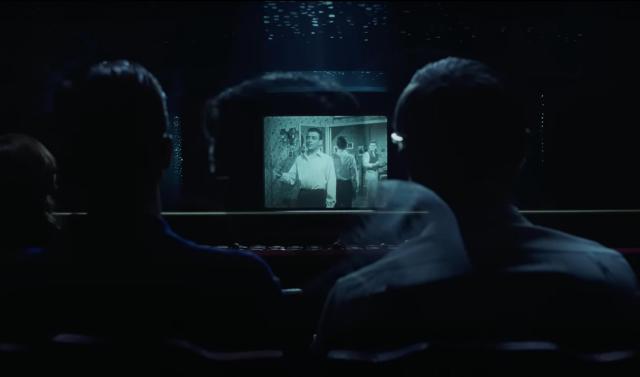 What Guadagnino’s adaptation of Queer does most brilliantly of all is depict the haunted death-in-life of queerness that Lee feels when he’s desperately reaching out for tenderness in a hostile world. When Lee starts spending time with Eugene, his longing is expressed through ghostliness: he sits listening to Eugene while the image of the scene underneath features him reaching out to stroke Eugene’s face, as Lee imagines what he wants to do; later, while the two men sit watching Jean Cocteau’s Orpheus in a movie theatre, Lee again imagines himself leaning in to kiss Eugene, as his body stays still and the ghostly image beneath moves, doing what he wished he could. This is the death-in-life of homosexuality under repression. Yes, Lee does fairly openly lust after young men, but he’s living in a small pocket of Mexico amongst other American immigrants, a number of them also gay. Outside this isolated little life, Lee cannot live openly; he can’t even live in America due to his issues with drugs, let alone his homosexuality. Like so many other men at the time, Lee had to be careful about coming onto men in case he came onto the wrong one, so he reaches out through his mind, imagining what he wants to do through the Gothic image of ghostliness.
Not only are ghostly bodies a part of Guadagnino’s Queer, there are also other bodies in various states of being, the disembodied bodies, both figurative and literal. Lee has a dream including, among other things, a naked woman with no legs (not like she lost them or was born without them, but like a mannequin in pieces) and a needle hanging from one arm. The woman asks “Aren’t you queer?” and Lee responds “I’m not queer, I’m disembodied.” Nearby, the centipede crawls, as Lee touches the woman’s breasts, albeit like he doesn’t quite want to. There’s also a pair of disembodied Black feet with the centipede crawling around one of the ankles. Here, Lee sees the disembodied bodies of people Othered by society, from the addict to Blacks, and meanwhile the centipede of control lurks, like a panopticon unbound by the prison walls. Later, Eugene repeats “I’m not queer, I’m disembodied,” as he and Lee are tripping on ayahuasca together. The uncanniness, for Lee, is monumental, as he feels like the moment was prophesied by his earlier dream, like he and Eugene have somehow communicated telepathically already.
The Lonely Queer(s)
 Nearing the end of the film, Lee returns to Mexico City after two years away—two years since he and Eugene parted after their adventure in the South American jungle, after they became one in the wilderness together. Eugene’s apparently not been seen since heading into the jungle as a guide. Lee longs so badly for Eugene, expressed by Guadagnino through more Gothic imagery of ghostliness. In a dream, Lee sees an Ouroboros snake; the never-ending cycle of his loneliness laid out before him. Then we see the centipede necklace on Eugene, who’s lying in bed under a piece of glass, almost like a body to be autopsied, as if, even in death, Eugene is forever controlled by a heteronormative society.
Perhaps the most Gothic of all in Queer during this feverish dream is an Uncanny revisiting of Burroughs’s own history when he and Eugene play William Tell: Lee shoots Eugene, then holds him until he vanishes, then Lee goes for the door and vanishes. This has eerie real-life parallels to the accidental killing of Burroughs’s wife, Joan Vollmer; they played William Tell during a party to disastrous results. After this dream, we see Lee, now elderly, in a hotel room alone. He pictures a still-young Eugene cradling him while he’s dying, cuddled up like the night long ago when Lee was going through agonising withdrawal on their South American trip and crawled into bed next to Eugene for comfort. Old Lee fades into a multicoloured flash, slipping away as nothing more than disembodied matter into the universe’s vastness. There’s a tender beauty, filled to a sagging point with melancholy, at the end of Queer, marked by a Gothic revisiting of the past by Lee and the ghostly presence of Eugene’s love still haunting his existence, right up to the final breath.
 Father Son Holy Gore