
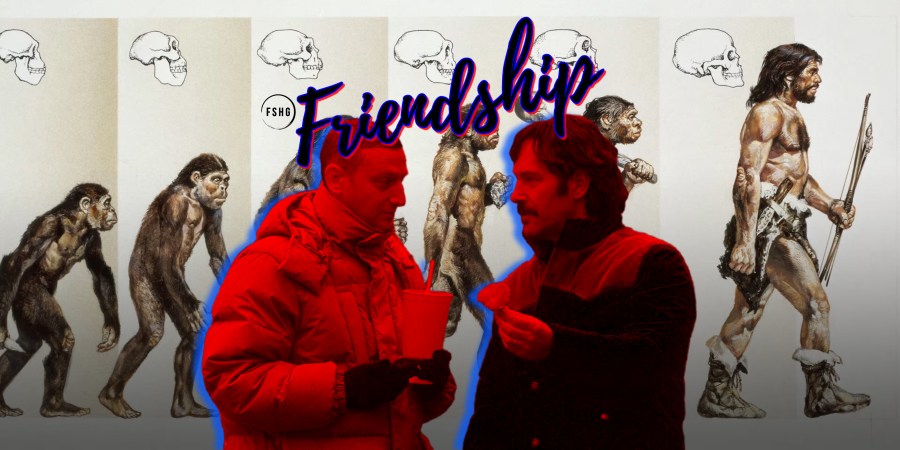
Friendship (2025)
Directed & Written by Andrew DeYoung
Starring Tim Robinson, Paul Rudd, & Kate Mara.
Comedy
★★★★1/2 (out of ★★★★★)
Andrew DeYoung’s Friendship is simultaneously a demented comedy and a genuinely realistic look at 21st-century male behaviour. Craig Waterman (Tim Robinson) and his wife Tami (Kate Mara), who’s recently beaten cancer, are not in the best place. He’s slightly aloof, and it’s bothering her increasingly, so much so she’s been talking a lot with her ex-boyfriend lately. Suddenly, Craig meets his neighbour, Austin Carmichael (Paul Rudd), a local meteorologist who’s got a very different perspective on life from himself. They start to spend a lot of time together and bond unexpectedly. Things take a sour turn after Craig’s invited to hang out with Austin and his buddies, which results in an awkward night that changes the new friendship forever and leaves Craig more alienated than ever.
Friendship is a dark comedy about some men’s inability to grow and change, as well as the depths of male insecurity. Craig desperately wants to connect with another man, but he’s almost entirely incapable of changing his behaviour, except when things have reached the point of no return. Austin, on the surface, is a man not necessarily afraid of change, yet underneath his carefully crafted exterior is a deeply insecure man whose fragile identity is held together by smoke and mirrors. DeYoung’s film is hilarious and wonderfully cringeworthy at times. It’s also an introspective look at men dealing with their own faults, being rejected by other men, and failing to make even the smallest changes to improve their relationships. Friendship would be funnier than it already is if only it wasn’t so insightful. Friendship briefly touches on the evolution of human history in order to highlight male resistance to emotional and psychological evolution. In one scene, Austin shows Craig a “400,000–year–old stone hand axe carved by Homo Erectus,” one of the “first human objects ever made.” Austin speaks of the first people on Earth while Craig reels from the existential weight so hard his nose starts bleeding. While human evolution has come a long way, a lot of men cannot seem to evolve socially, like Craig. Later, Craig goes overboard while he and Austin are supposed to be lightly boxing when a sucker punch knocks Austin out. After this, Austin rejects Craig. In a later hilariously awkward scene, Craig tries to make new friends from work by attempting to repeat Austin’s existential moment with the stone hand axe using a small sword from 18th-century Europe. While this shows that Craig has no real identity of his own and has to riff off Austin in order to try making friends, it’s interesting to juxtapose the stone hand axe with the sword; the axe, at least originally, was a tool for construction while the sword was a tool of violence. Craig simply can’t separate the constructive v. destructive aspects of his own personality, at least not long enough to make people actually enjoy his company.
The centrepiece of Friendship is male insecurity in its various forms. Craig feels threatened by Tami’s ex-boyfriend, but does nothing to change the behaviours that are pushing Tami away and pulling her back to her ex. In the end, he’s just a man-child, and much of his insecurity seems to come from not being able to have a normal adult friendship. We see this best after the incident at Austin’s house with the boxing when Craig, in response to the uncomfortable violence he dealt out and its aftermath, starts eating a bar of soap. Craig reinterprets the classic parent line ‘I’ll wash that mouth out with soap’ but in a situation that calls for far more adult behaviour. He even calls himself a “bad boy.” Similarly, Austin’s also filled with insecurity, which the audience and Craig discover after it’s revealed that he wears a toupee to cover up a glaring bald spot. In a kind of reversal of Craig’s insecurity about being a child and not quite a man, Austin’s insecurity stems from feeling old, and his use of a toupee conceals his male concerns about visibly ageing. Not only that, the toupee reveal is only the beginning of Craig unravelling Austin’s carefully crafted identity. Craig discovers more, like how Austin claims not to have a phone because that’s somehow cool, but later notices that Austin does, indeed, have a phone. Both Craig and Austin are insecure men in their respective ways, though they go about masking and dealing with it far differently.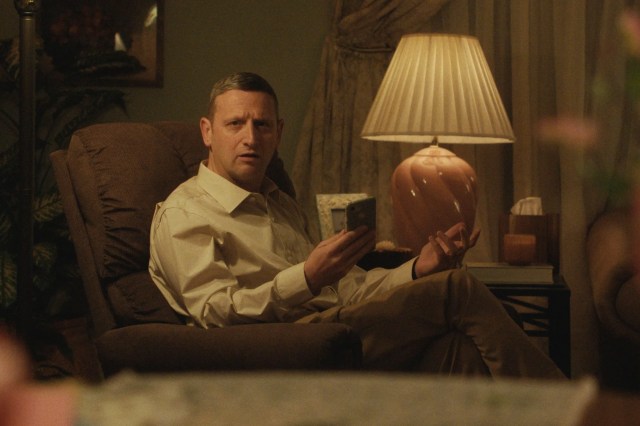 Craig’s so desperate to find male connection that he not only does strange things, he finds any way he can to feel like part of a club or group full of men. He attempts to eat “the full SEAL Team Six lunch at Rick’s Bar” but can’t even fathom finishing everything once it’s in front of him and he starts eating: “It’s the meal the guys ate after they killed Osama and buried him at sea. It’s 22,000 calories.” After everything, Craig says that men “shouldn‘t have friends” but it’s only reactionary. He tries to reconnect again with Austin and the latter’s group of friends once more before things finally go totally haywire, leading to the film’s finale.
By the end of the film, Craig still longs for acceptance from Austin, as he sits handcuffed in the back of a cop car after going off the deep end. While sitting and stewing in sadness, he sees Austin turn to wink at him, making him smile widely. There’s a darkly comic irony present in the finale since Austin’s a narcissistic, insecure man himself, and Craig has still kept his hair-loss secret in spite of everything; a bond between strange, fragile men. Friendship is cringe cinema at its best. Although some critics have read the film as merely sketch comedy translated into feature format, its brutally awkward comedy serves as a reflection of men’s painful social evolution, or a lack thereof. DeYoung understands that one of the biggest struggles men face today is getting out of our own way and learning how to change into better human beings. Friendship is a riotous, intelligent critique of male insecurity, as well as men’s resistance to personal and social growth.
 Father Son Holy Gore
Pingback: Reviews: Friendship (2025) – Online Film Critics Society