
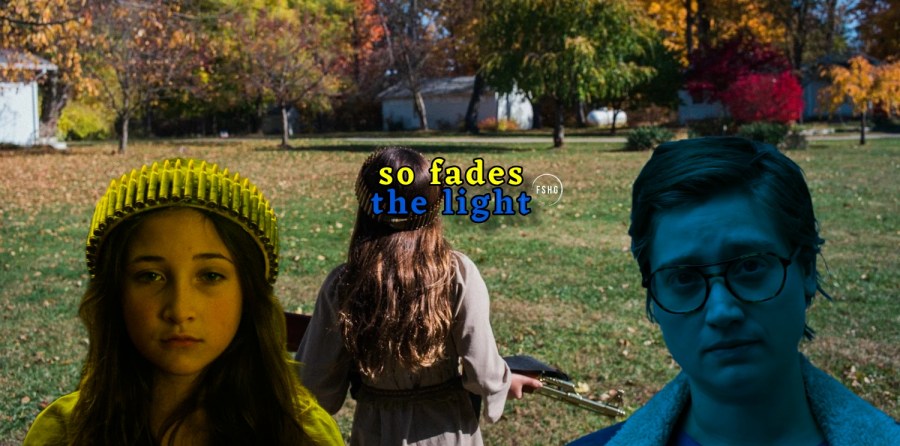
So Fades the Light (2025)
Directed by Rob Cousineau & Chris Rosik
Screenplay by Rob Cousineau
Starring Kiley Lotz, D. Duke Solomon, William Swift, & Ny’Ea Reynolds.
Thriller
★★★1/2 (out of ★★★★★)
DISCLAIMER:
The following essay contains
SPOILERS!!!
Turn back, or be forever spoilt.
Rob Cousineau and Chris Rosik’s So Fades the Light is a story about cults, brainwashing, and trauma that follows a young woman called Sun (Kiley Lotz), fifteen years after the cult she was part of—by whom she was worshipped as a child god—crumbled à la Waco and its leader, The Reverend (D. Duke Solomon), was jailed. As Sun now lives a nomadic life travelling in her van taking on random jobs along the road to keep herself in a little money, she heads back to the old compound her cult called home. What she doesn’t know is that The Reverend has been released from prison and is also heading back to the compound, where they’ll have one last confrontation.
So Fades the Light takes a compelling approach to a story about cults, similar to another film this year Abigail Before Beatrice and 2011’s Martha Marcy May Marlene, in how it focuses on not just trauma but the protagonist’s attempts to overcome the trauma instilled in her by a cult and its leader. Many movies about cults focus on someone still stuck in a cult, or on the cult de-programming aspect, or solely on the idea that someone who escapes a cult will always be caught in its web and will inevitably succumb to some kind of tragedy. While there are many moments in So Fades the Light when Sun’s very clearly still caught in The Reverend’s web, despite how much time has passed, she works towards moving beyond her former cult’s influence. The biggest focus of Cousineau and Rosik’s film is how a man like The Reverend isn’t a romantic figure the way some cult leaders have been presented—even Charles Manson and Jim Jones have been romanticised and glorified in certain ways over the years—he’s just a manipulative, misogynistic creep who’ll use anything and anybody, including a helpless little girl, to achieve his desires. The big question is whether Sun can fully leave The Reverend and the trauma he inflicted in the past. So Fades the Light deals with how cults and cult leaders force unattainable male expectations onto girls and women. The film feels particularly based on David Koresh, his Branch Davidians, and the 1993 Waco siege with suggestions of The Reverend doing very Koresh-like things involving the girls and women in his cult, aptly named the Ministry of Iron and Fire. As a little girl, Sun was called a “God Queen.” She was expected to be a saviour-like figure, emotionally and psychologically burdened with a profound sense of responsibility for the lives of others at such a young age. We witness a flashback of Sun being treated as a god by cult members and the pressure it caused: one sick person questions why Sun wasn’t helping them, as if she really were God and could’ve ended their suffering with a snap of her fingers. In the end, Sun is just another girl/woman who’s been used by The Reverend to further his narcissistic fantasy that God, through her, speaks to him.
The real beauty of So Fades the Light comes from a perspective that pits two faces of religion against each other: the one face that can be beautiful, represented by the people who feel a true sense of duty to their fellow human beings; the other face that can be and often is ugly, represented by the people who want to twist religion into a cudgel they use to beat others down. At the beginning of the film, The Reverend preaches his hatred: “We see the war before us now on the news and in the streets of not just the leftist cities, built in the image of Satan, cities of sin partaking in homosexuality and integrating fornicators against our God Queen. We see these wicked demons in the clean streets of our small towns.” One of the young women Sun meets along her travels believes religion can be a beautiful thing until certain people get involved: “I think it‘s the people that fuck it up.” The Reverend is one of those people. We don’t just see his manipulation of Sun, along with the rest of the cult, we see his overall manipulation of women specifically. One Koresh-inspired scene features a young couple having marital issues receiving counselling from The Reverend when he insists the husband must leave so he and the wife can do “important work … meant only for the eyes of our Lord God.” Later, when The Reverend and Sun meet again after 15 years, his callousness comes through so clearly. At perhaps his cruellest moment during their reunion, he laments losing the cult’s compound but makes no mention of any of those who died for his cause; he only thinks about the damaged real estate, not the damaged, nor lost, lives left behind in his wake.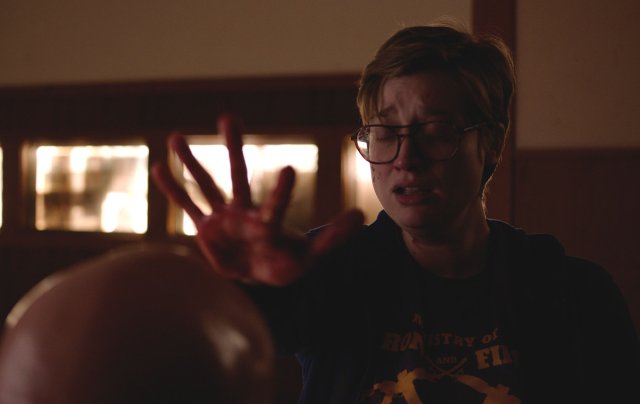 Sun’s trauma is evident throughout the film when she has visions of The Reverend quoting scripture and lurking in the shadowy corner of a room while she tries to sleep; he lives in the darker corners of her psyche. He haunts her, telling her things like: “You will die of your sin.” Her trauma’s not only psychological, it also exists in the preserved form of physical items from the cult’s compound. Sun winds up a gas station that doubles as a museum to the Ministry of Iron and Fire, The Reverend’s cult, where she has a horrifying, uncanny experience seeing all kinds of memorabilia laid out before her, the history of her trauma catalogued; there’s even merch, too. In the end, Sun hands over her trauma to a man; she doesn’t traumatise a man in order to get past what happened to her, rather she figuratively uncrowns and rids herself of the responsibility The Reverend once burdened her with as a child. If it’s men who’ve burdened girls and women like Sun, then it’s men who should carry that burden themselves.
So Fades the Light is traumatic and unsettling, yet finishes with hope. Sun relieves herself of a great burden and though her trauma will never disappear it will hopefully continue to lessen. What’s greatest about the film’s ending is that when Sun gets back in her van weeping we can hear echoes of religious hymns in the background, but she cuts them off, then songs from a mixtape she was given earlier begin to take over as her internal soundtrack. Earlier in the film, Sun meets a group of young people, one of whom gives her the mixtape later, and we begin to understand that she’s been so sheltered over the years in the cult that she doesn’t even know Dolly Parton. The subtle moment at the end when the mixtape songs break through the hymnal fog in Sun’s mind shows that she’s slipping free of The Reverend’s existential grip and, contrary to the film’s title, she’s finally able to start letting the light shine through all the darkness of her trauma.
 Father Son Holy Gore