
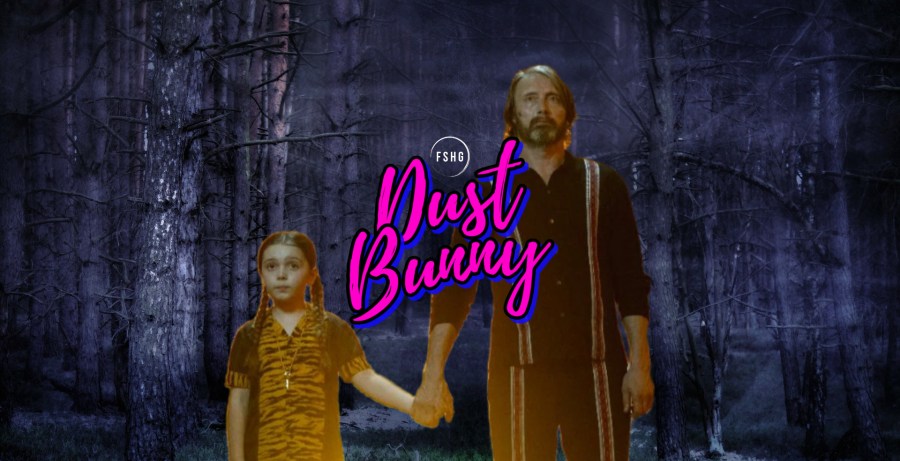
Dust Bunny (2025)
Directed & Written by Bryan Fuller
Starring Sophie Sloan, Mads Mikkelsen, Sigourney Weaver, Sheila Atim, & David Dastmalchian.
Action / Fantasy / Horror / Thriller
★★★★ (out of ★★★★★)
DISCLAIMER:
The following essay contains
SOME SPOILERS!
Peek under the bed only if you dare.
In Bryan Fuller’s theatrical directorial debut Dust Bunny, young Aurora (Sophie Sloan) believes her family’s been eaten by a monster lurking under her bed, so she sets out to solve the mystery by asking her reclusive neighbour, Resident 5B (Mads Mikkelsen), if he’ll help. Little does Aurora know, Resident 5B is more than reclusive, he’s part of a dangerous underworld of people who understand life and, more importantly, death as a series of economic transactions. Aurora’s belief in a monster under the bed starts to chip away at the reality Resident 5B believes in, and their journey together alters them both significantly.
Fuller’s always been an imaginative, innovative mind, which is hard to deny if you’ve seen Hannibal, American Gods, or Pushing Daisies, so it’s no surprise Dust Bunny is an incredibly creative work of art. More than innovation and creativity, Dust Bunny is a thoughtful, heartfelt, and beautifully bizarre look at how the worlds of children and adults collide. Most of all, Fuller’s film sweetly addresses the idea of finding a chosen family, no matter who they are or how we find them; it’s not solely about blood or family ties, it’s more often about who is willing to love us they way we deserve to be loved and what people are willing to put on the line to protect us.
 One of the best aspects of Dust Bunny is the juxtaposition of Aurora’s understanding of a monster v. adults’ understanding of a monster. Aurora sees the monstrous dust bunny under her bed as very real, not a metaphorical monster, whereas Resident 5B, Laverne (Sigourney Weaver), and others see the real-life monstrousness of people. Gradually, these two worlds and understandings of monstrosity collide. Yet underneath it all, Aurora’s monster can still be read metaphorically as the monstrous callousness of adults. It becomes a real, living monster from the lack of love Aurora was shown by the families meant to love and protect her. Aurora has tracked a monster through the lives of various people, not only her foster families, due to how she’s been disregarded by others. Laverne puts it succinctly in brutal fashion when she mentions “delayed personhood“—the concept that babies/kids are not people yet, so they have no rights, et cetera—and plainly says Aurora isn’t “a person yet” so she really doesn’t matter. Laverne becomes the epitome of Aurora’s issues with adults, and it’s something we see in real life with the way many adults treat kids: grown people frequently forget that children are people, too; the more we treat kids like their thoughts and feelings are unimportant, the more monstrousness will continue to creep into their lives and the lives of those around them.
When Resident 5B tells Aurora the monster is her responsibility, he explains: “You wished for it. You have to live with it.” In the end, Aurora ultimately has to contend with the monster in her own head. At one point she explains she wished for the monster to eat her previous families because most of them were not nice to her; she’s clearly spent a lot of, if not all of, her young life in foster care. She thinks the monster eats any foster family in her life, regardless of whether they’re good, because she doesn’t deserve a family. We also get glimpses of Resident 5B’s past. Through Laverne, we understand Resident 5B sees his younger self in Aurora, and at one point he calls Laverne “mom,” probably because she’s the only maternal-like figure he’s had in his life, though not a positive one. Through Dust Bunny‘s events, we see that Resident 5B and Aurora have each dealt with monsters in their own way, leaving them both wounded hearts seeking family, love, and tenderness wherever they can find it.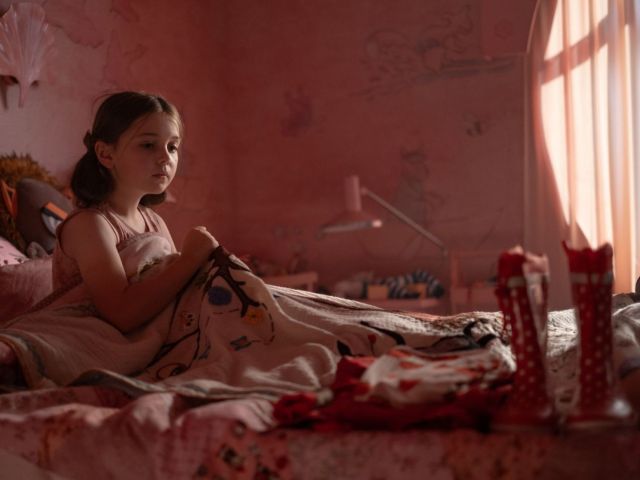
Aurora: “I know what‘s real”
Resident 5B: “No, you think you know.”
Aurora: “You think you know.”
The ending, without spoiling anything outright, suggests Aurora won’t ever be entirely free of the monster under her bed; it will continue to follow her. It’s really all about Aurora fighting back the feelings of being undeserving of love and care. Thankfully she finally finds a kindred spirit and parental figure in Resident 5B, whom she earlier calls her father when someone comes knocking at her apartment door. The hope is that Aurora and Resident 5B can love each other and heal from their troubled childhoods. Dust Bunny is a hopeful piece of fantasy horror that urges us to find the people who care for us, no matter where we find them; love is the only way to fend off the monsters under our beds and in our heads.
 Father Son Holy Gore
Pingback: Reviews: Dust Bunny (2025) – Online Film Critics Society