
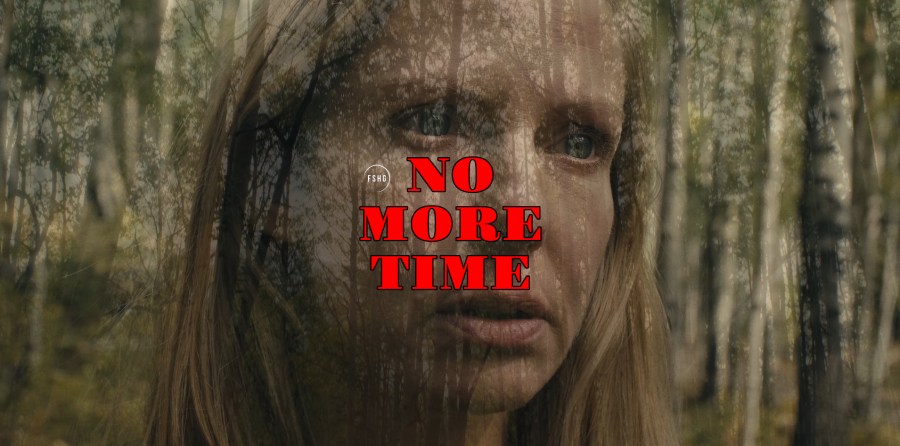
No More Time (2025)
Directed & Written by Dalila Droege
Starring Jennifer Harlow, Mark Reeb, Tunde Adebimpe, James Babson, John Cowan, Lindsay Sparks, David Sullivan, & the voice of Jim Beaver.
Thriller
★★★1/2 (out of ★★★★★)
DISCLAIMER:
The following essay contains
SOME SPOILERS!
Avert thine eyes lest ye be spoilt.
Ever since the start of COVID-19, we’ve seen new films and TV shows dealing with everything from lockdown boredom to the spread of new viruses to reactionary responses and more. Dalila Droege’s No More Time deals with a fictional disease that’s turning some people into murderers and making others disappear entirely. The film centres on Hilaire (Jennifer Harlow) and her husband Steve (Mark Reeb) as they find a place to stay in a tiny town while they travel across a decaying America. They meet new folks like Noah (Tunde Adebimpe), a mask-wearing man whose wife has disappeared, and Jason (John Cowan), a divorced, mask-hating bigot. Hilaire and Steve do their best to stay safe, but in this new America, it’s more and more difficult to determine who is a safe person to be around.
No More Time was made back in 2022 but not released until now, and that’s actually perfect since while Droege’s film deals with a lot of early COVD-19 pandemic themes, it’s just as much an excellent portrayal of how deeply divided America is in 2025, not only over COVD-19 but so many other things. Hilaire and Steve eventually face a divide in their relationship, too, which explores how the pandemic tore society apart and also tore people apart on an individual level. No More Time somehow comes across with hope by the end, as Droege seems to ruminate on how humankind can learn something from the natural world, if we can just stop arguing for a moment. What’s most haunting about the film is that ultimately pushes us to consider whether human beings are a virus, a plague thrust upon nature.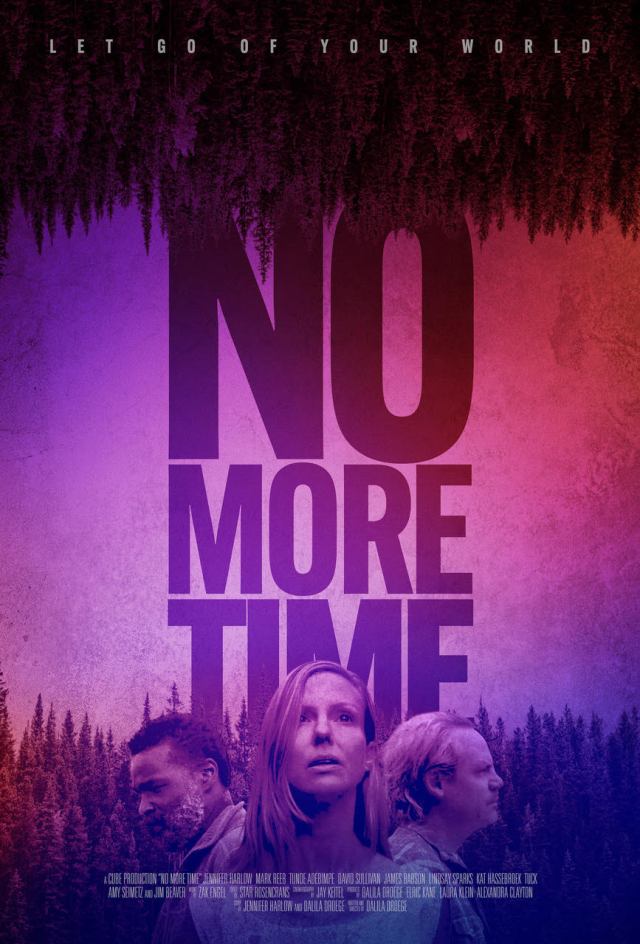 The great hypocrisy of people, not just Americans, in the face of COVID-19 is dealt with throughout No More Time. First we hear a clearly right-wing radio host on his pulpit preaching to the masses. He blabbers on about how he’s bringing people “the truth, not the news” but then rails on “those hiding behind a mask” and says “fuck ‘em” when talking about people taking precautions against the viral outbreak. He’s angry at the news yet immediately uses his radio platform to broadcast his bias. This is exactly like real life: people complain the media is biased while simultaneously ignoring anything that doesn’t affirm their already deep-seated beliefs. Most clearly, Droege’s film deals with pandemic hypocrisy through Jason, who calls someone he kills a “mask–wearing faggot.” He has the nerve to later give a racism-tinged rant about how people will go “back to living like savages” if they don’t work together; reminder, this is after we’ve already seem him commit a murder. No More Time captures the hypocrisy of so many right-wing reactions to the COVID-19 pandemic. They accuse everyone else of trying to divide people, then there’s Jason killing people wearing masks, or a woman shows up at the house where Steve and Hilaire are camping out who sneaks her way inside before trying to force them out of the place, calling them snowflakes and “fascist fucks.”
The whole ‘nature is healing’ phrase online that remains a meme was actually, underneath the memeification, a serious note about the natural world returning to momentary peace and regrowth while the industrial human world halted during the early days and height of the COVID-19 pandemic. Droege addresses this in No More Time through the plot detail that at least some people in the film’s self-contained world are disappearing, as if into thin air. When Steve first meets Noah, the latter mentions his wife has disappeared; this doesn’t get much attention until later at the end. As a brutal act of violence is committed, a bird sits atop a branch, then flies over the landscape, above the peaceful animals living their everyday lives. Then Noah comes face to face with a deer. He has a moment of what feels like recognition; his eyes and face warm while he stares at the deer and the deer stares back at him. Does he recognise the deer? Has his wife disappeared then her soul took up residence in an animal? Or is Noah recognising that cycles of life, death, disease, and decay are merely the natural process and, to the deer, all this is merely another phase of the world? Droege’s film is poetic at times, most certainly at the end.
At times, Droege frames various shots upside down—one exceptional shot features a landscape image of the forest both right-side up and upside down as they merge into one—a very literal illustration of the world being turned on its head during the COVID-19 pandemic. No More Time envisions a pandemic in which human behaviour is the ultimate form of destruction. It’s interesting to consider the final few images in Droege’s film featuring the natural beauty of landscape and the roaming animals in juxtaposition with all the preceding scenes of human interaction, many of which involved violence. No More Time is truly a film about the virus of humanity. It’s an existential exploration of the fact that no matter how far advanced humans become technologically or medically, people will still find a way to destroy everything and each other, yet nature will outlast us, absorb us, and continue on in some shape or form while we’ll fade into the obscurity of time as a violent, destructive aberration from nature.
 Father Son Holy Gore