
Something of a Monster (2025)
Directed by Brandon Duncan
Screenplay by Hyten Davidson & Christian Missonak
Starring Ashley Bacon, Rebecca Ana Peña, Ameerah Briggs, Joy Avigail Sudduth, Hyten Davidson, & Greg Brostrom.
Thriller
★★★ (out of ★★★★★)
DISCLAIMER:
The following essay contains
SPOILERS!
You’ve been warned.
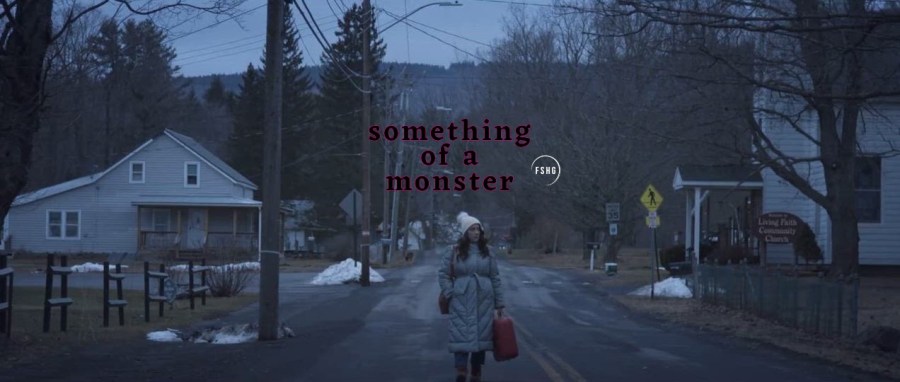
The pressures and troubles of motherhood have been big this year with festival premieres of films like Mother’s Baby and Nesting (a.k.a Peau à Peau), so Brandon Duncan’s Something of a Monster fits right in while it also sits slightly uniquely apart from the other two titles because of how it deals with a phantom pregnancy and what the experience of such a pregnancy does to the would-be mother. In 1984, Amelia (Ashley Bacon) is sent from North Carolina to the Catskills by her mother-in-law, where she stays at a remote inn looked after by Wendy (Joy Sudduth) and Robin (Ameerah Briggs). Her phantom pregnancy is seen as something shameful, she’s deemed crazy, and everyone now treats her like a fragile piece of china. Up in the Catskills, Amelia doesn’t exactly find any peace and quiet to heal. She’s sure she sees a woman in the woods at night, though nobody believes her. The situation eventually escalates from a few strange occurrences to outright danger.
Something of a Monster explores the expectations forced onto women from an interesting perspective focused on Amelia’s phantom pregnancy and all the condition suggests about not just her situation but the situation of many real-life women who have to deal with everyone transferring their own ideas about what’s normal onto their lives and their bodies. Amelia and another woman in the film are each dealing with phantom pains: one is dealing with a phantom pregnancy born of all the expectations put upon her to be the ideal woman for her husband; the other is dealing with the lingering grief of a lost child she cannot shake while everyone ignores her and the memory of what happened to her child. Something of a Monster is about how far some women are pushed and then often abandoned by those who pushed them beyond their limits, leaving them adrift and sometimes seeking comfort in the strangest places.
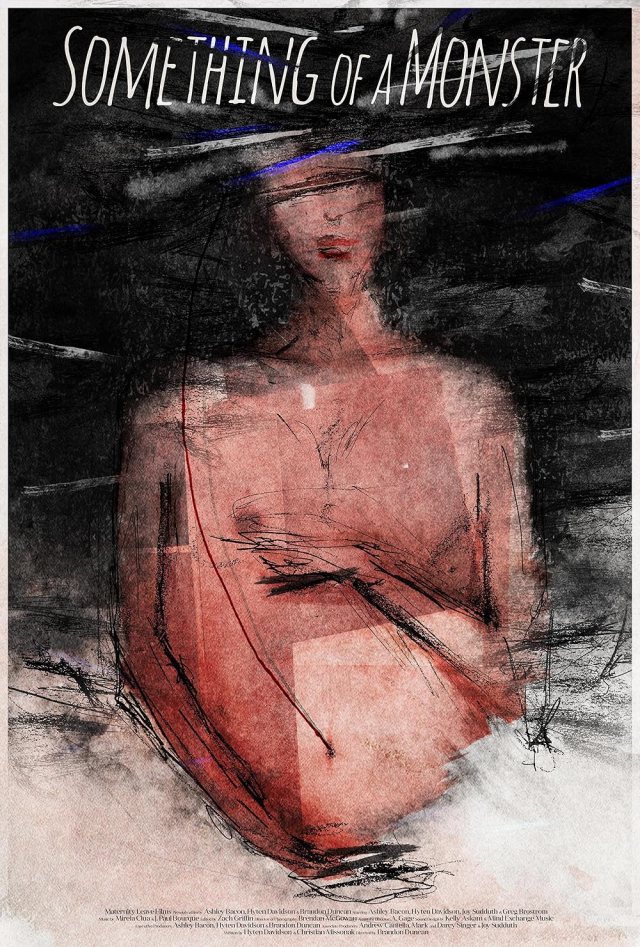 Amelia’s body and her mind are treated equally poorly throughout Something of a Monster. Amelia’s already tortured psychologically, as she experiences recurring nightmares about her phantom pregnancy: she first dreams of her baby crying and trying to pick it up but her hands are full of dirt, then the baby disappears and there’s nothing but snow left in the bassinet; she later dreams of the bassinet filled with melted snow and the baby’s clothes float in the water. Apart from her own headspace, nearly every single person around her seems intent on judging her as a bad or crazy person because of the phantom pregnancy. Robin passes judgement on Amelia’s body and her psychological state, first saying it’s hard to believe how pregnant Amelia looks, then comments about talking to her at the wedding and “she seemed regular” before questioning how Amelia’s husband Josh (Greg Brostrom) could “marry a crazy lady.” The saddest, most anger-inducing moment when Amelia’s body and her mind are judged is after she goes to see a local doctor in the Catskills who tells her: “Your body create something of a monster—tricked you into thinking you‘re something you are not. It‘s fantasy.” From the personal to the professional, Amelia is dismissed, treated with a sense of disgust, and labelled crazy by everyone she encounters. One person unexpectedly helps her in the end.
Past this point is a fairly significant spoiler.
The woman in the woods is in fact very real and her name is Genevieve (Hyten Davidson). We discover that her child died at the inn years ago, but because the town of Woodgrove “survives on tourism, on being idyllic and charming,” nobody talked about Genevieve or what happened to her child. Woodgrove was so intent on burying the past that the pool, where the child died, was eventually filled in with cement. The town refused to acknowledge Genevieve or her grief. She was eventually exiled to the woods rather than given support. Amelia’s disgusted by the way Wendy bangs pots and pans at Genevieve to drive her off “like she was an animal.” Genevieve’s grief, like Amelia’s phantom pregnancy, is treated by others like something worthy of shame. Amelia seems like she could someday wind up like Genevieve if people continue to isolate her. Thankfully, she finds solace in reaching out to Genevieve. In the process she has to finally confront the reality of her own psychological state instead of running from it. One poignant scene features Amelia having to fake going into labour as a diversion tactic when Genevieve appears to them as threatening. She later tells Genevieve about her sense of loss due to believing she was pregnant yet never actually having a baby inside her, describing her growing belly like “a grave with no body.” Amelia and Genevieve find comfort in one another when they find no warmth from anybody else.
What’s real to us in our minds is real. It doesn’t matter if it’s literally real because, as John Milton wrote in Book I of Paradise Lost, “The mind is its own place, and in it self / Can make a Heav’n of Hell, a Hell of Heav’n.” Something of a Monster deals with two women who are so depressed by loss, whether figurative or literal, to the point they’re driven to psychological extremes. Amelia’s mental state becomes a physiological response, and Genevieve’s physical loss of a child results in a tortured psychological response. Both women at the film’s centre simply needed care, tenderness, and understanding instead of the brutal reactions they received from others. The film is actually beautiful underneath the phantom terrors of grief and loss. Genevieve and Amelia find hope to carry on and move beyond what’s happened to them after everything they’ve been through, though the enduring haunting in Something of a Monster is that women like them exist in real life and far too many of them never find any such hope unfortunately.
 Father Son Holy Gore