
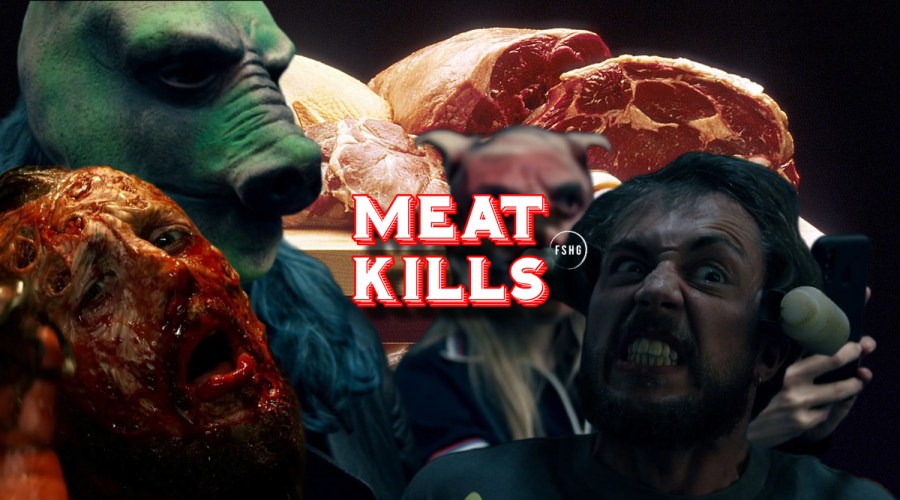
Meat Kills (2025)
Directed by Martijn Smits
Screenplay by Paul de Vrijer
Starring Caro Derkx, Emma Josten, Sem Ben Yakar, Sweder de Sitter, Derron Lurvink, Bart Oomen, & Chardonnay Rillen.
Horror
★★★★ (out of ★★★★★)
DISCLAIMER:
The following essay contains
SOME SPOILERS!
Turn back, or you’ll spoil the meat.
Martijn Smits’s Meat Kills follows a young woman called Mirthe (Caro Derkx) as she works towards joining Animal Army, a group of militant vegan activists. Mirthe gets a job at a local pig farm so she can film evidence of them “violating EU welfare regulations.” This gets her in with Animal Army, but she really has no idea exactly what the group, led by Nasha (Emma Josten), is planning to do next. The activists soon raid the farm, pitting them against the owner, Jonas (Bart Oomen), along with his sons Jonathan (Sweder de Sitter) and Jacco (Derron Lurvink). At first, the activists are just there to gather more footage of the farm’s nasty practices, then Nasha quickly leads them down a violent path that Mirthe feels is going much too far. When Jonas fights back, everything spirals into grisly chaos.
Meat Kills is over the top in its depiction of militant vegans, yet reflects a deeper societal rift related to how cultural discourse has divided into extremes on all sides of politics. That doesn’t mean Smits’s film tries to legitimise right-wing views or anything of that nature. Instead, the film points a finger at anybody, part of any political wing, who thinks that cruelty and torture is a legitimate method of creating peace. The film makes us think about the acceptability of political violence in general, too. Meat Kills will definitely start a few cultural conversations amongst the sociopolitically engaged, and it’ll likewise satisfy a lot of horror hounds who are merely seeking a few bloody thrills.
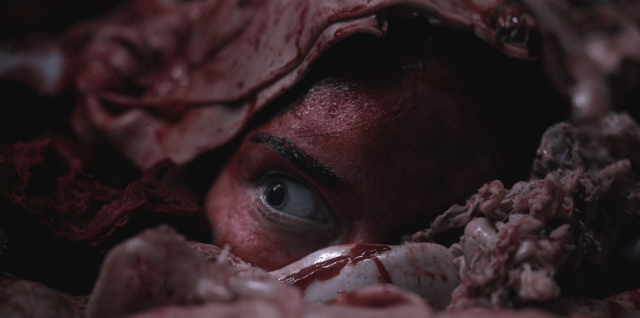 Although Meat Kills depicts people on different sides of the political spectrum, the film deals directly with certain issues on the Left. I consider myself a Leftist, but the Left overall has long had a major issue that doesn’t help any of their causes, and that’s a tendency to cannibalise our own because they don’t pass purity tests of belief; something depicted in Meat Kills through Nasha’s treatment of the other activists, particularly Mirthe. Nasha yells at Mirthe for not wanting to torture and murder other humans in the name of their cause: “You’re just as bad. You just act as if you’re good. But you’re evil.” She says this without a shred of self awareness about her own hypocrisy. Hypocrisy is a large part of Meat Kills on all sides, as we see Nasha and Jonas’s respective hypocritical views. Jonas earlier defends his farm’s practices to Myrthe like they’re being kind to the animals they kill, and we later see a sign on the pig slaughterhouse that reads “With pride, we work on top quality, animal friendly produced food,” suggesting there’s an animal-friendly method of murdering animals so they can be eaten. Neither side on display in Meat Kills is righteous.
While many will disagree strongly, political violence is acceptable when it comes from the oppressed’s side, though at the same time there are certain forms of violence, like torture and sexual assault, that are simply unacceptable, no matter against whom it’s used. Many people like to say that rapists should be subjected to rape themselves, but to use any form of sexual violence, against anybody, is to condone it as a viable form of violence, and any enjoyment of such violence is a degradation of the soul. In Meat Kills, Nasha turns the violence done against animals onto humans and, in spite of her intentions, legitimises the same torture humans use against animals. In one scene, Nasha tags Jonathan’s ear the way pigs have their ears pierced and tagged in the slaughterhouse. In a much more brutal scene, Nasha uses an electric device on Jacco’s temples that’s used to sedate the pigs, and shocks him until he screams like one of the pigs. We can relate the violence in Meat Kills to the way the death penalty is treated in many countries: violence begets violence begets violence. We can’t solve or curb brutal crimes by committing more brutal crimes, especially when the death penalty has become fetishised in places like America where executions are treated like sporting events, including a seating area where people can watch death up close. In the same sense, Nasha can’t stop animal cruelty by being cruel to human animals, either, and especially when she appears to take great pleasure in it.
Meat Kills will likely divide people, especially those who read the film as an attack on only the Left. In the end, the film doesn’t force anybody to choose sides because both sides, represented by Nasha and Jonas, are equally cruel and violent. As I wrote previously, I do believe that political violence by the oppressed is acceptable, albeit only in certain forms. Luigi Mangione gunning down the CEO of a for-profit company that has denied coverage to countless Americans, many of whom went on to die, is an acceptable inevitability and has already resulted in change by scaring corporate America. The government torturing political prisoners, or fellow inmates sexually assaulting a rapist in jail, is unacceptable in its legitimisation of torture and sexual violence. We can argue forever about why I feel murder is acceptable when it’s beating back oppression and torture/sexual violence isn’t acceptable in any form, but then many people will have to explain why they also accept sending soldiers to the other side of the world to murder other soldiers and civilians, or why they write off the unending murders of children at the hands of Israel as somehow merited. Meat Kills is a smart, gory film that forces us to seriously look at the pain human beings cause, to ourselves and to animals, even though it doesn’t offer any easy answers.
 Father Son Holy Gore