
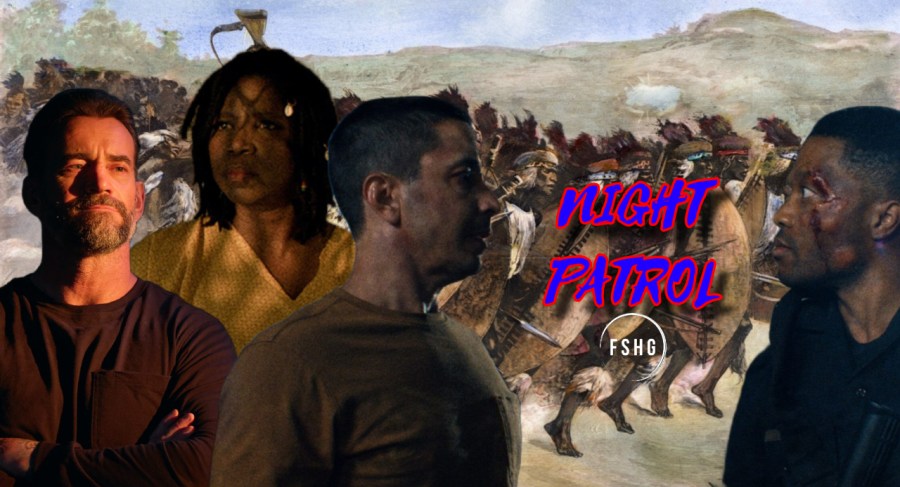
Night Patrol (2026)
Directed by Ryan Prows
Screenplay by Prows, Tim Cairo, Jake Gibson, & Shaye Ogbonna.
Starring Justin Long, RJ Cyler, Phil Brooks, Dermot Mulroney, Jermaine Fowler, Nicki Micheaux, & Flying Lotus.
Horror
★★★★1/2 (out of ★★★★★)
DISCLAIMER:
The following essay contains
SOME SPOILERS!
You’ve been warned.
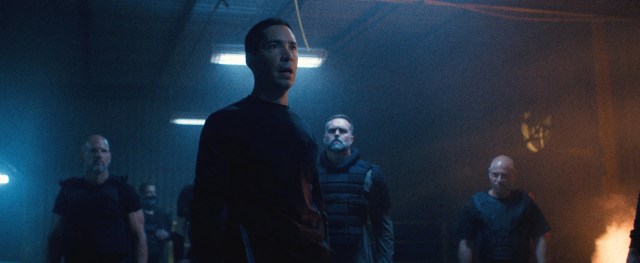
In Ryan Prows’s Night Patrol, several stories come together: a cop named Hawkins (Justin Long) is brought into the fold with other white cops by a Deputy (Phil Brooks) for a violent, racist night patrol shift; Wazi (RJ Cyler) is a young man mixed up in the local gang scene while his brother Xavier (Jermaine Fowler) is a cop and their mother Ayanda (Nicki Micheaux) leads a gang of Crips who represent their Zulu heritage. They all collide when Wazi realises his mother’s been right for years: the local cops aren’t just nasty racists, they’re literally inhuman monsters. Then, the fight for the neighbourhood and city begins.
Prows’s debut feature Lowlife was a gritty, powerful piece of work that confronted the dangerous realities of multicultural America, even more important now in 2025 than in 2017, and now Night Patrol goes further by dipping deeper into the horror genre, using the vampire to deal with a monstrous overreach of police power. The film leans deep into history, not just with the vampire, since the patrol of white cops at the story’s centre dredges up memories of America’s pre-Civil War past and the emergence of contemporary U.S. policing. Prows taps into the 21st-century American zeitgeist at the perfect time with new videos appearing online everyday of masked ICE agents storming neighbourhoods and at times using deadly force to oppress Black, Hispanic, and Indigenous peoples. Night Patrol plays with the gothic figure of the vampire alongside American history to confront how little the country has progressed over the past 160 years, and to deal with the rightful growing rage of communities tired of living under the thumb of white supremacy. To some, the eponymous crew of night cops are an extreme version of real American cops, though in reality they’re actually going back to the foundations of contemporary American law enforcement in the infamous slave patrols. Slave patrols go back to 1704, when the first such patrol was begun in South Carolina; the concept eventually moved into the thirteen colonies until the abolition of slavery after the Civil War. White men would patrol the Antebellum South with guns and whips to police enslaved Black people. The Deputy and his band of white cops are out at night patrolling to find, and typically murder, Black people exclusively. At one point, Prows and his co-writers make clear how American policing plays into the country’s historical reliance on violence when the gang members attempting to defend their community—blocks of apartments aptly named Colonial Courts—realise the cops are using signal jammers to prevent any calls going out: “Isolate and destroy. It‘s textbook ethnic cleansing tactics.” Bram Stoker’s Dracula has frequently been read by scholars as a narrative about fears of a reverse colonisation by various Others outside of the British Empire, the same fears espoused by many right-wing racists today related to immigration from America to the U.K. to Australia, whereas Night Patrol positions the vampire as purely a white coloniser trying to wipe out a marginalised community.
Prows presents vampires not as an Othered group, like they’re frequently depicted in Gothic fiction, rather they’re a group with power and authority guided by their whiteness. In Night Patrol, vampirism represents white supremacy. The Deputy explicitly tells a bunch of caged Black people about to have their blood sucked that they’re “dog shit on the heel of America‘s boot.” Hawkins Sr. (Dermot Mulroney) espouses many racist views while laying out the grand mission for his group of vampires, calling the Black community “vermin” and stating that the vamps must use steel teeth so their real ones won’t touch the “unclean flesh” of “the low beasts of the field.” He refers to the cops as guardians of “civilisation” against “the unwashed.” There’s also a heavy use of Christianity on Hawkins Sr.’s part, which is interesting since most vampire fiction tends to present Christianity as a weapon used against vampires; here, it’s part of a vampiric whiteness. Hawkins Sr. tells a new vampire: “This is your baptism. Wash yourself in blood.” The ultimate cure for all this weaponisation of whiteness and Christianity is Black culture and Black spirituality, represented by Ayanda and her adherence to Zulu mysticism. One of the only ways Wazi is able to fight back against the white vampire cops is by finally embracing the ways of the Zulu like his mother.
 Ayanda tells Wazi and the others: “Our jewelry, our weapons, our culture—that‘s the enemy’s weakness . . . One thing the colonisers all fear: our Blackness.” This cultural approach is twofold: it’s both how the protagonists of Night Patrol deal with the white cop vampires, and also how real-life, non-white Americans push back against the continual creep of white supremacy. While White America and its various forces use very real, very brutal violence to police non-white people, it also engages in a never ending culture war that’s constantly trying to twist aspects of Black, Indigenous, Hispanic, Arab (and more) cultures into warped narratives to isolate them and portray them as dangerous/’uncivilised.’ This is why it’s necessary for people to continue expressing their own cultures, and to continue using their cultures as methods of resistance, because by refusing to cut themselves from their roots they’re refusing to allow the spread of white supremacy’s necropolitical rot. Night Patrol is one of the most powerful genre films of the 2020s. Prows deals with the racism that America continually tries to convince itself no longer exists by portraying White America’s monstrosity through a timeless gothic monster that never seems to stop draining the life out of Black (or Hispanic, or Arab, or Indigenous) communities.
 Father Son Holy Gore