

Honey Bunch (2026)
Directed & Written by Madeleine Sims-Fewer & Dusty Mancinelli
Starring Grace Glowicki, Ben Petrie, Jason Isaacs, Kate Dickie, & Julian Richings.
Horror / Sci-Fi / Thriller
★★★★1/2 (out of ★★★★★)
DISCLAIMER:
The following essay contains
MINOR SPOILERS!
Turn back or be spoilt forever.
Madeleine Sims-Fewer and Dusty Mancinelli’s Honey Bunch is a unique tale about Diana (Grace Glowicki), a woman who had an accident that put her into a coma and is now being taken by her husband Homer (Ben Petrie) to a remote trauma centre to help her heal. At the centre, the married couple meet others who are there for treatment and it appears to be a place where genuine healing occurs. But as Diana begins to unravel what’s happened to her, she finds out more about Homer that colours how she views their marriage. Not only that, she finds out secrets about the trauma centre that make her question reality itself.
Honey Bunch dips into the world of literature, from a brief reference to Daphne du Maurier’s 1938 gothic novel Rebecca to a much more lengthy overall reference to Homer’s The Odyssey, in order to tell a story about the forms control can take when love is involved, especially patriarchal control. Although there’s a romantic element to the story Sims-Fewer and Mancinelli tell, there are far more unsettling elements lurking in the background of that romance. Honey Bunch is a story about love and devotion. It’s just as much a story about how devotion can be warped into control that limits a loved one’s autonomy, even if the one devoting themselves to their love has the best of intentions.
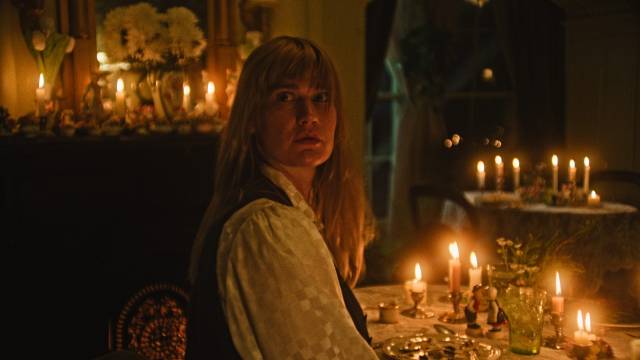
Honey Bunch makes several connections with Ancient Greek literature which immediately come up when Homer quotes directly from the writer Homer’s text The Odyssey, telling Diana: “Take courage, my heart, you‘ve been through worse than this.” Diana replies: “Am I supposed to be Odysseus or something?” The biggest connection here, apart from the character Homer bearing the Greek writer’s namesake, is when we discover the name of the remote clinic where Diana’s gone for treatment: Retrouvailles. The word ‘retrouvailles’ is French and means a joyful reunion or rediscovery of someone/something after a long absence. This French word at once calls us back to Odysseus and his return home after the Trojan War, and likewise plays into Diana’s own reunion with/rediscovery of herself, albeit both Odysseus and Diana deal with things that are not joyful whatsoever in their figurative/literal journeys home.
Homer, the husband, takes the place of Homer, the great Greek writer, but not in any heroic sense, rather he helps illustrate issues connected with patriarchy and the treatment of women in both real life and literature. The Greek Homer wrote women into narratives in which they were often (though not always) relatively powerless. Homer the husband writes Diana into his own narrative in which she, at least for a time, is entirely powerless. While there are dissenting women who don’t/won’t follow Greek patriarchal ideals in Homer’s work, such as The Odyssey, many times Homer presents a dichotomy of good v. bad women; the good women are those who conform to Greek society’s patriarchal constructs, the bad women are those who do not conform, which creates a hierarchy of womanhood. Diana’s husband falls into a similar trap. Homer expects Diana to be a certain type of woman, one who always expresses the words “I love you,” but Diana doesn’t think she needs to always say the words for him to understand she loves him. She brings up the spectre of patriarchy hovering over her husband when she says: “Why don‘t we put the word ‘obey‘ back into our vows, as well?” Apart from expected behaviour in women, Homer, among other Greeks, often focused largely on a woman’s looks, too. This is where Honey Bunch touches on connections between the patriarchy of Ancient Greek literature and contemporary society. In one scene, Diana and Homer talk about the idea that beauty changes, but Diana believes that if you love someone they’ll always be beautiful, whereas she believes Homer is too focused on “the aesthetic deterioration of a woman.”
While the eventual reveal of what’s happening in the film paints Homer in a different light than at the beginning, Homer has still dictated his relationship with Diana on patriarchal terms, making decisions for her solely due to his own feelings and without her input. At nearly every turn, until almost the very end of Honey Bunch, Homer reinforces a harmful patriarchal system that robs his own wife of choice and bodily autonomy. In one comical yet telling moment as Homer and Diana talk outside, she has to tell him that he’s “standing on a dead woman,” as he notices he’s right atop a grave. Honey Bunch does a fantastic job, through a story that’s equal parts gothic horror and science fiction, of exploring how love can be a beautiful thing but can also lay bare a person’s issues with control. Madeleine Sims-Fewer and Dusty Mancinelli probe the depths of their story to question how far a person will go for love, though simultaneously question whether someone can go too far, and whether they’re doing it for the person they love or, all too often, more for themselves. After all, the Trojan War was technically ‘fought over a woman,’ but it was brought on and fought by men, more about male pride than love of a woman. Helen had no say; she was treated as an object, a prized possession. Similarly, Homer’s actions in Honey Bunch are what precipitate the plot of Diana’s personal odyssey; she, like Helen of Troy, had no say in the matter, either. What’s ultimately at stake in the film is Homer’s attempts to alleviate his own burden of loss, and the result, while not a Greek tragedy, is certainly tragic.
 Father Son Holy Gore