
Pandemonium (2023)
Directed & Written by Quarxx
Starring Hugo Dillon, Arben Bajraktaraj, Ophelia Kolb, Manon Maindivide, & Jerome Paquatte.
Horror
★★★★1/2 (out of ★★★★★)
DISCLAIMER:
The following essay
contains SIGNIFICANT SPOILERS!
Turn back,
lest ye be spoiled.
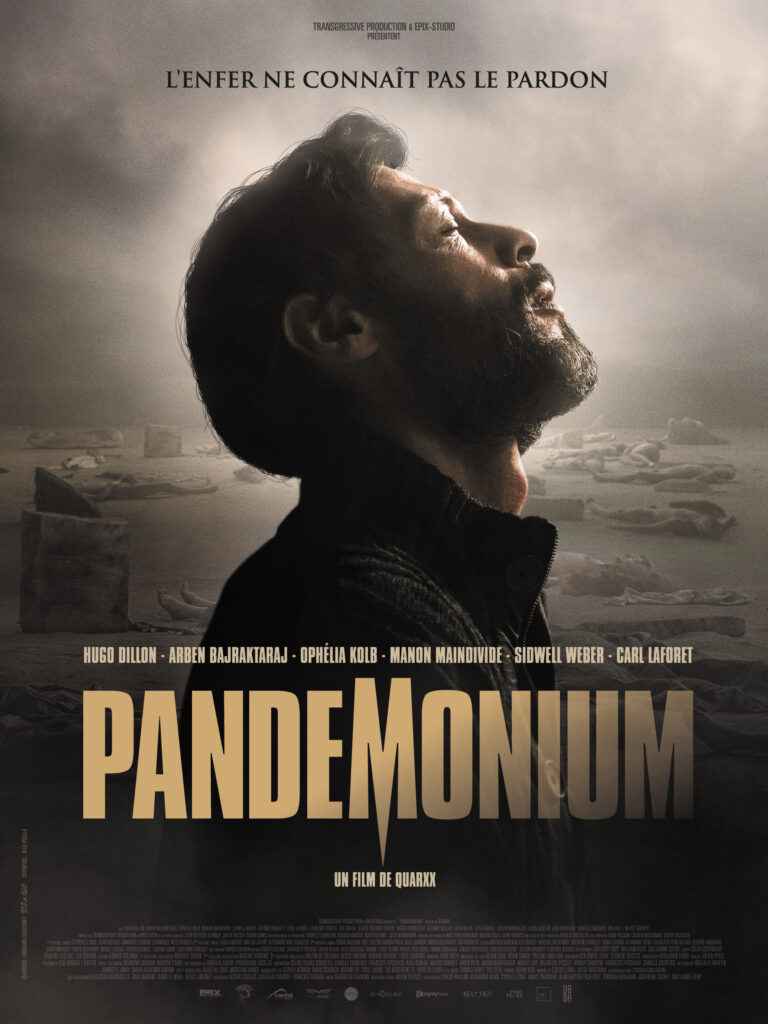 Quarxx is a fascinating director, whose previous film Tous les dieux du ciel (English title: All the Gods in the Sky) was an incredible and uncomfortable piece of cinema, and now, at Fantasia 2023, he has brought us his latest feature, Pandemonium. The story follows a man called Nathan (Hugo Dillon) waking up on the road after a terrible car accident. Nathan fast discovers he’s dead, along with a man named Daniel (Arben Bajraktaraj) involved in the accident. The two start trying to figure out what happens next. Two doors appear to them, each beckoning with different music. Daniel and Nathan have to decide which door to choose, or if they even have a choice. Because dead men don’t really get to choose, do they?
Pandemonium at times diverts too much attention from Nathan, and though it does so for the sake of trying to take a wider look at Hell, the film falters slightly by not keeping its focus more on him and his sins. Nevertheless, Quarxx’s film is a haunting vision of a medieval Hell where people must atone for their sins no matter how the demons of the Underworld choose to inflict punishment upon them. The film makes extra sure to depict how the suffering of Hell isn’t something your soul can wiggle out of on a technicality. In the world of Quarxx’s Pandemonium, our sins will haunt us, hunt us down, and drag us back to Hell if we get the foolish idea we can somehow outrun judgement.
 There’s an evident philosophical scope to Pandemonium just from the film’s title, given that the word ‘pandemonium’ comes from John Milton’s Paradise Lost in which Pandaemonium is the capital of Hell, where Satan and the many other demons meet after the fall from Heaven. The beginning of the film entails Nathan and Daniel arguing over what’s real, what’s not, and how the afterlife works while they seem to be in Purgatory prior to their final judgement. Quarxx uses the first piece of the film as an exercise in the philosophies of life, death, and sin. Daniel and Nathan committed different sins, and Christian Hell is all about a hierarchy of sins. This also connects to more literature, this time reaching back to the medieval, as Dante Alighieri’s Inferno depicted a Hell that was literally tiered, from the lesser sins to the greater ones, and spiralled down deeper towards the pits of Hell as the sins got worse and the punishments became increasingly more awful.
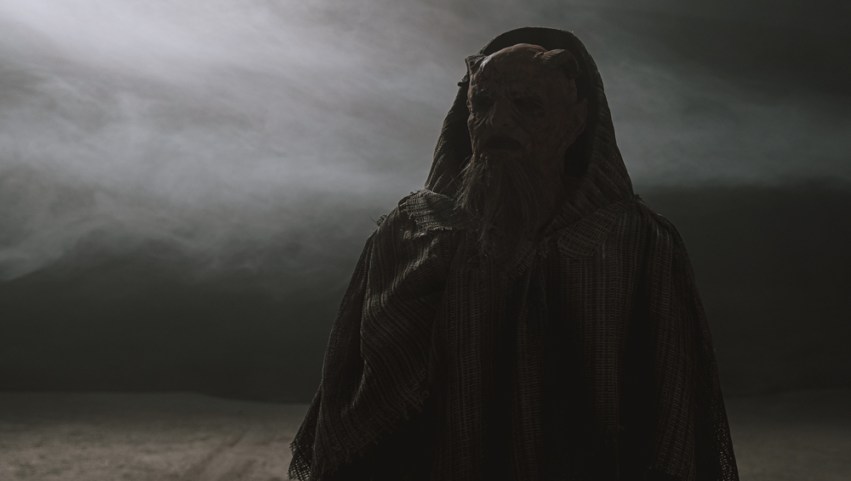
When Nathan first arrives in Hell, he comes upon a lot of bodies that look like they’re covered in ash or dust; a bunch of broken, discarded toys on the floor of an ancient basement. He sees one is a little girl. He gets a glimpse of her crimes: the little girl is Jane (Manon Maindivide) and she not only killed her parents, she cooked her sister in the oven. Yet she’s only a little girl, so it seems she’s in a part of Hell that’s not as bad as others. The same goes for Julia (Ophélia Kolb), whose daughter Chloe (Sidwell Weber) committed suicide after she ignored the issues Chloe was having with bullies. An obvious hierarchy of sin is presented in Pandemonium, especially after we witness what happens to Nathan when he encounters Norgül, one of Hell’s tour guides who says simply: “I am nobody.”
The brutality Nathan faces as his punishment in Hell is becoming a “new toy” for a horrifying, demonic, vaguely human monster after the two are locked in one of the Underworld’s cells. Nathan’s term is thousands of years. But his monstrous cellmate beats him into such a bloody pulp that he dies a second time and winds up reincarnated into a brand new body. The final moments of the film are pure terror, as we witness Nathan’s demonic cellmate tasked with tracking his soul down again and return it to Hell to face full punishment. The terror comes from how Nathan’s been reincarnated, which shows us just how evil this medieval Hell can get when there are sins needing cosmic atonement.
Quarxx could have elaborated further on his vision of Hell to make it even more Miltonic or Dantean—Paradise Lost and Inferno are big, complex texts with many descriptions of Hell’s labyrinthine construction—but Pandemonium is still a horrific and mesmerising trip into the bowels of the Underworld. One important way that Quarxx sticks to a medieval vision of Hell is noticeable when Norgül tells Nathan: “After death there is only Hell. Humanity is evil by nature and most atone for its sins.” A predominant medieval Christian perspective on Hell was that people were, by nature, sinners, and contemporary Christians, particularly Catholics, still see it that way. Yet those of us who aren’t religious can admit, just by looking at the news headlines any given week in 2023, there are so many horrors and terrors lurking in human behaviour, from war to anti-Black and anti-queer/trans violence and so much more. We have to reckon with the evil and the horror of human beings, as well as the potential horror and terror of our own actions, even if there’s no Hell to make us atone for our sins after death.
 Father Son Holy Gore
Pingback: PANDEMONIUM French transgressive horror – Reviews and Arrow VOD news – From La Casa de Papel to Elite: Unpacking the Success of Spanish TV Series