

Out of Darkness (2024)
Directed by Andrew Cumming
Screenplay by Ruth Greenberg
Starring Safia Oakley-Green, Chuku Modu, Iola Evans, Arno Lüning, Luna Mwezi, Kit Young, Rosebud Melarkey, & Tyrell Mhlanga.
Horror / Thriller
★★★★ (out of ★★★★★)
DISCLAIMER:
The following essay contains SPOILERS!
Avert thine eyes lest ye be spoilt.
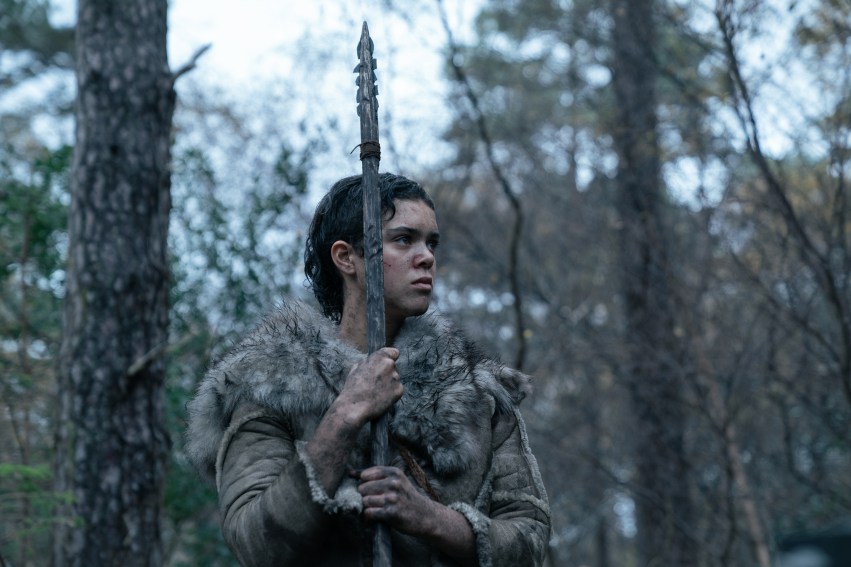 Compared to films set in other time periods, there’s not an abundance of prehistoric stories in cinema, and there are very few good ones among those, but there’s a new title to add to the worthy list with Out of Darkness, which depicts a group of people in the Palaeolithic Age attempting to survive and make it to new territory when they’re seemingly hunted by what they think is an evil, monstrous entity.
Out of Darkness is a fascinating horror-thriller set in the Old Stone Age; an adventure film crossed with elements of a slasher. The most compelling pieces of Ruth Greenberg’s screenplay examine the fact that while human beings and our behaviour have evolved, there are many ways in which things haven’t changed since the early days of human history. Andrew Cumming’s film is about the enduring poison of patriarchy, as well as the human tendency to fear—and destroy—what we don’t know or understand. Unfortunately even today, humans, like the terrified humans from Out of Darkness, still often kill first, ask questions later, if they ever even ask questions at all.  Palaeolithic patriarchy is on display throughout Out of Darkness, and shows us that patriarchy is as old as the Earth itself. Quickly, gender roles are laid out by both Adem (Chuku Modu), the traditionally masculine leader of the group, and Avé (Iola Evans), the woman pregnant with Adem’s child. Avé tells Beyah (Safia Oakley-Green) that her unborn child will “have to earn her place” but says that Beyah has “a purpose now” because Adem sees Beyah as useful. Yet Adem sees Beyah as a mere object, not even a person: “You‘re for whatever I need,” he tells her creepily. What’s interesting is that the old man who’s part of the group does nothing tangible to help the group—his supposed wiseness is his only contributing factor—yet he’s seen as more valuable than a “stray” like Beyah.
The naming of Adem and Avé is a curious one that alludes to the timelessness of patriarchy since they’re so close to Adam and Eve. Even if there was no real Adam and Eve in the biblical sense (which, y’know, there was not), the patriarchal nature of their story has still endured throughout history. While in the film Avé doesn’t wind up a scapegoat like Eve in Christianity’s narrative, Beyah’s made a scapegoat due to her being a woman, specifically when her period’s blamed for attracting the so-called demon stalking their group. The scapegoating of Beyah and her menstrual cycle culminates with most of the remaining members of the group deciding they should sacrifice her to the ‘demon’ they believe is hunting them. Thankfully Beyah outlasts the violent patriarchal whims of her fellow travellers, both male and female, however, she only encounters more terror.
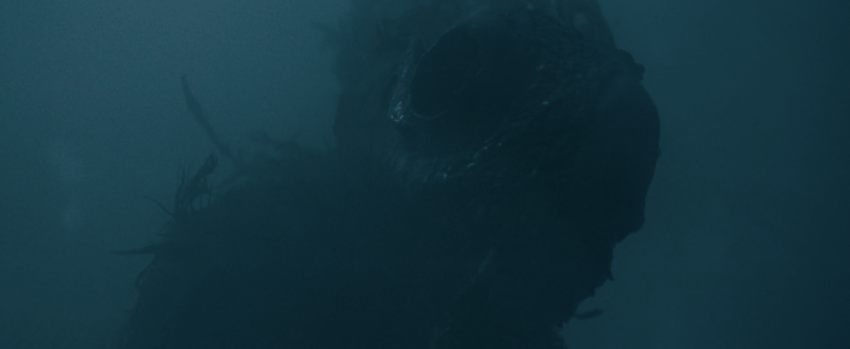
Out of Darkness portrays early human brutality in the face of difference. At first, the group of neanderthals appear to the human group as monsters because they’re wearing strange masks. Later when Beyah finds the stolen child, she sees the neanderthals unmasked; this is when she slowly starts to see that, apart from a little physical/cultural difference between herself and the neanderthal woman she winds up murdering, there’s really not much different between the groups. In the film, the neanderthals wind up like so many groups throughout history: they’re killed and their murderers take over their homes. Even though Beyah’s remorseful at the end and intent on learning from this experience going forward, she still brutally murdered an innocent, unarmed woman right in front of the child’s eyes and then made the neanderthals’ caves her home, like an Old Stone Age precursor of colonialism. Out of Darkness further positions the neanderthal as a Gothic figure/monster in terms of early humans like Beyah coming in contact with them—a kind of past-meets-present moment in terms of human history and evolution. Like a number of Gothic figures/monsters throughout history, the neanderthals’ ‘scary’ Otherness is simply a product of someone else’s fears, and they suffer a cruel fate due to nothing but ignorance.
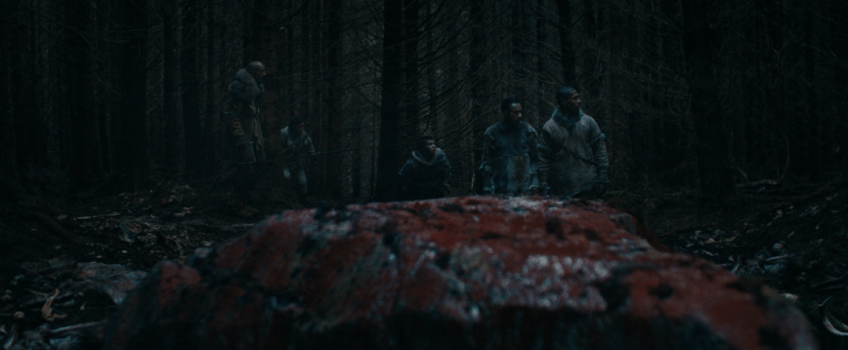
“It’s like us”
“No, it’s not.”
 One reason Out of Darkness is so unsettling has to do with the fact that, at our core, humanity has changed very little since the beginning of time—our tools, our technology, our language, and much more has evolved, even our bodies, but many of humanity’s darkest instincts, from patriarchal control to all kinds of violence, haven’t changed much if at all. Right now there are multiple genocides happening in various corners of the world, from the Middle East to Africa, and the humanity of those being subjected to genocide is routinely erased. The humanity of the neanderthals in Out of Darkness only seems to be realised after they’ve been murdered when it’s too late. It’s hard for me not to think of Palestinians being dehumanised, and how it feels like they gain some kind of humanity for many people only after their deaths.
Out of Darkness is a grim film, in spite of an ending that suggests humans have learned from experience since our earliest days walking the Earth. While Beyah comes around to seeing the neanderthals lived just like her and her group, her sentiments in the closing moments of the film, sombre though they are, seem to forget to express that her big learning experience she hopes to carry forward came at the expense of others’ lives. And this speaks to a much larger, global issue that crosses lines of race and culture and all else: progress always comes at great cost, usually to those who never agree to pay it in the first place.
 Father Son Holy Gore
Pingback: Reviews: Out of Darkness (2024) – Online Film Critics Society