

Touched by Eternity (2024)
Directed & Written by Marcis Lacis
Starring Andris Keiss, Ivars Krasts, Edgars Samitis, Inese Pudza, & Mikelis Kreilis.
Comedy / Horror
★★★★1/2 (out of ★★★★★)
DISCLAIMER:
The following essay contains
SPOILERS!
Turn back, or live forever being spoiled.
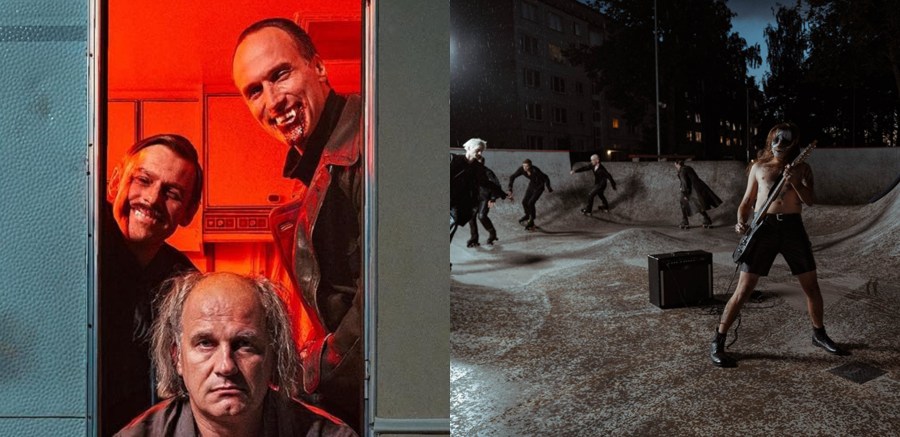
Marcis Lacis’s Touched by Eternity, like Alphaville in 1984, asks: “Do you really want to live forever?” The film follows a man whose name we never hear but who claims most people have always called him Fatso (Andris Keiss), as he passes away the time trading cryptocurrency and ingesting yeast because a podcast host has pushed the theory that yeast is “the source of eternal life.” One evening, Fatso’s visited by two vampires—Egons (Ivars Krasts) and Carlos (Edgars Samitis)—who believe he’s “the chosen one,” according to their group. This is what he seemed to have been searching for, except the realities of immortality are far more dark and depraved and monotonous than he anticipated, so he begins to rethink what it is he wants out of life.
Touched by Eternity is a pitch-dark comedy that gradually becomes darker as the film wears on until it reaches an abyssal end. It isn’t the first vampire story to look at the downfalls of immortality, yet Lacis creates something unique that touches on both the terrors of living forever and also the general romanticisation of vampires throughout the history of Gothic fiction that still hasn’t come to an end in pop culture.
 A passing yet important moment in Touched by Eternity is a metafictional one that occurs in a scene where it appears like the vampires are listening to an academic lecture, as if they’re in a university seminar, as a woman talks about the different representations of vampires throughout the history of literature. She makes references to Marx’s “capitalist vampires” and the folklore depictions of vampires in the 19th century. There are other moments of literature that make their way in, such as a brief recitation of a Christina Rossetti’s “When I Am Dead, My Dearest” (1848): “And dreaming through the twilight / That doth not rise nor set / Haply I may remember / And haply may forget.” A curious historical mention (that may or may not be a shoutout to Pablo Larraín) is when Carlos says he’s a fourth-generation vampire and the great-grandson of Augusto Pinochet; like it’s something to be proud of, too. Most interesting when it comes to history, literature, and vampires is that the woman lecturing refers to John Polidori’s The Vampyre (1819), largely regarded as the beginning of a romanticised view of vampires, the complete opposite of Touched by Eternity‘s efforts to take the romance out.
A romanticised view of vampires has really taken hold over the past century, and particularly as Count Dracula and other vampires became increasingly sexualised on the big screen. Before that, vampires were typically hideous creatures, or, at the least, they were portrayed as deviant, often negatively queer. Touched by Eternity de-romanticises the vampire. These vampires don’t seem too concerned with ‘turning’ anybody. They mostly kill and feed. In this vampiric world, there’s no sense of an ethical vampirism. One man’s carried off naked like a side of beef to be devoured. Another woman has her neck snapped while the vampires, Fatso, and even her dog indulge in her blood. In Touched by Eternity, the expectations of vampirism versus the reality are on display for good laughs, too. In one scene, Egons breaks down and admits that he’s not happy with vampirism, hilariously lamenting the fact that they seem to go to dusty old barns and other places just to sleep in tents: “I want to sleep in a bed. Or a coffin, at least.” This is even reflected in an earlier nightmare that Fatso has, in which he sees himself in a coffin, only to later discover that, should he become a vampire, he’ll be sharing a tent with another bloodsucker. The comedy and darkness abound throughout Lacis’s film.
 The film opens with a quote from Anger in the Sky (1943) by Susan Ertz: “Millions long for immortality who don’t know what to do with themselves on a rainy Sunday afternoon.” If a person can’t live in the moment, or if a person can’t find a purpose for which to live, then what good is immortality? Even worse, what good is immortality if you have to give up your morality to achieve it? Part of the vampires’ argument when they try to convince Fatso to join their ranks is that he’s wasted his life anyway: “There are few people who have wasted their lives so miserably that it won’t change much when they become vampires.” When Fatso refuses to give in he says he wants to remain human, to which the oldest of the vampires, the child-appearing Oskars (Mikelis Kreilis), replies: “You‘re a shitty human.”
The discussion of morality and vampirism in Touched by Eternity is brilliant when considering the woman lecturing earlier in the film on vampires and literature makes specific reference to Immanuel Kant, whose moral philosophising has influenced generations of thinkers, and it’s Kant who informs Fatso’s final decision on whether to become a vampire. One of Kant’s most famous quotes about ethics is as follows: “Act in such a way that you treat humanity, whether in your own person or in the person of any other, never merely as a means to an end, but always at the same time as an end.” Fatso isn’t willing to treat other people as the bloody means to his vampiric end, so he chooses death. And, again, what’s the point of living forever if you have to give up your soul to do it? When Fatso asks what will happen to his soul if he becomes one of them, the Chancellor of the vampires asks him: “Why do you think you have one?” But we know that Fatso has one because otherwise he wouldn’t have bothered to ask about his soul. Touched by Eternity isn’t about a typical grand, quasi-religious view of vampirism as evil and humanity as good, it’s about each person’s sense of morality when confronted with the dark realities of what vampirism requires when the romanticism ends.
 Father Son Holy Gore