

Falling Stars (2024)
Directed by Gabriel Bienczycki & Richard Karpala
Screenplay by Richard Karpala
Starring Shaun Duke Jr., Rene Leech, Andrew Gabriel, Diane Box Worman, Orianna Milne, & Piotr Adamczyk.
Drama / Horror
★★★ (out of ★★★★★)
DISCLAIMER:
The following essay contains SPOILERS!
Turn back or be spoiled forever.
Witch stories have been told in countless ways since the earliest days of folklore, they were later popular in the era of Gothic fiction, and they remain popular today, but Falling Stars might be the most unique witch story to come along in film since the year 2000. The film follows three brothers—Mike (Shaun Duke Jr.), Adam (Rene Leech), and Sal (Andrew Gabriel)—who go along with a friend to see the grave of a supposed witch who fell from the sky, after which their lives are irreparably altered. The brothers and their friend realise everything’s going wrong after they leave the grave, yet the only way to undo what’s been done is to return and cleanse the grave with fire. Easier said than done, especially on a night when there are more falling stars dropping from the sky.
Gabriel Bienczycki & Richard Karpala’s film links a number of ideas revolving around witches, depicting the crossover between misogyny and the hatred of witches, as well as portraying witches as a balancing force in the natural world. Falling Stars focuses on one family specifically and dives into how generational legacies continue to haunt entire bloodlines; a microcosm of the larger issues at play. Not everything plays out as well as it could, yet Bienczycki and Karpala manage to do something unique, and unsettling, in the witch horror sub-genre that doesn’t retread all the footsteps that came before.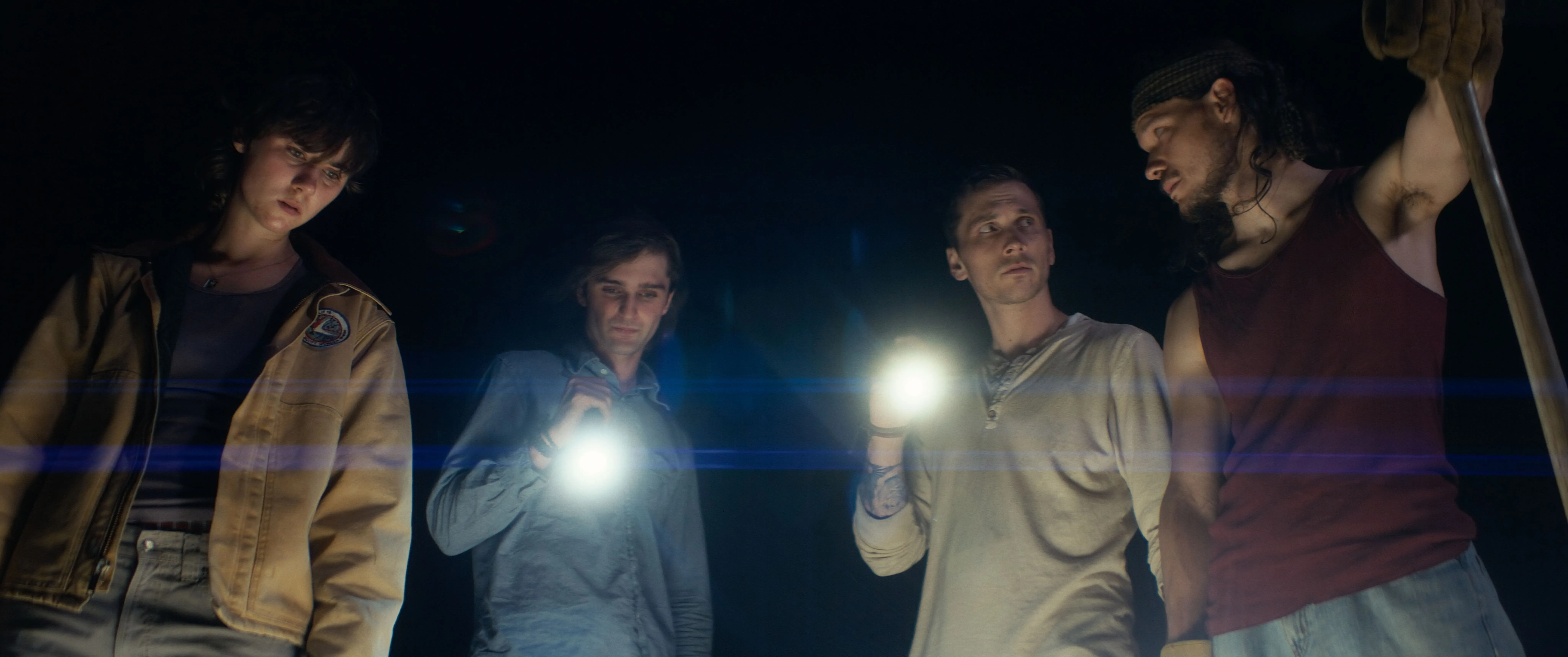 The film’s opening text tells us that witches are similar to falling stars when they come down from the sky during harvest time, and this is immediately interesting because there’s an almost biblical feel to the story’s scope, as Lucifer was connected to planets and stars. Lucifer was known in Roman folklore as the planet Venus, and in other sources he was depicted as a bringer of dawn/light. Christianity, along with popular literature, later warped Lucifer into the devil after his fall from Heaven. In Falling Stars, the witches may seem like they’re an evil force through the perspective of the male characters particularly, yet their depiction as an almost natural force descending during harvest makes them feel more like retribution. In several shots we see how bad the weather’s getting, and the falling witch stars are likewise said to be getting worse: “Every year they’re hungrier, and they‘re coming earlier, too… parts of Europe, West Africa, they‘re seeing falling stars as early as August.” It’s as if the witches, like the changing climate across the globe, are coming to take from those who do nothing but take from the Earth. Not only that, witches have historically been misrepresented and lied about, exactly how Lucifer was twisted into something dark through the annals of history.
A glaring parallel throughout Falling Stars is how fear of witches is typically pure misogyny, and that in many families/communities this misogyny has been passed down from one generation to the next. While the brothers are headed out to the witch’s grave, Mike and his friend talk about women. One of them mentions having “a hex” put on them, then the other remarks: “Blue balls is a hex.” There’s more talk about “orgies and devil worship” and how “demons love to fuck witches.” Another marker of the misogyny-witchcraft connection with two men using sexual rhetoric while discussing women and witches interchangeably. There’s also just good old fashioned misogynistic language crossed with witch imagery, as a radio host refers to “bitches on broomsticks.” The generational spread of the hate for witches in Falling Stars is made evident when Mike is on the phone with the radio host who tells him that people “don‘t burn witches anymore.” Mike responds by saying his parents burned witches, to which the host replies: “And that‘s how their parents did it, doesn‘t mean it‘s the way we do it today.” Even though the host himself engages in witch hatred based in misogyny, he recognises that times have changed. But have they really?
Despite the sense that Adam begins questioning his family/community’s tradition of burning witches, he still tries to burn the dead witch, and the ending suggests that he too has suffered the consequences like his brothers. The ending mostly shows how that the generational cycle of misogyny and witch hatred in the brothers’ family was not broken, nor will it disappear in their community at large, nor the world, either. Falling Stars portrays a world in crisis, but not a world under siege for no reason. The film follows Mike and his family’s struggle while simultaneously making it fairly clear that the struggle is linked to horrible traditions and the consequences those traditions have created. Their story is a sad tale of the connection between how we treat women and how we treat the natural world. Falling Star exposes a patriarchal view of life that expects women, like the Earth itself, to take so much of humanity’s abuse without ever fighting back, as the witch-nature connection ties all of women and Mother Nature’s revenge together in a haunting package.
 Father Son Holy Gore
Pingback: This Week at the Movies (Oct. 25, 2024) – Online Film Critics Society