
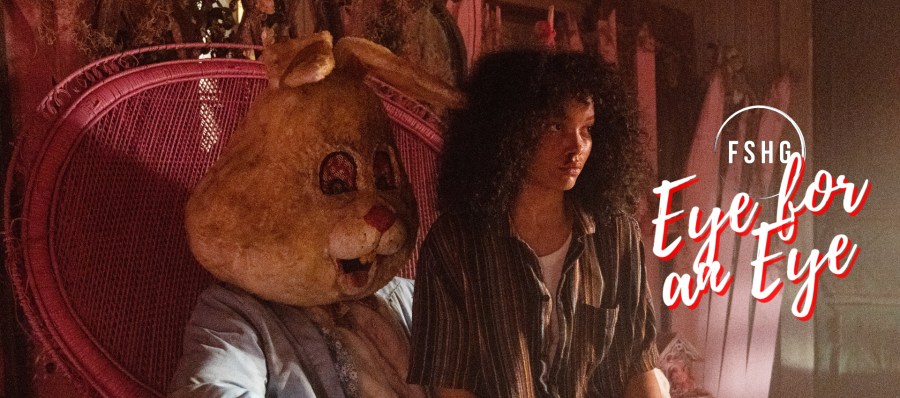
Eye for an Eye (2025)
Directed by Colin Tilley
Screenplay by Elisa Victoria & Michael Tully
Starring Whitney Peak, S. Epatha Merkerson, Finn Bennett, Golda Rosheuvel, Laken Giles, & Ben Bladon.
Horror
★★★ (out of ★★★★★)
DISCLAIMER:
The following essay contains
SPOILERS!
Avert thine eyeballs,
lest ye be spoiled.
Elisa Victoria’s involvement in Eye for an Eye was a promising sign since the film is based on her graphic novel Mr. Sandman. The film follows Anna (Whitney Peak) as she grieves following her parents’ death, forced to move to Florida to live with her grandmother, May (S. Epatha Merkerson). She meets a couple other local teens, Shawn (Finn Bennett) and Julie (Laken Giles), and they start to spend a lot of time together. One day, Julie and Anna watch as Shawn commits an act of violence against a boy that reverberates through all their lives after the boy hears about Mr. Sandman—a chilling local legend who people say likes to take eyes—and seeks revenge.
Eye for an Eye deals with the haunting ramifications of hatred, and the transformative potential in admitting one’s guilt. Despite Mr. Sandman taking on the traditional form of an evil entity, his presence in the story is about restoring justice, albeit a gruesome, gory justice that involves occasionally chomping on an eyeball or two. The film really deals with accepting the part many of us have played at some point—even if a quiet, indirect part—in allowing others to be hurt. Where do those who have no power go when they want to fight back against those who hold power over them? Well, in Eye for an Eye, they go to Mr. Sandman. All they’ve got to do is sign on the wooded line.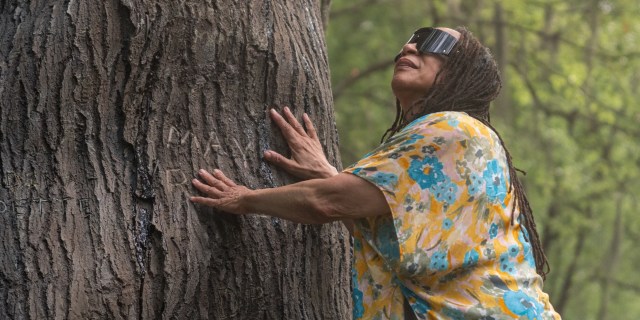 Even though Eye for an Eye doesn’t particularly lean culturally on the Blackness of its characters, there’s significance in it being a Southern Gothic story focused on a family of Black characters set in Florida. Blackness and the Gothic in America has a long, significant history. Some of the earliest American Gothic came from the slave narratives of formerly enslaved men and women who escaped to freedom then often told stories of their brutalisation through gothic language. Writers from Solomon Bayley to Frederick Douglass to Harriet Jacobs and so many more described what was done to them by white slave owners using language/imagery that white authors of the Gothic could only dream(/nightmare) of using in fiction. Also, it’s important that the film is set in Florida after Whitney has to move from New York. Florida was once a slave state and eventually a Confederate state, too. Even post-Civil War, the state was the site of numerous racial massacres throughout the twentieth century: the Ocoee massacre, the Newberry Six Lynchings, the Perry massacre, and, perhaps best known due to the film about it, the Rosewood massacre. Eye for an Eye doesn’t talk about race; at least not openly. Is there racial potential in the fact that Mr. Sandman is basically pale white? He doesn’t discriminate, though. He’ll take any eyeballs, no matter what colour head they were in. Still, all the weight of American Gothic’s relationship to Blackness comes to mind, even if inadvertently, since Eye for an Eye centres so closely on Anna’s family.
Mr. Sandman is a form of folk justice in a world that rarely doles out appropriate punishment those who physically or psychologically harm others. While other people Mr. Sandman goes after seem unrepentant for their sins and carry no guilt, Anna feels terrible for standing by idly, allowing the boy to be hurt. She tries apologising to the boy. But Mr. Sandman’s wheels of crooked justice are already turning, so Anna has to make a much grander gesture to the entity’s shadowy forces. There’s an interesting nod towards Christianity in the resolution of Anna’s struggle, as we get a reference to Leviticus 24:20: “Fracture for fracture, eye for eye, tooth for tooth; whatever injury he has given a person shall be given to him.” Anna must rectify the violence she allowed to be done by doing violence to herself. She accepts what she must do and it allows her to keep her eyes, rather than suffer the fate of other guilty souls. This can act as a larger metaphor for how we deal with our own guilt: either live with it and let it hollow you out until the darkness takes you, or accept it, take your figurative lumps—in Anna’s case, quite literal—and live beyond guilt. On top of that, Anna likely feels some measure of survivor’s guilt in the wake of the accident that killed her parents. Guilt is all but eating her alive, in a couple different ways throughout the film. In the end, she chooses not to let the guilt consume her.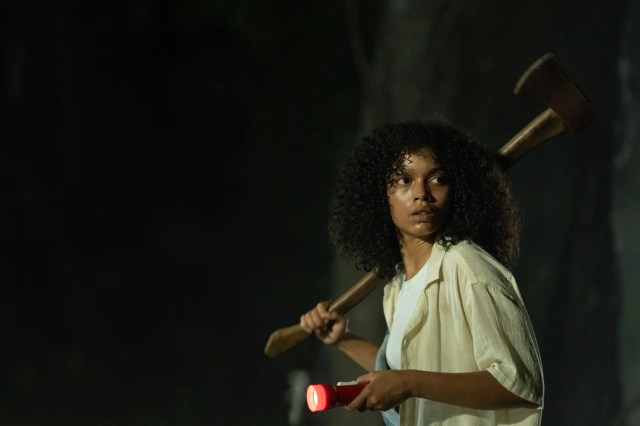 The film’s Southern Gothic aspects could’ve been used to a greater degree, especially given all the historical/racial/social problems in Florida, yet Eye for an Eye still tells a satisfyingly disturbing yet hopeful tale about living, or dying, with guilt. Anna faces guilt on two fronts: one she could’ve prevented and one over which she never had any control. In the face of tragedies piling up, she finds a way through all the guilt and refuses to be another tragedy. Sometimes the price of guilt is having to live with it. Anna chooses accountability for the guilt she brought upon herself, and for the survivor’s guilt she never chose, she chooses life. A great image occurs in a scene after Anna offers up an ‘eye for an eye’ to Mr. Sandman and we see her in a coffin, covered in a black liquid—maybe the oily manifestation of guilt itself—that slowly begins to dissipate; this is Anna metaphorically coming back to life, the corpse-like blanket of guilt removing from her flesh and bones. When all is said and done, Eye for an Eye is a Gothic imagining of life for the living beyond guilt and death.
 Father Son Holy Gore
Pingback: New Horror Film with A Near Perfect Score is Taking Over HBO Max – Comicleaks.com