
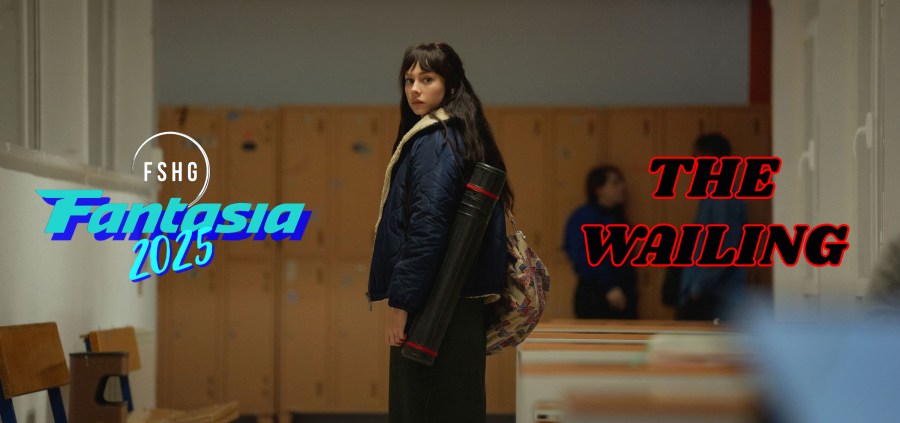
The Wailing (2025)
Directed by Pedro Martín-Calero
Screenplay by Pedro Martín-Calero & Isabel Peña
Starring Ester Expósito, Mathilde Ollivier, & Malena Villa
Horror
★★★★1/2 (out of ★★★★★)
DISCLAIMER:
The following essay contains
SOME SPOILERS.
Perhaps the scariest feature screened during Fantasia 2025 was Pedro Martín-Calero’s The Wailing, a horror story that links the lives of three women across twenty-five years connected by a single thread: a terrifying male presence who stalks them and even harms those they love. The film begins in 1998 briefly with Marie (Mathilde Ollivier) as she collapses at a club, then jumps to 2022 with Andrea (Ester Expósito), who begins to notice a strange, dark man lurking in the background of her daily existence. When things go very sideways in Andrea’s life, she starts to unravel her past, and, as it turns out, that shadowy man has been lurking since before Andrea was ever born.
The Wailing‘s visuals are at times enough to make the skin crawl, as the dark figure gradually infiltrates the women’s lives deeper. The story, while enough on the surface, can be taken as a metaphor of battling against mental illness while those around you are incapable of seeing the things you see. It’s a haunting film that warns of the dangers in not listening to those struggling with mental illness. Andrea and Marie struggle because, for the most part, their fears of the shadowy man are ignored and dismissed. The Wailing examines the toll it can take to confront a deep darkness by yourself. A reading of The Wailing focused on mental illness also brings up ideas about the generational effects of dealing with mental illness, which arises as soon as Andrea discovers that Marie was her mother. We have no way to know about the other women the shadowy man has clearly stalked, revealed once the apartment in the creepy old building is visited by Marie late in the film; they could be other members of Andrea and Marie’s family for all we know, or maybe they’re just random women. Even without that full knowledge or the theory itself, the man stalking Andrea and his complete infiltration of her life begins as soon as her mother dies; the curse of mental illness works its way down the genetic chain.
In the end, The Wailing suggests the need to come together to face invisible threats, like old ghostly men, or mental illness. After Marie, then Andrea, another young woman even closer to current day has now been burdened with the curse. She reaches out to those who know Andrea in an effort to try changing, or at the very least understanding, her fate. The young woman meets with Andrea’s friends, the same two we see earlier in the film who are the only ones that supported Andrea, insisting on believing her without being able to see the creepy man she told them about. As the film closes, these women begin to form a support system for the most recently afflicted woman in what we see has been a long line of them, going back beyond Andrea and even Marie. Once again, to follow the mental illness reading, The Wailing acknowledges that only when empathy is present can people find the support they need to deal with serious, dark mental struggles. There are hints of a very dark history behind The Wailing, particularly in the final act when we see a bit more about the shadowy man haunting Andrea and Marie. It suggests a trail of dead women in the man’s wake, a legacy of pain doled out all but entirely to women. Part of what makes The Wailing work so well, and why it’s a genuinely terrifying horror film, has to do with the fact the story builds lore without over explaining, leaving slight mystery to the shadowy man’s true origins. The truest terrors are often those that still retain an essence of the unknown.
Andrea and Marie are terrorised to their limits, yet in the end, despite all the horror they each experience, there remains a glimmer of hope for the next generation of terrorised women. The Wailing is grim in its entirety, and even the end has its depressing aspects, though there’s an acknowledgement that with the help of others, the shadowy man’s presence—in this reading, mental illness—can be dealt with and his terror lessened. Pedro Martín-Calero and co-writer Isabel Peña deliver a supremely dark story that suggests invisible forces, whether supernatural or psychological, can only be fought when people open their eyes and their minds to things they don’t initially understand.
 Father Son Holy Gore