
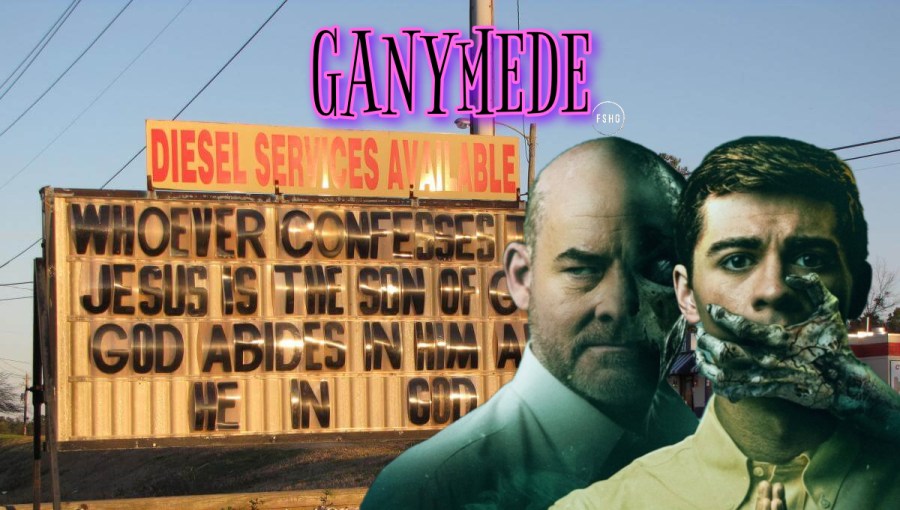
Ganymede (2024)
Directed by Coby Holt & Sam Probst
Screenplay by Coby Holt
Starring Jordan Doww, Pablo Castelblanco, Robyn Lively, David Koechner, & Joe Chrest.
Horror
★★★1/2 (out of ★★★★★)
A teen boy, Lee Fletcher (Jordan Doww), who comes from a long line of Fletchers and lives in the shadow of his father Big Lee (Joe Chrest), has a tough time reconciling his family’s religious values with the feelings buried deep within: Lee acts like a regular straight boy, but longs to touch, kiss, and cuddle an openly gay classmate, Kyle Culper (Pablo Castelblanco). Big Lee and his wife Floy (Robyn Lively) aren’t the only repressive influences in Lee’s life. Pastor Royer (David Koechner) looms large over the Fletcher family, from Big Lee’s political life to their daily life as a god-fearing Southern family. It’s Pastor Royer who gets called in to try exorcising the gay out of Lee after the boy’s caught spending a little too much time with Kyle for everybody’s liking. The pastor essentially introduces Lee to a crude form of conversion therapy, complete with ECT. While Lee struggles, and his religious upbringing urges him to expel his homosexual desires, he feels a darkness lurking—a hideous entity that seems to be repression manifested into a horrible living thing. And that darkness threatens to consume Lee, as well as destroy everything around him.
Ganymede is a queer gothic horror film due to its focus on the past and how it comes to bear on the present, specifically through part of the plot involving Floy’s dead brother, Neal (Pete Zias), Lee’s secret gay uncle who committed suicide due to the homophobic forces converging upon his life. Pastor Royer’s own repressed desires are linked to his past and inform why he pushes back so fiercely against homosexuality, both socially and personally. The eerie creature that follows Lee and dead gay Uncle Neal become gothic monsters, though for different, opposing reasons: one is symbolic of repression, one is symbolic of repression’s deadly effects. Ganymede is filled with grim, unsettling moments, yet finishes in a space that allows for hope, allows for change, and allows for life in the face of literal and existential death.
GANYMEDE: A MYTHOLOGICAL SCAPEGOAT
 The title Ganymede refers to Ganymede from Greek mythology. Ganymede is a divine hero from Troy. Homer described Ganymede as the most handsome of mortals and told the story of how he was abducted by the gods to serve as Zeus’s cup-bearer in Olympus. The Latin form of the name Ganymede was Catamitus, from which the English word catamite is derived. In Ancient Greece and Rome, a catamite was typically a pubescent boy who acted as the intimate companion to an older man (a.k.a a boy used for paedophilic purposes).
There was a belief that Zeus had a sexual passion for Ganymede and many consider Ganymede’s abduction by Zeus as a rape akin to those of Europa, Lo, and other female abductees at the hands of Zeus; this isn’t just our contemporary scholars, either. Since 5th century BC, it’s been believed there was a sexual desire on Zeus’s part for Ganymede. In the modern historical period, many scholars have referred to Ganymede being raped by Zeus. All of this comes to bear on Ganymede, as the title evokes Pastor Royer’s twisted homophobic logic that tries to shift blame for internalised homophobia onto openly gay men. In Greek mythology, Ganymede’s beauty was used as a scapegoat—so beautiful Zeus simply couldn’t resist defiling him. He’s victim-blamed for the violent sexual desires of the god Zeus, like how raped women were often asked by police and others, What were you wearing?
Similarly, a lower-case ganymede—as Pastor Royer calls Kyle and a boy the pastor himself once lusted after as a teen—is scapegoated for straight men’s inability to deal with their own confused sexuality. What’s really damning is the connection the film makes between homophobia and misogyny. The same logic being used against Ganymede, both lower and upper cases, is the logic rapists use to attempt to justify their sexual violence against women. Misogyny and homophobia emerge from the same place: patriarchy. They’re two systems of behaviour and belief that place hetero men at the top of the hierarchy. This is also partly why, in Ganymede, Lee and Floy come together in the end. Obviously some of it has to do with Floy finally realising her son will always be her son, gay or not, and she makes the right choice. That choice also comes about because Floy witnesses Big Lee cheating on her right in the garage with their housekeeper. Floy sees the way Big Lee treats women while he parades around as a righteous religious man. He views women as interchangeable based on what he wants, and when he deems Lee Jr. as defective due to being gay, he makes up his mind to move on from Floy to someone who’ll give him a son who can carry on his hetero legacy. Floy witnessing Big Lee cheating is the last push she needs to fully embrace her son and separate herself from her husband’s hypocrisy. Ganymede, among other things, depicts how various forms of oppression intersect and intertwine, making each other stronger, though the film also depicts how they almost always unravel eventually.
CLASS, RACE, & RELIGION IN GANYMEDE
 There’s a class angle to Ganymede considering the Fletcher family’s position in their town due to Big Lee’s political power. It’s unclear if Big Lee refers to “Fletcher County” as a proper name, which would indicate the family’s deep colonial ties to the town, or if it’s just a colloquial name, which still indicates the family’s elite social status. For Lee Jr. to come out as gay would spell catastrophe for the Fletcher family’s religious and Southern political image. There’s also Big Lee’s thirst for legacy. He’s distraught by the idea of Lee Jr. being gay not just because of his religious beliefs, he’s also upset because, in his mind, this means no biological legacy to continue the bloodline. He literally sees it, as many religious people do, as the termination of a bloodline, the death of a family dynasty.
There’s also a potential racial angle, seeing as how Kyle is most likely Mexican—he and his mother aren’t white and speak Spanish together at home—while the Fletcher family are white, as well as the fact they’re in a Southern U.S. town that runs on religion. Historically, non-white Americans have been viewed by white Americans as sexually deviant, from Indigenous peoples to enslaved Africans. Big Lee is disgusted by Kyle, likely due to a dual dosage of racism and homophobia. In America, and beyond, white supremacy has routinely equated supposed racial purity with heteronormativity. One tentacle of the monster known as European colonisation in America was the erasure of non-heteronormative beliefs and practices amongst Indigenous tribes. Heteronormativity is not only synonymous with white supremacy, it’s a key aspect of colonisation; not just in America, either. In Ganymede, Kyle’s character—more specifically, Big Lee and also Pastor Royer’s disgust with Kyle—exists within layers of context. Other horror films might choose to cinematically punish Kyle by having violence, physical and/or sexual, done to him. Ganymede focuses more on the ethical monstrousness of men like Big Lee and Pastor Royer rather than the potential homophobic violence they might commit. This isn’t ignoring that homophobic violence exists since Lee does violence to himself, internalising homophobia, and he also externalises his internalised homophobia against a closeted classmate, Justin, after they almost have a sexual encounter while cruising in a public toilet. Ganymede is more focused on how homophobia is rooted in belief systems and communities, how it survives and thrives through collective life support amongst religious bigots, and, perhaps more than anything else, how homophobia can be weaponised by those who’ve internalised it after fermenting in the closet far too long.
The worst culprit in Ganymede is the influence of religion. Pastor Royer wields incredible power over the Fletcher family, to the point he’s trusted to act in a psychological role. He’s the most dangerous person in the film. He becomes a very physical form of danger and violence in Lee Jr.’s life after he introduces a crude form of conversion/aversion therapy to the boy, taking us back to the 1960s especially (though even into the ‘70s and ‘80s in certain places) when gays and lesbians were given drugs and occasionally shocked with electric current while being forced to look at erotic same-sex photos and video. The idea of aversion therapy particularly, which was often a part of conversion therapy itself, was to flood the patient’s brain with a sickening, or painful, feeling while they were looking at erotic same-sex imagery in order to associate that feeling with same-sex desire. It’s exactly what Pastor Royer does, as Lee Jr. pictures Kyle while he’s being shocked with paddles placed against his temples. At one point, we see the confused state Lee’s been put in due to religion, psychiatry, and science merging through Pastor Royer into traumatic psychological violence, as he goes from looking up a list titled Causes of Psychosis to looking at Matthew 8:28-34 titled Jesus Cures Two Demoniacs. He’s caught between the world of science and the world of religion, lost amongst the strong tide—Pastor Royer, as well as his family—that pulls him away from his true gay self. All Lee can really do is hang on tight until the tide breaks and attempt to survive all the repressive forces at work trying to drown him.
UNBURY YOUR GAYS
 Uncle Neal is but one of a litany of dead gays in cinematic history, yet Ganymede ultimately refuses the ‘bury your gays’ trope by refusing to let past terrors and corporeal horrors continue to haunt present-day gays. Lee escapes what almost becomes a traumatic cycle in his family on his mother’s side. Part of that is due to Kyle, who will not let go of Lee, no matter how difficult things become. Part of that is also due to Floy, who tosses out her admittedly forced attitude towards homosexuality before it’s too late and stands by her gay son in defiance of Big Lee who’s symbolic of heteronormative patriarchy’s hypocrisy.
One dead gay is enough in Ganymede, and the entire plot is all about allowing no more dead gays. It takes a lot of pain and, indeed, some trauma for Lee to arrive at a positive place. At least he’s alive to be in that place. There’s so much hope for him going forward, particularly with his mother finally fully by his side. There’s even the closet case, Justin, seeming to be living his truth in the closing scene, spending time with Lee and Kyle—here’s to hoping his nose is done being broken thanks to toxic masculinity combined with internalised homophobia.
The real terror of Ganymede are all the results of repressing sexuality and treating non-heteronormative sexuality as if it’s something monstrous. The real monsters are Big Lee and Pastor Royer, and all the other men like them in many towns, as well as cities, across America, Canada, and every other country on Planet Earth. This kind of man leaves trauma in his wake, as he preaches and pontificates to the world about what’s right and what’s wrong while living opposite his own words. This kind of man has a child only to reject them simply because of who their child grows up to love. This kind of man cannot reckon with his own desires, nor live a so-called holy life that he tells others to live. Ganymede turns a traditional Gothic portrayal of homosexuals as monsters into contemporary Queer Gothic that rightly posits white heteronormative patriarchy is the monster and will eat all of us alive if we let it. Lee survives the monster and, in the process, saves his mother from succumbing to it, too. Big Lee goes off to live his hypocritical truth, and as for Pastor Royer, he remains haunted by the internalised homophobia he’s come to call a friend after so many years.
 Father Son Holy Gore