
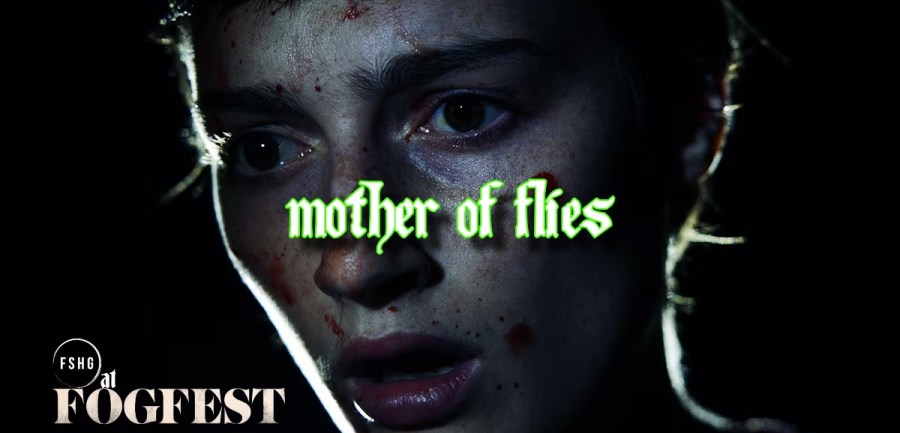
Mother of Flies (2025)
Directed & Written by John Adams, Zelda Adams, & Toby Poser
Starring John Adams, Zelda Adams, & Toby Poser
Horror
★★★★1/2 (out of ★★★★★)
The Adams Family—John Adams, Toby Poser, and Zelda Adams—have graced us all once more with a personal, soulful rendition of witchcraft horror in Mother of Flies. Their film concerns Mickey (Zelda Adams), a young woman been battling cancer, as she and her father Jake (John Adams) head into the deep woods to visit a woman called Solveig (Toby Poser) who claims to be able to help Mickey. Solveig deals in necromancy. She’s even offering her services free of charge. The longer Jake and Mickey stay in the woods with Solveig, the more Jake begins to question the woman’s methods. But Mickey wants to stay the course. She believes there’s hope, even in what presents as darkness.
Every film the Adams Family makes is unique, and their style has given new life to indie horror over the past 5-6 years since they properly announced themselves with The Deeper You Dig. This family of filmmakers has a collective yet singular vision of what horror can be: it doesn’t only have to rest on the dark, the disturbing, or the weird, it can be all that while retaining a beauty and a heart. Mother of Flies is the pinnacle (so far) of the Adams Family’s work, infused with more than just the family’s unique take on horror; this one is deeply personal. Mother of Flies tackles the sometimes uncomfortable and always present ways in which death intertwines with life, and how sometimes the spectre of death can bring forth new life, like a resurrection ripped from the religious and made flesh.
 In horror films, traditionally, death has been something to fear, or it’s been portrayed as something ugly, whereas Mother of Flies recognises that though death is our common end as humans, it can hold beauty depending on how you perceive it. Solveig sees death differently than most. When someone comments on a dead animal, Solveig retorts: “It‘s as beautiful dead as it was alive.” Solveig seems to perceive death on a spiritual level rather at the level of the body. When she asks Jake if he believes in magic and he replies that he doesn’t, she says: “Your child has died.” This obviously strikes Jake strangely, given he’s dealing with a daughter who has cancer, so Solveig clarifies: “In magic lives the child eternal.” She’s suggesting a spiritual death in Jake, whose adult mind has deemed magic part of the childish world of make believe. And the first real death is the death of the mind before the body.
As for the body, Solveig believes that the sentence of death doesn’t necessarily have to be the end and, most importantly, her methods of combatting death challenge the entire Western colonial comprehension of medicine. After a particularly painful ritual, Jake questions Mickey about whether Solveig’s methods are worth it, or even sensible. Solveig calmly questions Jake back about why her methods are any different than chemotherapy, during which patients often experience painful, uncomfortable side effects. Plus, she uses natural(/magical) methods rather than a bag of chemicals injected into the veins. Jake still immediately balks at nearly everything Solveig does, despite it all being natural and, considering the state of American healthcare, free. Perhaps the most significant aspect of Solveig’s witchcraft throughout Mother of Flies appears to be that she draws from nature in order to conjure her magic. We discover Solveig has paid dearly for her necromancing in the past because of traditional—and likely religious—views of necromancy as unnatural. Yet she gets her powers from nature. So, couldn’t bringing life back from death be considered birth, then, if it’s brought back by Mother Nature with Solveig as the witchy midwife?
“Life is rhythm—the heart, the drum.
But death knows only silence.”
Mother of Flies digs deep into the darkness, then comes up clutching beauty and hope in its bloody hands. There are several disturbing moments in the film, but its most powerful images revel in the beauty that’s possible beyond the corporeal horrors of death. The Adams Family have brought so much of their own lived experience into Mother of Flies. Anybody who’s followed them will understand just how deeply they’ve drawn from the personal well here. Creating horror stories from personal tragedy and triumph can often be a dark, dreary exercise in reliving trauma; in this film, it’s an exercise in poetic catharsis. Mother of Flies is one of the most profound films in any genre of the past decade about death, as it refuses to let death rest solely in the realm of the ugly and the feared—sometimes death can return us to life and resurrect what was previously dead within us.
 Father Son Holy Gore