

Foreigner (2025)
Directed & Written by Ava Maria Safai
Starring Rose Dehgan, Chloë MacLeod, Ashkan Nejati, & Maryam Sadeghi.
Horror
★★★★ (out of ★★★★★)
The following essay contains
SLIGHT SPOILERS.
Ava Maria Safai’s Foreigner follows the unfortunate experience of Yasamin Karimi (Rose Dehgan), who starts at a new school following her family immigrating to Canada. Yasamin worries she won’t fit in: “What if the Canadian kids don‘t like me?” Once she arrives at school, three white girls, led by Rachel Stanford (Chloë MacLeod), act like they want to be her friend, though it’s soon clear—to the viewer, not Yasamin unfortunately—they just want to force her into a white Canadian mould, even if it breaks her. Other sinister things are happening, too. Yasamin is changing, and not for the better. Is it merely the peer pressure of living in a new country amongst a new culture? Or is it something more demonic?
Foreigner is a smart exploration of the pressures many immigrants, specifically those who aren’t white, face when coming to Canada, amplified to horrific proportions. The seemingly sweet exterior of the three white girls gives way to reveal an ugly interior, just like the maple syrupy sweet mask of Canada eventually, once you actually live here (or just finally see through it), begins to slip and the racism reveals itself. Yasamin battles against how she perceives herself and her culture. Underneath that battle are the insidious powers of whiteness at work shaping her perceptions, warping what should be her love of her roots into a poisonous rejection of them.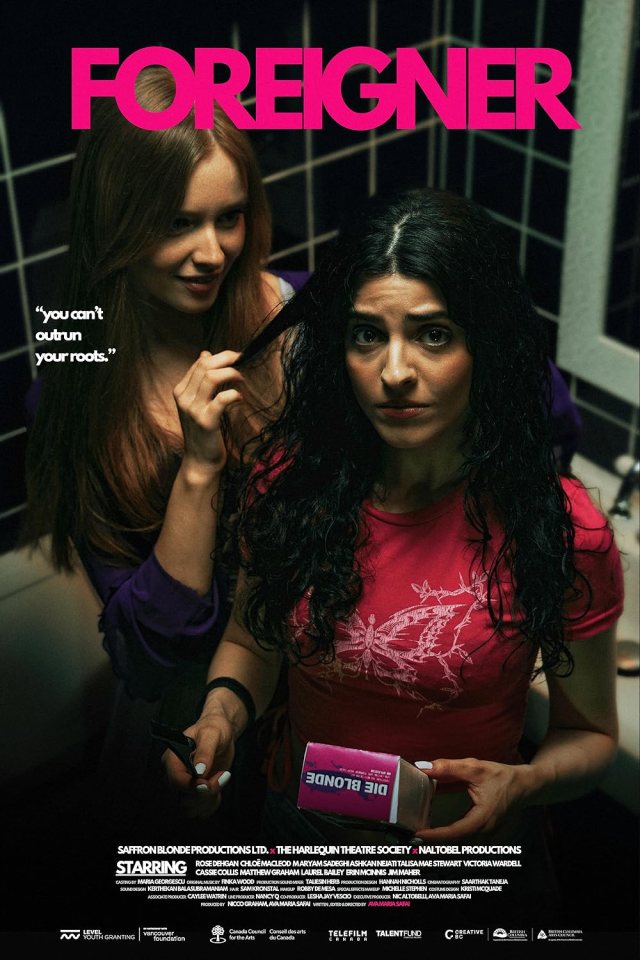 Safai does an incredible job in Foreigner portraying how whiteness is a sinister force in the lives of non-white immigrants to Canada, all the more significant since Canada has, until recent memory, gotten by pretending the country doesn’t experience the same levels of racism as seen in America; a bald-faced lie. Yasamin’s hit by microaggressions galore with the trio of eerie white girls, especially Rachel, asking her increasingly racist questions—she says she’s from Iran and one of them questions whether it’s a “third world country“—and making racial assumptions such as that she looks “kind of Spanish.” Her father is eager to believe in the promise of Canada rather than the reality: “This is Canada, baby! Perfect Canada.” He’s likely happy due to the relative freedom compared to Iran. Yet Yasamin, at the mercy of white Canadian high-school kids, sees and feels the real Canada.
Yasamin’s problems are also due to the way whiteness is portrayed in the media; something she’s never been able to escape because her own mother was consumed by an inner self-hatred fuelled by whiteness that was passed down to her. In one scene, Yasamin reads a magazine that’s barely subtly promoting the idea that blonde—code for white—is the standard for what’s considered beautiful. She’s also doomed to repeat what her mother went through since her mother encouraged her to practice English by watching English sitcoms, and those sitcoms were filled with nothing but white people, including the traditional, typical ‘hot’ blonde character. Similarly, the trio of white girls who become obsessed with Yasamin encourage her to go blonde so that she can look like a girl who’d be on Canadian Idol. Rachel, in typical racist fashion, actually frames using blonde dye as a form of freedom in comparison to Iran: “Here in Canada, girls can dye their hair.” Whiteness becomes the spell of a demonic force that lulls Yasamin into hatred of her own culture. At one point while Yasamin watches her tape of English sitcoms, she actually looks like she’s mesmerised by the spell of whiteness. The three creepy white girls can be seen akin to the Three Witches of Macbeth, except they’re the three white witches prophesying Yasamin’s cultural downfall. Everything about whiteness in Foreigner is spellbinding, just not in any kind of positive way, rather in the most destructive, poisonous way possible. Foreigner explores whiteness as a sinister presence, a demon that tortures those who dare not conform to its standards, an ideology of perceived purity that worms its way into the brain and heart like the Die Blonde works its way into Yasamin’s scalp. The play on cultural roots and hair roots—featured succinctly on the film’s poster with the tagline “You can‘t outrun your roots” next to an image of Yasamin with a box of dye—captures the way ethnic/racial superiority is a problem located entirely in the head. Safai’s film is a borderline satirical horror about cultural identity, an important genre film due to how it fearlessly portrays the terrible powers of whiteness. Maybe more importantly, even with a ray of hope in the end, Foreigner remembers that the terrors of whiteness are ever present, lurking at the periphery of Canadian consciousness, no matter how True North strong and free the nation appears on its surface.
 Father Son Holy Gore