
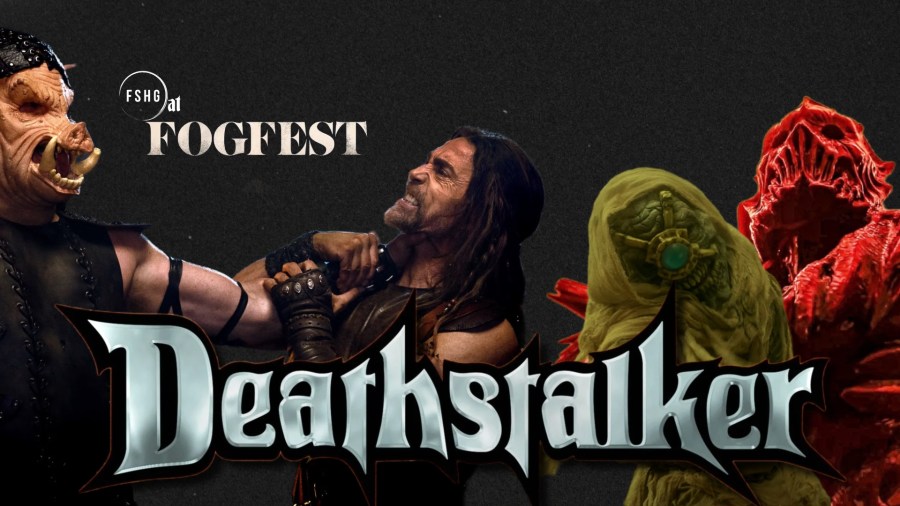
Deathstalker (2025)
Directed & Written by Steven Kostanski
Starring Daniel Bernhardt, Patton Oswalt, Christina Orjalo, Paul Lazenby, Nicholas Rice, & Nina Bergman.
Action / Adventure / Fantasy
★★★1/2 (out of ★★★★★)
Steven Kostanski—whose directorial and design work in films like The Void and Psycho Goreman, among others, has helped push the horror genre back towards gnarly practical effects—brought his remake of 1983’s Deathstalker to the far Eastern shore of Canada for St. John’s, Newfoundland & Labrador’s horror film festival Fog Fest. The film centres on the eponymous hero, Deathstalker (Daniel Bernhardt), a battle-scarred swordsman who fights against an all-consuming darkness brought on by the evil Nekromemnon (Nicholas Rice). Deathstalker winds up with a sidekick called Doodad (voiced by Patton Oswalt) whose magical abilities are, at best, a little rusty. The pair also come to travel the roads with Brisbayne (Christina Orjalo), an intelligent, flute-playing thief. The three of them must battle against Nekromemnon’s forces, including the resurrected Dreadites. Can Deathstalker and his friends overcome such darkness before the whole world’s doomed?
Sword-and-sorcery films are so closely associated with the 1980s, though there have been many of them across every decade stretching right back to the 1920s; there were at least 46 sword-and-sorcery films made and released during the ’80s. Kostanski’s Deathstalker pays homage to ’80s-era sword and sorcery while updating it for 2025. There are still existential ideas afoot in Kostanski’s film, and lots of wonderful camp, yet this version of Deathstalker presents its female characters and even its male protagonist in far different ways than sword and sorcery of the past. 2025’s Deathstalker is a fun, delightfully foolish, and heart-filled tale best watched in a packed theatre full of movie lovers like the audience at Fog Fest this year.
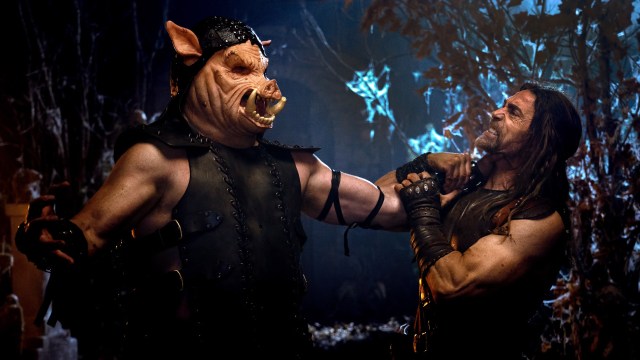
One of the most loveable things about Deathstalker is how Kostanski stayed true to so much about the 1980s sword-and-sorcery films—mainly practical effects and camp—while bringing the genre into the 21st century with a focus on making female characters into multi-dimensional human beings, as well as presenting masculinity in a tough but vulnerable way. Female characters in Deathstalker are not relegated to the role of eye candy like in most older sword-and-sorcery films, they’re allowed to have agency and intelligence while they’re simultaneously able to be beautiful. Often in older sword-and-sorcery films, women were scantily clad and could rarely save themselves, or they were wise old crones. Kostanski’s Deathstalker allows its female characters agency and intelligence, along with clothes to cover themselves, and makes one of them an intricate part of the plot, as Brisbayne helps Deathstalker overcome a powerful villain. Best of all, the Deathstalker character isn’t presented as an infallible, unbreakable hero who needs not rely on anybody else; this is so often the case in sword-and-sorcery films, and in many other films regardless of genre prior to the 2000s. This Deathstalker can be hurt and potentially killed, not to mention he’s not the only source of strength along the journey he undertakes. Several times, he must rely on others for strength and emotional support. Without spoilers, one pivotal moment for Deathstalker relies on an earlier good deed he did for a monstrous character whom previous sword-and-sorcery heroes might have simply destroyed.
A genuine sense of heart is what makes Deathstalker so unique in the realm of sword and sorcery because the plot hinges on the masculine, heroic Deathstalker using more than his big, beefy muscles to vanquish the evil threatening their world. At one point, in the face of monstrous figures, Doodad explains to Deathstalker that they’ve “forgotten the joy of music, or the comfort of a brotherly hug,” and Deathstalker soothes one by embracing them. After Brisbayne and Deathstalker get to know each other better, she tells him: “Life is much simpler when you live for one destiny.” These moments and the sage advice of others begin to chip away at Deathstalker’s lone wolf existence. He slowly understands that living only for the self is a way of living that isolates a person, allowing the world’s darkness to grow. Deathstalker is a film that recognises the era in which it’s made. We’re at a point in history where the more isolated people are, the more horrible the world becomes, and the only way we can overcome the darkness is by coming together to let in the light.
At its core, Deathstalker is a story about “the might of never–ending darkness” versus the heart of those who fight against it joined together in pursuit of a collective goal of freedom and happiness. The need for collective action against the forces of darkness is very real and timely. Those with power currently, around the world, are using it often against the most powerless, and the only way we can prevent this from getting any worse is by joining together. Power doesn’t lie in the hands of one, or a few of, society’s supposed elite, whether that’s a corporate businessman or a dark wizard; power lies in the hands of the many, so long as we fight together. The most profound truth in Kostanski’s remake is that real power “comes from more than just the sword.” We see this every day in 2025: unarmed protestors in America combat ICE’s dark forces by preventing armed masked men from kidnapping citizens off the streets; Palestinian families with nothing to eat stand up bravely to the Israeli military’s horrifying firepower; trans women proudly continue to assert their identities public in the face of violent threats from both individuals and governments; and the list goes on. Kostanski’s remake is a testament to the fact that the forces of darkness only thrive when we as people remain divided, and that in the face of unchecked power, a unified collective holds the keys not only to survival but, more importantly, to liberation.


Pingback: From Our Members’ Desks (Nov. 17, 2025) – Online Film Critics Society