
Dream Eater (2025)
Directed & Written by Justin Hewitt-Drakulic, Mallory Drumm, & Alex Lee Williams.
Starring Mallory Drumm & Alex Lee Williams.
Horror
★★★ (out of ★★★★★)
DISCLAIMER:
The following essay contains
SOME SPOILERS!
The new found footage horror, Dream Eater, is an unsettling spiral into madness, as Alex (Alex Lee Williams) and his girlfriend Mallory (Mallory Drumm) head to a remote cabin in the woods where they plan to film Alex while he experiences violent episodes of parasomnia. Things have been getting increasingly dangerous with the progression of Alex’s parasomnia; mostly recently, he hurt himself, though claimed it was an accident. The longer Mallory and Alex stay at the cabin, the more Alex seems drawn towards something terrible in the darkness of his mind. Despite Mallory doing everything she can to help, she’s incapable of dealing with what lurks in the recesses of Alex’s past.
Dream Eater is a terrifying little film that, at its core, is about how trauma is stored in the body; even when you don’t realise it’s there, it lurks within, awaiting a time when it will emerge and potentially destroy everything in a person’s life. The film tackles the consequences of buried trauma through a plot that leans into the supernatural. Dream Eater is a story about how burying trauma warps a person’s world, and the world of those around them, into an unrecognisably dark, disturbing existence that can swallow someone whole.
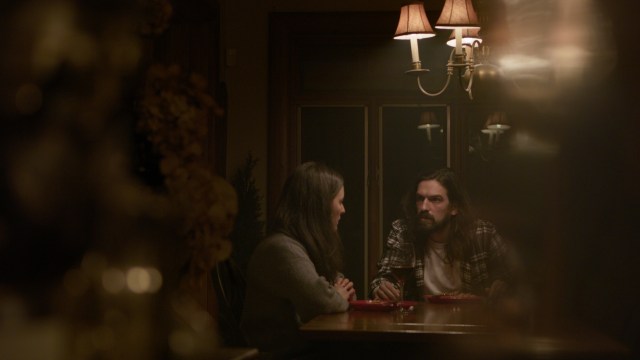 Without spoiling the big plot points, Dream Eater digs into Alex’s past and the trauma he experienced due to being abandoned by his parents and living in the foster care system, but that’s just the tip of an awful iceberg. At one point, Mallory seeks out a man called Dr. Armitage who’s written about issues related to parasomnia. Dr. Armitage tells Mallory: “Trauma is such a powerful force. If untreated, it can slither into all the facets of your life, corrupting it until finally it transforms you into something you never wanted.” In this description, the doctor describes trauma like a poisonous snake. What we witness throughout the rest of the film, particularly after Mallory uncovers more about Alex’s birth parents and the reason he spent most of his life in foster care, is Alex succumbing to a poisonous trauma he doesn’t fully understand.
Part of Dream Eater is not just about trauma, it’s about traumas that people don’t even know exist in their bloodline. While many children are aware of the traumas their parents experience, and this often gets passed down from generation generation, there are just as many children who are unaware of their parents’ traumas, and many who don’t actually know their birth parents so they have no way of understanding any generational trauma, hereditary or otherwise, that might be passed onto them. In the 2014 book The Body Keeps the Score: Brain, Mind, & Body in the Healing of Trauma, Bessel van der Kolk writes that trauma is stored in the body, in nervous system responses and sensory memories, rather than in language. This is deeply relevant for someone like Alex, whose family history is not accessible to him through language since he doesn’t know the truth about his parents. His traumatic family is, however, accessible to him directly through the body, as his escalating parasomnia episodes almost recall memories of his mother/father that he doesn’t consciously know. Alex doesn’t know what happened with his parents until Mallory finds out later and reveals the truth to him, so he’s effectively swimming in the dark, unaware of the monstrous things that exist around and within him ready to pull him under the surface into an abyss below.
 There are many typical found footage moments in Dream Eater, though what the film does best is take on a very personal story and plot rather than have its characters dealing with a completely exterior force that they just so happen to stumble upon. There are plenty of other found footage horror films that do this, too, yet Dream Eater also feels realistic most of the time due to the struggle Alex and Mallory go through as partners trying to navigate a serious psychological and relationship issue. Dream Eater ends horrifically on the palpable fear that what was passed down to Alex may not be finished with his family, and, again, the film pushes forward a narrative with its finale that it’s really all about intergenerational trauma’s insidious nature. While the film strays into supernatural territory, its disturbing heart lies in a story about a relationship, and a life, torn apart by an inability, or even an unwillingness on Alex’s part, to confront the past’s horrors and what can often be the terrors of family trauma.
 Father Son Holy Gore