

Invader (2025)
Directed & Written by Mickey Keating
Starring Joe Swanberg, Vero Maynez, Ruby Vallejo, & Colin Huerta.
Horror
★★★★ (out of ★★★★★)
DISCLAIMER:
The following essay contains
SPOILERS!
You’ve been warned.
Mickey Keating’s latest film Invader follows Ana (Vero Maynez), a young woman who’s just arrived in Chicago to visit her cousin, Camila (Ruby Vallejo). Ana’s having trouble getting her cousin on the phone, and she has a creepy encounter with a cab driver, so she heads off from the bus station anyway. She doesn’t realise that a home invader (Joe Swanberg) has taken up residence at Camila’s home, which puts her on the road towards a violent confrontation with him. Right from the opening text telling us that, according to the FBI, a break-in occurs every thirty seconds in the United States, Keating is focused on an overly American tale. While Invader works wonderfully enough as a quick, mean home invasion horror, it’s clearly also concerned with the sociopolitical state of America. This reading of Keating’s film focuses on its representation of crimes conveniently ignored by many conservative and most right-wing Americans: the crimes committed by white American men, and, more specifically, those committed against non-white Americans. Invader‘s a disturbing snapshot of violence that contains commentary deeply relevant to where America is politically right now.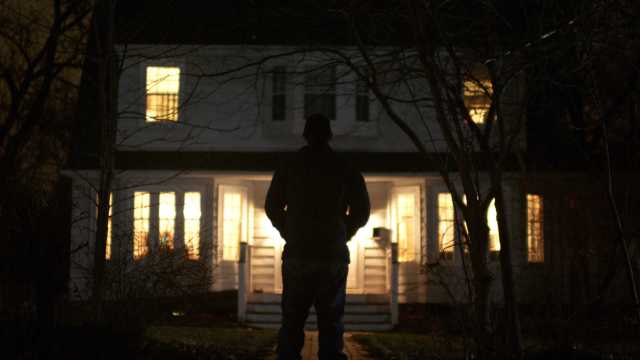 An interesting moment occurs in the opening scene when the home invader is moving around a trashed house and in the background it’s as if a radio’s playing yet we hear a report about the manhunt for Richard Speck after he viciously slaughtered eight nursing students in 1966. Why would Invader evoke Speck’s ghost, exactly? That ties into this overall reading of Invader as a commentary on and retort to the way many Americans view crime as something that comes from outside rather than from within. Speck’s killing spree in ’66 is one of the most infamous crimes to ever occur in Chicago, where the film’s plot plays out. Nearly all of Chicago’s worst crimes—the St. Valentine’s Massacre which is connected to Al Capone, Leopold & Loeb’s murder of Bobby Franks, John Wayne Gacy, H.H. Holmes, to name a few—were all instances of American-born citizens committing terrible crimes. Invader is a film centred on a white American man terrorising the homes of American citizens, and there’s the added layer of his victims clearly being Americans of Mexican heritage, which only makes Keating’s film more politically urgent.
 So many Americans are more concerned about the supposed threats from outside their borders and the non-white people they see as invaders, they forget that all too often the real threat comes from within, just like the terrifying man lurking inside Ana’s cousin’s home. More than that, many Americans, not just white ones, seem to pay little if any attention to the many crimes of white men against people of other races. Ana’s extended family, as well as other Mexican-Americans like Camila’s co-worker Carlo (Colin Huerta), have awful horrors visited upon them by the white American home invader. These types of crimes in America are often ignored by right-wing people because it doesn’t fit their narrative, and if they do acknowledge these crimes their acknowledgement often comes with a xenophobic or outright racist caveat with the intent to blame the victims. Apart from the killing, the worst aspect of the home invader’s actions is he’s not simply there to live, he’s not invading homes solely for the purpose of shelter, he’s destroying them and making them unliveable before he walks away, altering these spaces from a warm family home to an empty, destroyed house.
The scariest part of Invader is there’s no resolution; the violence will continue, one of America’s many perpetual social cycles. You don’t have to read Invader in the way this essay does. Though it’s difficult to ignore, from the opening text about break-ins across America to the interesting inclusion of a radio broadcast about Richard Speck’s crimes, that Keating is purposefully talking about America and its issues with crime. The film is one small story about the larger American sociopolitical landscape. Most unsettling is, Invader could’ve been made at any point in American history and it’d be relevant. Right now this film is ultra relevant because American violence only keeps on growing, becoming uglier, and getting more inexplicable like the home invader’s bizarre behaviour.
 Father Son Holy Gore
Pingback: This Week at the Movies (Dec. 5, 2025) – Online Film Critics Society