
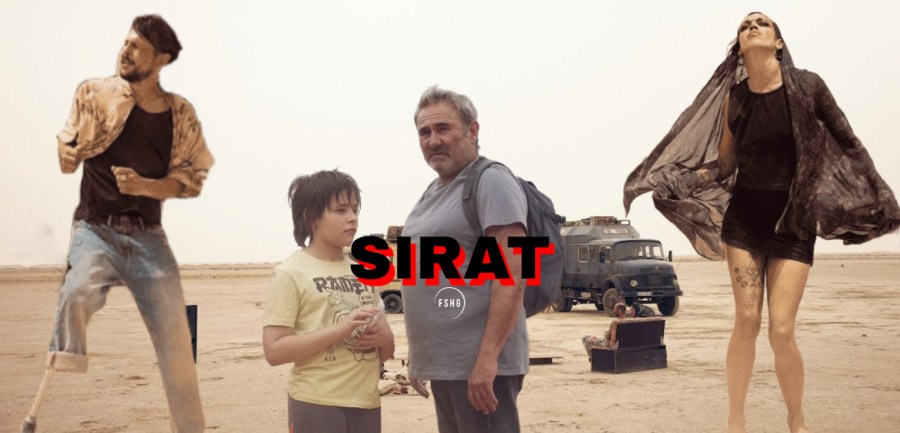
Sirāt (2025)
Directed by Oliver Laxe
Screenplay by Laxe & Santiago Fillol
Starring Sergi López, Bruno Núñez Arjona, Stefania Gadda, Joshua Liam Herderson, Richard ‘Bigui’ Bellamy, Tonin Janvier, & Jade Oukid.
Drama / Mystery / Thriller
★★★★1/2 (out of ★★★★★)
DISCLAIMER:
The following essay contains
SLIGHT SPOILERS!
Avert thine eyes lest ye be spoilt.
Oliver Laxe’s Sirāt begins with Luis (Sergi López) and his young son Esteban (Bruno Núñez Arjona) at a rave in the desert searching for his estranged or simply just missing daughter. When he’s told about another rave where he could continue searching, he heads across treacherous road in Southern Morocco. He joins a convoy of ravers, including two friends called Jade (Jade Oukid) and Tonin (Tonin Janvier). He quickly gains their trust, as they all brave the long, brutal road ahead together. Further along the road, Luis and his new friends experience terrifying, tragic events. The question is, will they turn back, or will they keep on going in spite of all the odds facing them?
Sirāt is at once very real, very literal, then at the same time deeply metaphorical and poetic: on one hand, Laxe is telling a story about a man dealing with one tragedy who’s faced with escalating tragedies as he tries to deal with the initial one propelling him towards an uncertain fate; on the other hand, Laxe is telling a story about how we cannot escape judgement, nor punishment for the mistakes we’ve made. The Islamic mythology of As-Sirāt, a bridge over which one must pass in order to access Paradise or else fall into the fires of Hell, serves as a metaphor about living through Hell’s fire while still amongst the land of the living—a psychological journey of torment across both a physical and mental desert.
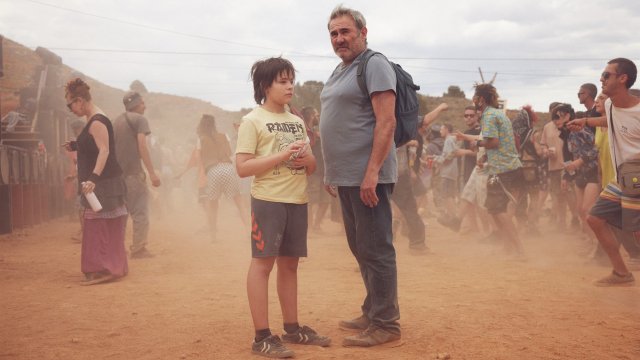
“Is this what the end of the world feels like?”
“It’s been the end of the world for a long time.”
Luis’s journey across the metaphorical bridge is a depiction of what it’s like to experience the pains of hell while still alive. It’s hard not to consider that Laxe and co-writer Santiago Fillol are leaning on As-Sirāt for more than just a title, considering the film features a scene when one of the women in the convoy watches a TV screen in a desert shack featuring crowds of people in Mecca at the Kaaba. The title Sirāt, referring to As-Sirāt, is undeniably a purposeful symbol Laxe and Fillol use to evoke the sense that Luis is being judged, whether by a higher power like Allah or simply by us, the viewer. In Islam, As-Sirāt is the bridge everyone has to pass on the Day of Resurrection if they are to enter Paradise (Jannah), but if one doesn’t make it, they fall into a place of punishment (Jahannam). It’s worth noting that in Islam the Resurrection will begin with a trumpet blast because Sirāt opens with a people stacking speakers in the desert before rave music begins thumping endlessly out of them.
As people walk As-Sirāt, they’re interrogated about religious duties, including their īmān (a believer’s recognition of faith and deeds in the religious aspects of Islam), their prayer, almsgiving (charity), pilgrimage to Mecca, ritual washings’, ghusl (ritual purification), and responsibility to relatives. Luis seems to adhere to a couple of these duties: the whole reason he’s on his journey into the desert is out of responsibility to his daughter, and later he offers up all his remaining money to help with purchasing gas for the entire convoy. Yet at the same time, where Luis’s existential torture plays out is in a responsibility to relatives. The entire reason he’s on that journey with his son in the first place is due to responsibility for his daughter, and there’s a sense Luis feels guilt related to his daughter, perhaps suggesting he’s responsible for his daughter running off from the family. Unfortunately his guilt and suffering only get worse later.
We can view the early parts of Luis’s journey in Sirāt as his figurative journey through al-A’raf, a border realm between Jannah and Jahannam. As the film progresses, Luis experiences nothing but tragedy. At the outset, he’s searching for his daughter whom he’ll likely never find. Partway through, Luis experiences a brutal loss. And nearing the end, he starts to lose some of the new friends he made on his pilgrimage in violent fashion. This can be viewed as his entering into a phase or place known as the Barzakh, where the soul has left the body and where sinners experience suffering. Luis experiences one especially harrowing tragedy that is his ultimate suffering, even more so given the reason he began his search at the start of the film. When the film leaves Luis, it feels as if he’ll never make it through Barzakh and into Paradise, or, for Catholics, he’ll never pass beyond Purgatory into Heaven. At the end of Sirat, it seems Luis’s suffering will be eternal. Does he deserve all that he’s suffered? Laxe doesn’t answer that. Perhaps there’s a point to not answering such a question from Sirat. Often, good people suffer more than those who’ve done horrible things. It could be that Luis was a great father. We’ll never know. Sirat isn’t a film seeking to offer the answers to deep, troublesome existential questions, it’s one that challenges the audience to endure its protagonist’s relentless suffering, to bear witness, and make of it whatever sense they will—kind of like what we’re forced to do with the everyday onslaught of our lives.
 Father Son Holy Gore