
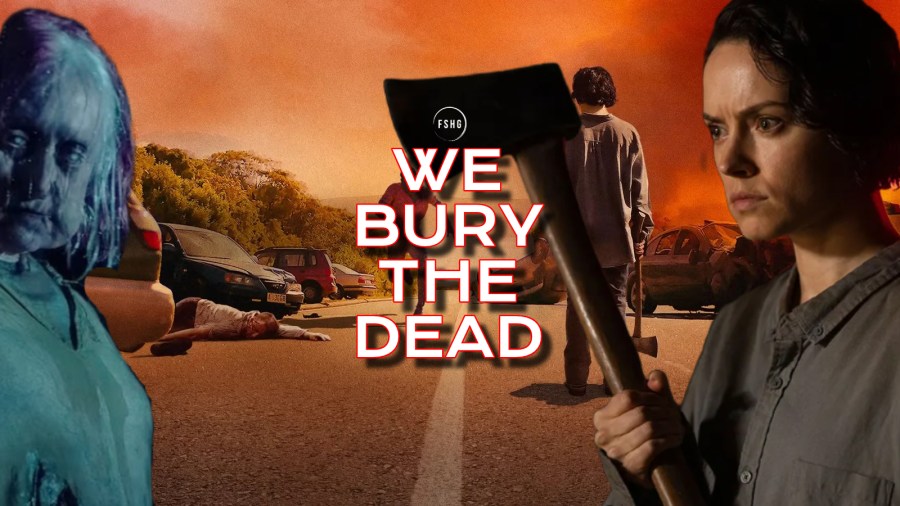
We Bury the Dead (2026)
Directed & Written by Zak Hilditch
Starring Daisy Ridley, Brenton Thwaites, Mark Coles Smith, & Matt Whelan.
Horror / Thriller
★★★★ (out of ★★★★★)
DISCLAIMER:
The following essay contains
SLIGHT SPOILERS!
You’ve been warned.
Zak Hilditch, whose 2013 feature These Final Hours depicts the last day on Earth, has returned to a different post-apocalyptic Australian landscape with We Bury the Dead, a zombie horror-thriller centred on Ava (Daisy Ridley), an American who volunteers to deal with body removal after the U.S. military accidentally deploys an experimental weapon off Tasmania’s coast and kills 500,000 people. Ava’s hoping to find her husband Mitch (Matt Whelan), who was in the area at the time. She winds up paired with Clay (Brenton Thwaites), a man determined to prove his worth by helping the clean-up operation. As Ava and Clay make their way across a devastated Tasmania littered with corpses, they face the revived dead and the brutality of the still living.
We Bury the Dead doesn’t reinvent the zombie subgenre wheel, but remains a very emotional zombie story that’s more about confronting loss and grief than survival. The undead in Hilditch’s film are confined to Tasmania and there are no implications that the infection is spreading beyond the island state. By containing the zombies, Hilditch refocuses from the survival horror of the similarly themed 28 Days Later or shows like The Walking Dead onto the emotional, psychological consequences in the aftermath of the dead returning to shambling life. Ava’s journey is as depressing as it is horrific, though the film doesn’t turn its back on hope, even through all the death and decay.
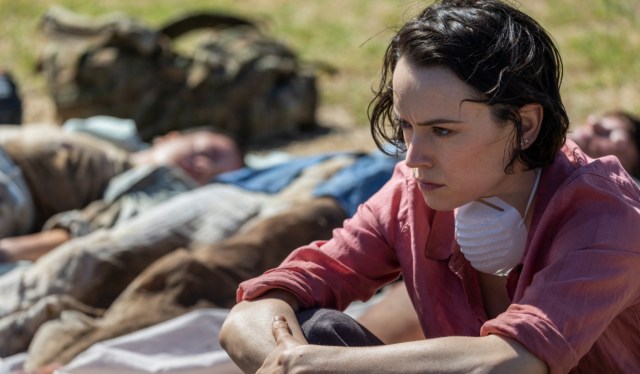 One of the more familiar tropes in zombie movies that’s found in We Bury the Dead is the juxtaposition of the best v. worst of humanity in apocalyptic times. Clay proves to be one of the good ones, even if he’s had family troubles. He’s out there on body retrieval duty in order to prove he can be a good, selfless man. He’s placed in stark contrast to Riley (Mark Coles Smith), a soldier who cannot accept the hand he’s been dealt. Riley puts Ava in a dangerous, disturbing situation due to his own pain. The military are overall portrayed horrifically in We Bury the Dead. Along their travels, Clay and Ava enter a restricted area where they see a military vehicle drive by and a soldier shoots a slow-moving man nearby, suggesting the soldiers aren’t checking to tell the difference between a potential normal, living person and one of the undead; a sinister reality that the living are just as dangerous, if not more dangerous, than a zombie. For all the zombie’s fault, it acts on instinct. Human beings like Riley have both free will and willpower, yet choose to commit vile acts anyway.
Several times in the film, the zombie’s treated as a ghost-like figure with “unfinished business” left behind. It’s suggested perhaps the people who do “come back online” have something they cannot die without doing, biologically wired to seek closure. This comes to an ultimate head late in the film when Ava has to confront grief and a painful lack of closure face to face. Ava begs for there to be “unfinished business” that will allow her more time to gain a sliver of closure. In Gothic fiction, the ghost has nearly always been humanised. In horror, the zombie is rarely humanised meaningfully without being played as camp, except in certain works like George Romero’s Day of the Dead and Land of the Dead. Hilditch’s treatment of the zombie by way of a ghostly, humanised perspective allows us to remember that the undead are still alive; not just their bodies, but their souls, too. When Ava stumbles across an undead man, she later tells Clay he “looked like he was lost, scared” rather than scary. A great scene features Ava coming upon another of the revived dead. This undead man doesn’t hurt her, instead he continues to dig a grave for his family, then calmly accepts a fate he wants in the wake of losing his family. This scene is a snapshot of how We Bury the Dead treats the zombie figure with a level of care rarely seen in the subgenre.
“Poor bastards. Imagine having to die twice.”
Without any major spoilers, We Bury the Dead clings to hope, humanity, and rebirth, despite all the sorrow, death, and decay on display throughout. Ava’s journey, especially once we hear more of her marriage’s backstory, is an emotional rollercoaster while we watch her try to deal with potential loss and a general grief about the state of humanity. Zombie fiction is at its best when interrogating humanity’s most troubling issues rather than focusing solely on blood, guts, and brains, which is why Hilditch’s film is a solid addition to the canon. We Bury the Dead suggests that no matter how bad we feel human beings’ relationships are with each other, from betrayal to ignorant hatred to outright violence, there’s always hope of beginning anew, and it addresses such a profound idea while also stitching the zombie’s humanity back into its cinematic costume.
 Father Son Holy Gore
Pingback: This Week at the Movies (Jan. 9, 2026) – Online Film Critics Society