
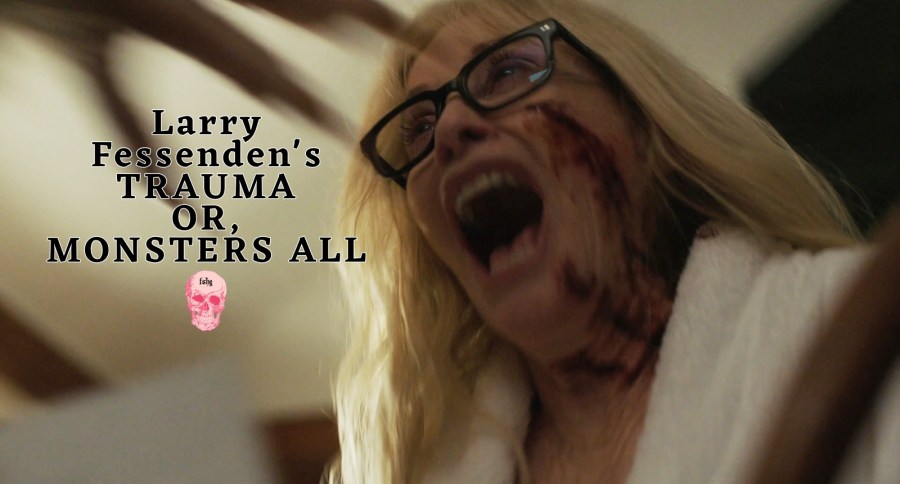
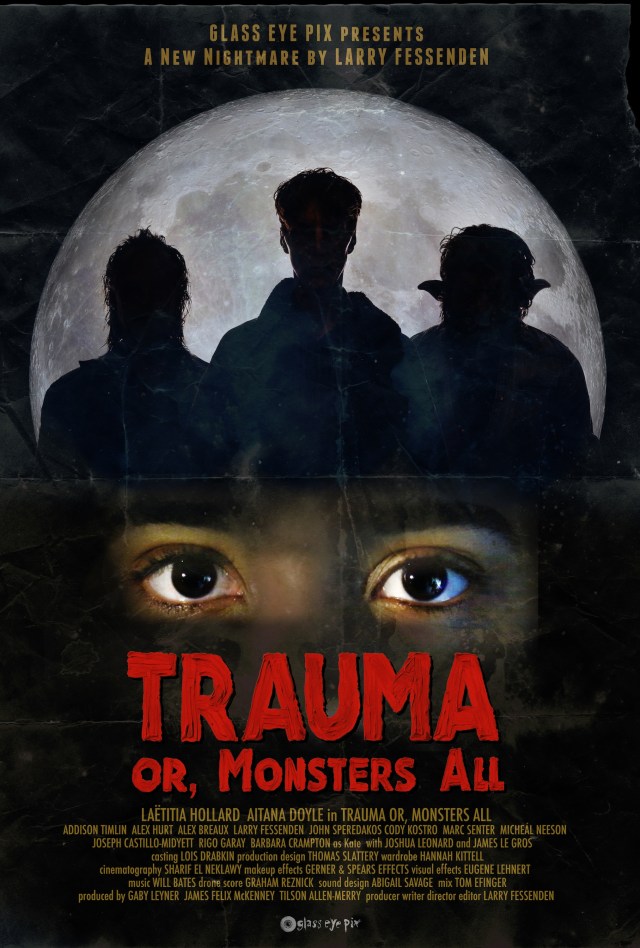
Trauma or, Monsters All (2026)
Directed & Written by Larry Fessenden
Starring Laetitia Hollard, Aitana Doyle, Addison Timlin, Alex Hurt, Alex Breaux, Larry Fessenden, John Speredakos, Cody Kostro, Marc Senter, Michael Neeson, Joseph Castilo-Midyett, Rigo Garay, Barbara Crampton, Joshua Leonard, & James Le Gros.
Horror
★★★★ (out of ★★★★★)
DISCLAIMER:
The following essay contains
MINOR SPOILERS.
Turn back, lest ye be spoiled.
Trauma or, Monsters All, which premiered at the Overlook Film Festival this year, is another monstrous feature from director-writer Larry Fessenden, yet this film is even more unique than Fessenden’s previous work because it brings together monsters from three of his previous films—Habit (1995), Depraved (2019), and Blackout (2023)—to create a unified work about how monstrosity and humanity are tangled together. When a writer called Cassandra (Laetitia Hollard) has an article printed in the local newspaper in Talbot Falls about supposed monsters lurking around town, she unleashes buried traumas and fresh wounds which sets the town on edge and even against each other. As Cassandra attempts to find out the truth about the monsters, she only finds more pain, and it unfortunately puts her in danger, though it isn’t necessarily the danger posed by vampires, werewolves, and Frankensteins.
Not every horror filmmaker or writer understands the complexity of monstrosity, even if they make monster movies, but Fessenden—similar to someone like Guillermo del Toro—understands monsters; not only what makes them scary, but also what makes them deeply human. Trauma or, Monsters All deals with different ideas about monstrosity, particularly how what is monstrous can often, though not always, be in the eye of the beholder. Fessenden’s latest film is about resisting the monster within. It’s also just as much about not being trapped by the monstrosity of history. Like Cassandra, we must seek history’s complexities and truths, but we also must recognise that moving forward and healing is just as much, if not more, important, otherwise we’ll only ever be defined by monsters and the ghosts of our traumas.
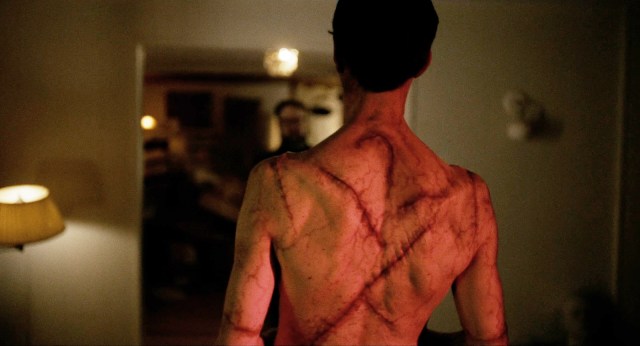
Fessenden’s film, as evidenced by its title, tackles trauma on a community level while it also deals with personal traumas, too. Trauma often does one of two things: a) it makes someone stronger, or b) it makes someone even more susceptible to further traumas, which is where Talbot Falls finds itself as a community in the wake of the events in Blackout (2023), as well as the events in Depraved (2019) despite the latter not taking place directly in Talbot Falls. Fessenden has always had his finger on the pulse of America. Trauma or, Monsters All is a microcosm of a haunted America going through trauma after trauma without any time to heal. A wonderful piece throughout the film is Cassandra’s interest in George Washington Carver, whose name alone expresses the contradictions of American history. Cassandra mentions Carver’s interesting life, including his queer relationship with a younger white man, and recognises that even Carver, whose life was deeply affected by slavery, found ways to move beyond the defining racism of America. Fessenden’s film briefly touches on issues of race, ultimately taking the stance that race is one of the ways the powerful monsters in society keep us divided. In one scene, a character, perhaps unknowingly, even quotes the immortal words of Rodney King: “Can‘t we all just get along?”
Fessenden’s film deals with monsters and likewise with certain monstrous people in the small town of Talbot Falls. In one passing remark, we hear from the local librarian about the people trying to shut down or defund the library due to children’s books they don’t like. This itself is a direct reflection of the real America that Trump has ushered in, as MAGA roars about censorship while cheering on banning books that deal with queerness, trans identity, or Black history. There’s also Polidori who’s in from out of town, but still represents a very human monster; those who’ve seen Depraved already know. But the most telling group of monsters are the angry white guys who all but hunt Cassandra because she wrote an article about the monstrous recent past of Talbot Falls; again, a real reflection of Trump’s America in which the enemies don’t seem to be the fascists or racists but the people trying to expose/deal with the nasty, violent truths of American history.
Trauma or, Monsters All also deals with the idea that human beings can, and so often do, become monsters, which speaks to a nature v. nurture concept of monstrosity; nobody’s born a monster, they’re shaped into one. The subplot involving Charley’s ex Sharon somewhat captures the spirit of Friedrich Nietzsche’s famous quote from Beyond Good and Evil (1886): “Whoever fights monsters should see to it that in the process he does not become a monster. And if you gaze long into an abyss, the abyss also gazes into you.” Sharon’s so lost due to Charley being cast out, because he’s seen as monstrous, that she winds up becoming a monster herself; her lingering trauma doesn’t allow her to see the monstrosity still around her, from the monstrous humans living in Talbot Falls to the literal vampire—Sam from Fessenden’s Habit, played by the director himself—who’s glided into town. Even if it’s not Sharon’s fault she becomes a monster, she still succumbs to genuine monstrosity, eventually committing a horrifying act of violence against a young queer woman.
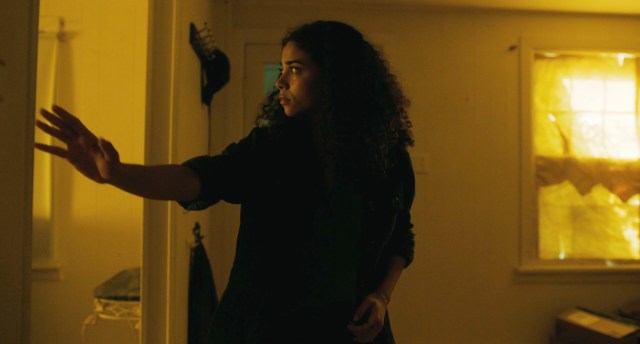
Something important that Trauma or, Monsters All does is it brings to light that monstrosity is all about perception in the end. In one scene, Sam ruminates on monsters, “or just people who identify as monsters,” and then questions: “I mean, what is a monster?” Even if we go back to James Whale’s Frankenstein (1931) with the scene featuring Frankenstein and the little girl, we can see that monstrosity isn’t necessarily a reflection of reality, it’s more a reflection of the person looking upon what’s deemed ‘monstrous.’ That scene illustrates how those who are different are rightly afraid of being labelled monsters. This is why, in Trauma or, Monsters All, Adam (from Depraved) and Charley (from Blackout) are trying their best to hide away from the world, in order to avoid all the terror and violence that comes along with the label of monster.
In Fessenden’s film, even the most arguably ‘bad’ monster is aware of how humans are warped into monsters: “Y‘know, you‘ve gotta practice things like empathy and kindness, morality, all the virtues, and if you don‘t, they atrophy.” The real monsters in our societies today are those who turn their backs to empathy and kindness. We’re living in a time when some of the most powerful, wealthy people in the world say things like empathy is a “fundamental weakness of Western civilization.” Like Sam says, once your abilities to empathise and be kind atrophy, “then you become like the undead.” The genuine monsters living in our world circa 2026 are the rich and powerful, as well as those following them blindly, who’ve allowed their better hearts to die. By the end of Trauma or, Monsters All, new horrors and traumas have been visited upon Talbot Falls, and the monstrosity of everyday human beings is revealed. There’s at least a glimmer of hope that the truth will prevail and that good, honest people still remain, though Fessenden’s film makes clear that neither the truth nor goodness will survive if we don’t come together to save ourselves from the dangerous potentials of human monstrosity.

