
Nightborn (2026)
Directed by Hanna Bergholm
Screenplay by Bergholm & Ilja Rautsi
Starring Seidi Haarla, Rupert Grint, Pamela Tola, Pirkko Saisio, Rebecca Lacey, & John Thomson.
Horror
★★★★ (out of ★★★★★)
At Fantasia 2026, Hanna Bergholm’s newest film Nightborn had its North American premiere, telling the tale of Saga (Seidi Haarla) and Jon (Rupert Grint), a couple moving to a rural family home in a Finnish forest and planning to start a family. When Saga later gives birth to her first child, she immediately finds it difficult to bond with the baby, whose back is very hairy and who scream-growls every waking moment. Jon thinks it’s just post-partum trouble. Yet no matter how hard Saga tries, she can’t seem to get into the groove of motherhood. And that’s before she wakes up with deep, bloody bite marks.
Nightborn is a fairy-tale horror that uses Finnish folklore to accentuate the idea of monstrosity in its depiction of motherhood. The film isn’t about a mother, nor a child, who’s monstrous, it’s about how mothers can be made to feel monstrous when they don’t have the traditionally expected experience of having/raising a baby. Nightborn uses the grotesque to paint a vivid, unsettling picture of one woman’s experience battling against the perceptions of others while struggling to be a mother. Yet Bergholm doesn’t ultimately deny that, amongst all the gruesome horrors, there are moments of beauty and happiness when a mother’s allowed to mother how she sees fit.
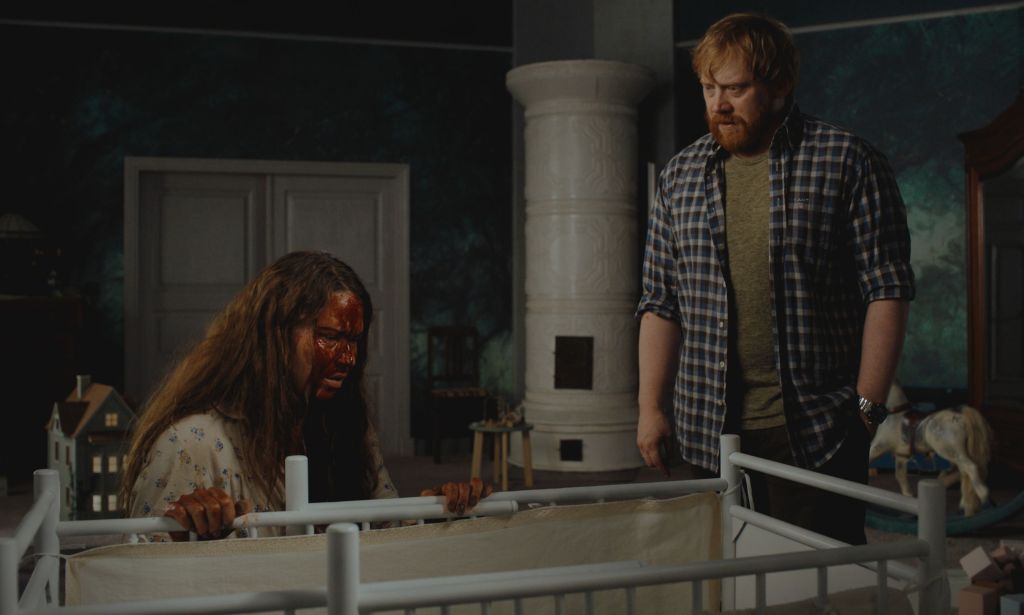
Bergholm’s film expertly tears apart the romanticisation of motherhood, confronting how difficult and painful being a mother can be when all the sentimentality is stripped away. There’s a fantastic mix of eroticism and motherhood when Saga tells Jon “Make me a mother” before they have passionate sex in the forest against a tree in damp moss. Immediately, we cut from the sound of Saga’s orgasm to a labour scream as Saga’s about to birth her child. What’s so perfect is the way that the romantic, even sexualised, view of motherhood is quickly dashed when Jon gets a shot of blood and amniotic fluid on his face, crouching between Saga’s legs to get an up-close view of the birth—a delightfully subverted cumshot. It’s from this moment onward that Nightborn dives fully into the gruesomeness of motherhood.
Gruesomeness isn’t the film’s only way of expressing motherhood’s difficulties. Bergholm and Rautsi’s screenplay makes great use of Finnish folklore to likewise address issues related to motherhood, or, even more broadly, to women living through patriarchal expectations. Early on, Jon notices a tree stump that resembles a woman on all fours with moss for hair. This is symbolic of a metsänneito aka “maiden of the forest,” whose beauty in front belies a hideous back half. The maiden would traditionally trick men in various ways. This folklore figure’s brief appearance in Nightborn relates to what occurs later when Jon begins to treat Saga as if she somehow led him astray, telling her outright she’s a “monster” who doesn’t “know how to love.” But what eventually results of Jon and Saga’s little family speaks to a liberation of mother and child, rather than ruination of the father.
While there are other themes and ideas going on throughout Nightborn, the film most of all deals with Saga’s deteriorating sense of what motherhood was in theory versus what it is in reality. Everyone around her tries to push her towards not only believing motherhood is a gift, but also believing there’s a single prescribed vision of a mother’s relationship to her child. Jon’s mother insists that being a mother is “the greatest happiness in the world” while Saga refuses to believe her own mother, whose frank and brutal thoughts on motherhood turn out to be the only honesty in Saga’s life. Saga’s mother spells out one of the film’s themes when she says: “You have a really romanticised idea of how people should be.” Nightborn deals with the results of a lifetime of girls/women being sold a romanticised, sanitised fairy tale version of motherhood, perhaps one reason why Bergholm’s film employs a narrative that plays out as a fairy tale.
Nightborn covers a lot of ground when it comes to perspectives on motherhood. What Bergholm does best is present a deeply bitter, occasionally sweet take on the toll motherhood can have on families. We even see the generational aspects of motherhood with Saga’s own mother. She initially seems like nothing but an asshole and later seems like she might be onto something about the hard truths of being a mother. Bergholm and Rautsi’s screenplay facilitates a difficult, uncomfortable, and darkly funny discussion about the stories we tell as societies, whether about monsters or motherhood. Nightborn is often terrifying, at times disturbing, though its real power is that it shuns traditional, patriarchal ideas about a mythical perfect mother, and recognises that the label of ‘monster’ is often more reflective of those who use it than it is of those it’s meant to describe.

