
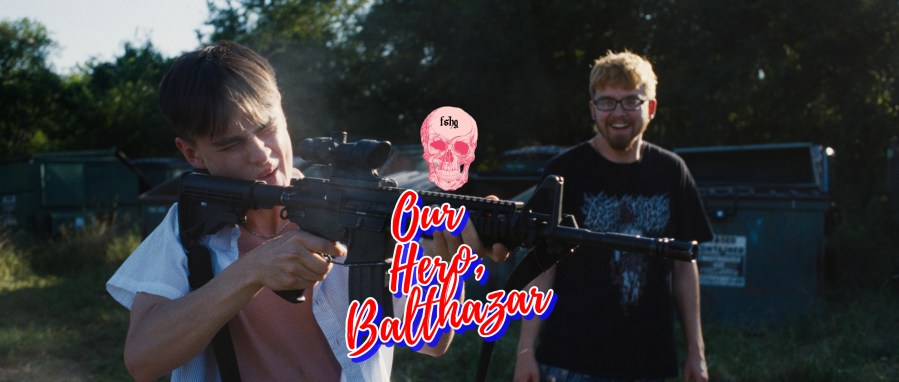
Our Hero, Balthazar (2026)
Directed by Oscar Boyson
Screenplay by Boyson & Ricky Camilleri
Starring Jaeden Martell, Asa Butterfield, Chris Bauer, & Pippa Knowles.
Comedy / Drama / Thriller
★★★★1/2 (out of ★★★★★)
DISCLAIMER:
The following essay contains SPOILERS!
If that’s fine with you,
pull the trigger & scroll.
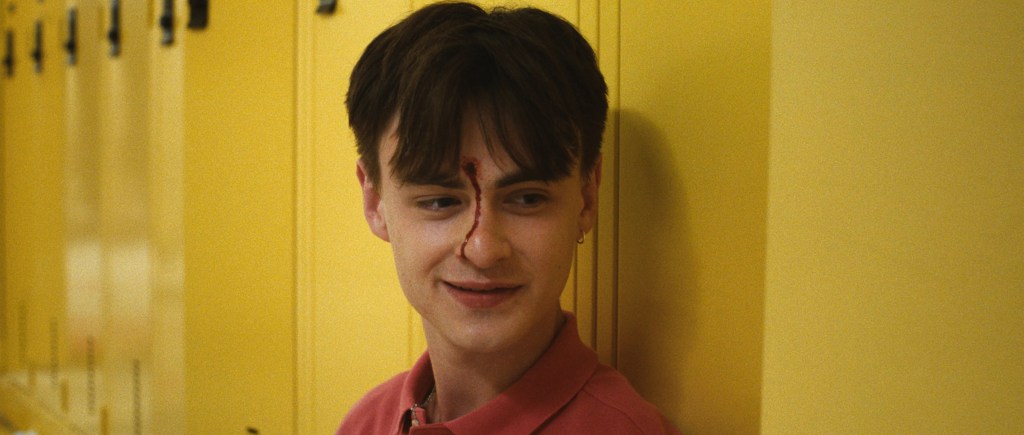
In Oscar Boyson’s Our Hero Balthazar, the eponymous Balthazar (Jaeden Martell) is a spoiled kid from a wealthy family who spends most of his days at home trying to manipulate his social media followers into believing he’s passionate about school shootings. One day he’s messaged randomly by a young man, whom he later discovers is Solomon (Asa Butterfield), threatening to commit a shooting himself. Balthazar decides to travel all the way to Texas in order to try stopping Solomon from doing something horrific, though it’s not out of altruism, rather he’s really hoping that a girl at school, Eleanor (Pippa Knowles), will find his supposed act of heroism attractive. What follows alters both Balthazar and Solomon, as well as the people around them, forever.
Our Hero, Balthazar is a darkly comic, disturbing, and provocative perspective on what boys/young men in America deal with on a daily basis, from seeing violence on their phones nearly every single day, to witnessing school shootings happening around them and the wildly varied reactions to them, to being indoctrinated into a toxic masculine worldview that crushes their ability to be good men and productive members of society. The most intense aspect of the film is how Boyson digs into psychopathy in boys/young men, as most of the film is a balancing act between looking at Solomon’s warped conception of masculinity and looking at Balthazar’s unnerving lack of empathy, both of which epitomise the upbringing of far too many American boys/young men today. Our Hero, Balthazar is more of a psychological horror than anything, as it confronts terrible parenting, sexual frustration, digital-age empathy or a lack thereof, gun violence, and more with brutal honesty.
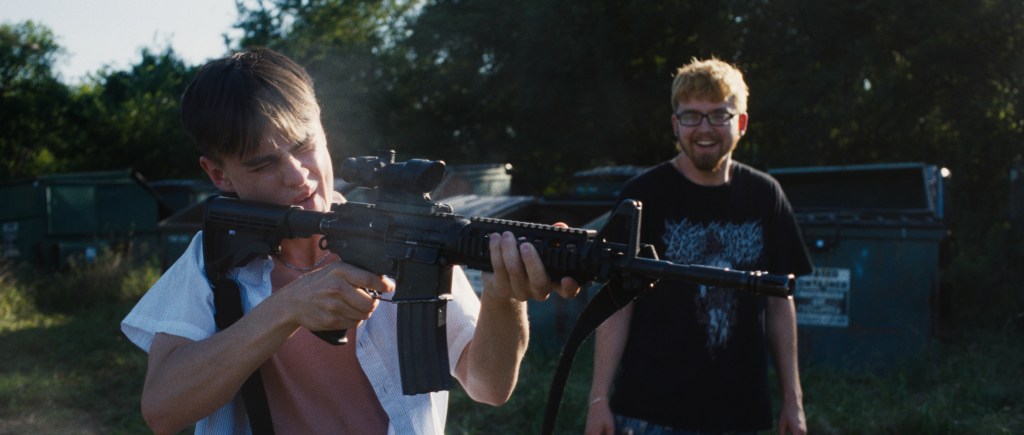
Toxic masculinity is on display throughout the film specifically through the character Beaver (Chris Bauer), Solomon’s deadbeat dad, a supplement salesman/con artist for a company hilariously called Thrush. Beaver and his equally toxic friend work hard to indoctrinate other men into a world of destructive masculinity, mostly to make a profit. Solomon’s been entirely brainwashed by their foolish speeches about “low T count” and how “suffering builds winning.” When he’s brought in as a salesman, he uses pseudoscience to try conning other men into buying supplements, as he tells one man that his mother didn’t expose him “to enough testosterone in the womb, she bore you weak,” which is also misogynistic, blaming the mother for not birthing a ‘proper’ man. Not only does Beaver warp his son’s understanding of masculinity, he frames living as a man as abiding by the “basic principles of capitalism“—this spills into a toxic masculine worldview since Beaver tries to convince his son not pay Grandma’s rent and instead reinvest money into more supplements—so Solomon only understands manhood as equating to sex with women or building wealth.
There’s an intriguing thread of homoeroticism throughout Our Hero, Balthazar. First, while Balthazar is trying to initially connect with Solomon, he makes use of AI programs to create not just a wholesale AI woman but an AI woman that’s actually created using a photo of himself. Then he talks dirty with Solomon online as the AI woman and goes well overboard with nasty sexual talk, only a bit of which comes from online searches. Later when the two actually meet in person, Solomon questions this, asking whether Balthazar came up with the dirty talk himself. He further mentions sending a picture of his dick. Perhaps strangest of all is the homoeroticism that happens between Solomon and his dad Beaver. Early in the film, a young woman who works with Solomon at the gas station says she finds it’s weird that he’s always talking about his dad’s dick. Then when Solomon and Balthazar are together, Solomon shows his new friend a straight up porn video featuring his dad, talking almost proudly about it. In a later scene, Beaver even grabs his son’s crotch in front of a woman, claiming Solomon has a big dick; rather than see it as intrusive or weird, Solomon laughs and treats it like a normal father-son interaction. Just as strange is Solomon’s obsession with a character called “Jimmy Phantasm” that seemingly veers into sexual obsession. This is actually a reference to shooter Randy Stair who was similarly obsessed with a character from the animated series Danny Phantom and eventually murdered three of his co-workers at a Pennsylvania supermarket in 2017. Stair didn’t struggle with homosexuality, but did express struggles with gender dysphoria and feeling he was a woman born in a man’s body. Solomon is so afraid of being perceived as unmanly that he redirects potential homosexual attraction towards an animated character rather than a real man. It’s incredibly revealing when Solomon shows Balthazar his guns, along with a Nazi armband, underneath which is visible an LGBTQ+ flag, then he says casually: “I had a lot of phases.”
What’s troubling about all the homoeroticism is certainly not that it exists, it’s the fact that both Balthazar and Solomon are two lonely, sexually frustrated young men, and it’s hard not to wonder whether if they simply embraced the homoeroticism they might not express their frustration in such unstable, destructive ways. Solomon in particular has been indoctrinated into toxic masculinity via his father, and being a man to him involves heterosexuality. Effectively, he’s robbed of a simple joy in life by not allowing himself to outright feel homosexual feelings, or any feelings for that matter, which then end up misdirected into, for lack of a better term, incel-like frustrations. In a similar way, Balthazar is driven by an obsession with impressing a girl at school that drives him deeper and deeper into antisocial behaviour. The same thing happens constantly in America, and many other places: boys and young men are so brainwashed by heteronormativity that they’d rather be in proximity to violence than to tenderness with other men, sexual or not.
What’s really disturbing about Our Hero, Balthazar is Balthazar’s lack of empathy and a fully realised identity. Balthazar’s entire identity is made up of pieces of other people from news stories and social media videos. He can cry on command, using that in order to appear like an empathetic person so he can gain online and social credibility. He actually studies the emotional videos of others then regurgitates their words when it suits him best. At one point, his life coach is trying to help him have a less lonely birthday when Balthazar coldly, and falsely, accuses him of paedophilia by repeating the words of a child sexual abuse survivor he saw previously online. Whenever the seriousness of life encroaches on Balthazar, he falls back on the words of others; he has no actual identity of his own, neither does he have any identifiable beliefs of his own. The only time he uses the words of others in a remotely positive way is when he recognises the grift Beaver’s using against Solomon, something he learned from his driver back home in New York. Even at the very end of the film, after all that’s transpired, Balthazar’s narcissism continues to drive him to seek fame and he once again utters the words of an actual young person affected by a mass shooting. It’s a perfect way to end the film, pointing to Balthazar being much more of a legitimate psychopath than Solomon.
Our Hero, Balthazar is a movie that could’ve been made even back in the ’90s, but the increasingly sinister presence of social media in all of our lives makes the film painfully relevant for 2026 and shows that nothing’s gotten any better, in fact it’s only gotten worse. There’s no hope to be found here, and Boyson would’ve done the subject matter a disservice by trying to force it into the story. That doesn’t mean there isn’t hope in real life that boys and young men will eventually be deprogrammed from all the madness and gendered nonsense into which social media and toxic men have indoctrinated them. Unfortunately right now and for quite some time, America’s facing an epidemic of gun violence, the overwhelming majority of which continues to be committed by (cisgender) men, and sometimes to confront such terrifying realities it means a filmmaker or storyteller has to be blunt. Our Hero, Balthazar is most certainly a blunt portrayal of male issues, albeit at times a deeply, darkly funny one, too. The most terrifying part of the film is not even Balthazar, nor is it Solomon, it’s the fact that both these young men are parented by terrible people who are more concerned about themselves than the potential monsters their children might become; that’s also one of the most terrifying parts about real life, too.

