
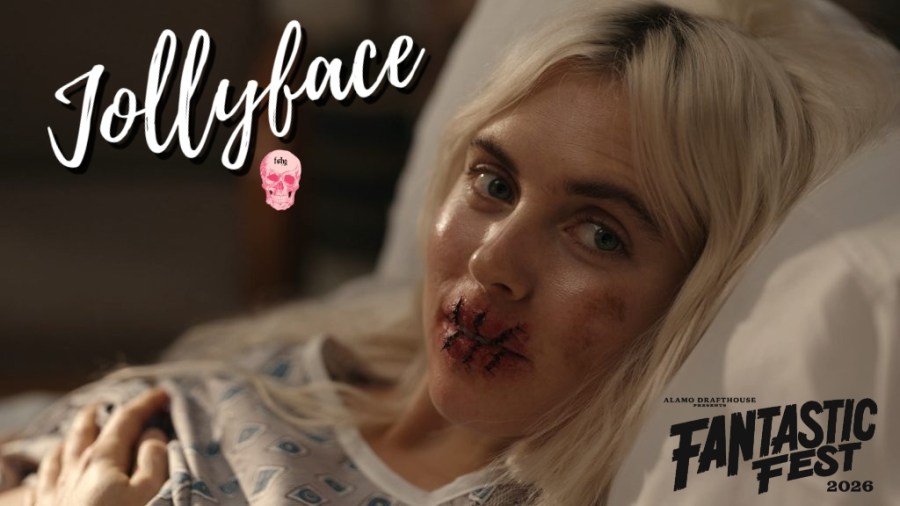
Jollyface (2026)
Directed & Written by Justin Floyd
Starring Emily Kimball, Kofi Siriboe, Alexis Louder, & Jacob Bridges.
Horror / Thriller
★★★★1/2 (out of ★★★★★)
Justin Floyd’s intense new film Jollyface kicks off with a married couple, Blair (Emily Kimball) and Nick (Kofi Siriboe), whose lives are shattered when Nick is inexplicably shot outside their apartment building. Blair tries to push the cops investigating the crime to take it seriously and not consider it a gang-related killing since Nick was far from a criminal. Yet because Nick was Black it feels like the cops are leaning on stereotypes in lieu of evidence. Blair tries to dig into things herself, leaning on her Black friend Charlotte (Alexis Louder) who’s a cop herself. The only issue is that Nick’s killer already has his eye on Blair and those around her, seemingly plotting more awful things.
Jollyface is a fiery piece of cinema about uncomfortable racial violence that’s still alive and well in 2026 America. People will now forever compare films about race to Jordan Peele’s Get Out, though, in the case of Floyd’s film, there’s a worthy comparison: whereas Get Out uses a horror/sci-fi vehicle to discuss how whiteness robs from Blackness, Jollyface uses a crime-thriller premise to discuss how whiteness accuses and deliberately misrepresents Blackness to cruel aims. Floyd’s film is so unsettling because its story isn’t told via metaphor, it’s a brutal and haunting dose of American reality.

Part of what makes Jollyface compelling is how it deals with a white woman experiencing some of the roadblocks a person of colour might were they the ones investigating a Black man’s shooting, in the process addressing how real allyship requires white people to actually put themselves and their bodies in harm’s way if they hope to affect genuine change. Blair initially has to push back against online perceptions when she takes her struggle onto the internet. Several comments on her live video say she’s “performative” and “too woke.” A white podcaster flippantly says that it’s only “Black–on–Black crime, they’ll figure it out” and even people close to Blair say they don’t know what “gang stuff Nick was up to.” At nearly every turn, Blair is refused the benefit of the doubt, something way too many Black people are all too familiar with when it comes to the law and the court of public opinion.
The response Blair receives as she pushes for answers forces her to put herself at risk if she wants to find out the truth, even if that ultimately doesn’t play out as well as she’d hoped. It isn’t enough for a white person to marry a Black person then call themselves an ally. Jollyface addresses this intelligently from the beginning when Blair believes a man is staring at them/her Black husband in a diner, only for them to realise the guy’s blind. Although this situation comes back to the forefront in an intriguing way later, this opening scene gives the audience a good perspective on how those outside a certain experience, such as white Blair going “Karen” on behalf of her Black husband, don’t always understand said experience until they actually put themselves in the line of fire, figuratively or literally.
The phrase ‘I don’t see colour’ takes on a wild, dark dimension in Jollyface, but anything more would be to spoil an unnerving reveal in the film. Jollyface is about how whiteness indeed sees colour and spends endless time obsessing over it. The film’s world sits in the shadow of whiteness and everything whiteness is capable of doing with its all-encompassing, systemic power. There are a number of conversations about race happening in Floyd’s film. Best of all, Jollyface portrays how genuine white allies will face, and have historically faced, similar consequences as the Black people they seek to defend because, in the end, whiteness respects little else other than an adherence to its beliefs and systems; anyone who stands in its way is expendable, no matter if they’re white on the surface, too.

