
What Happened to Doris? (2026)
Directed by Nick Simon
Screenplay by Thomas Fenton
Starring Heather Graham, Mimi Rogers, Marcus Coloma, Kevin Keppy, Morgan Peter Brown, & Margo Parker.
Horror
★★★ (out of ★★★★★)
Nick Simon’s What Happened to Doris? is another retelling of the tale of Doris Bither (Heather Graham), who claimed in 1974 that she was physically assaulted by one or more invisible entities. Doris is scraping by trying to look after her kids and juggling men when she starts being physically and sexually attacked by a dark presence in the night. Nobody believes her initially until they start witnessing the dark presence in her home for themselves. She eventually meets a couple UCLA scientists by chance in a bookstore and convinces them to look into the phenomenon. And then, the entity reaches out into the real world further.
While nothing can beat The Entity, a 1982 fictionalised version of Bither’s experiences, What Happened to Doris? does an especially good job focusing on how Doris faced not only disbelief of the supernatural in her attempts to figure out her situation, she also faced gendered disbelief. Above all else, Simon’s film is about belief, both in terms of trusting people and their experiences, and in terms of suspending disbelief when considering the existence of the supernatural.
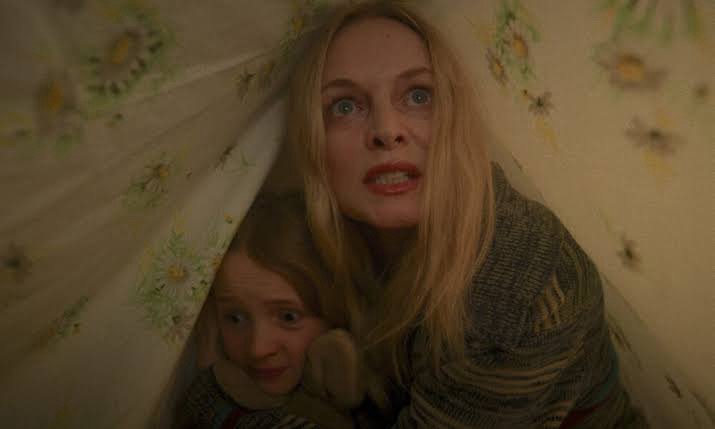
Simon recreates a number of the actual events that Bither experienced, such as the photos taken that featured strange balls and streaks of light surrounding Doris, or when the two scientists who visit Doris’s home—based on Kerry Gaynor and Barry Taff—witness a cupboard swing open on its own and a frying pan fly out before embedding itself in the cupboards nearby. Thankfully, Simon decided to focus less on scenes depicting Doris being sexually assaulted by the entity and more on Doris herself, particularly when UCLA’s Dr. Lillian Ross (Mimi Rogers) enters the picture. Dr. Ross is most likely based on Thelma Moss, who was an actress-turned-psychologist/parapsychologist. She’s the first authority figure to take Doris’s sexual assault claim—what she calls “phasmophilia”—seriously, as she calls out male bias around her by noting the only part of Doris’s story the men don’t believe is the rape; men are willing to believe in paranormal entities but not women’s lived experiences. What gives the film so much weight is the relationship that grows between Doris and Dr. Ross, which in turn helps Doris battle back against the dark presence assaulting her and her home.
Doris Bither was a woman who was abandoned in many ways, so it’s interesting when one of the scientists mentions the theory that “ghosts only inhabit attics and basements because they don’t wanna be around people. Those places tend to be abandoned, thus the hauntings.” Both Doris and her home are ‘haunted’ by the dark entity, so, if we go by the aforementioned theory, Doris herself is an abandoned place. Even the two UCLA scientists nearly abandon Doris before Dr. Ross steps in. In real life, Doris was living in far, far worse conditions than the film depicts; she was, in a sense, discarded or abandoned by the society and systems around her, from the economy to the hierarchy of gender. What Happened to Doris? is about the haunting Doris experienced, and it’s likewise about the way society’s haunted through the people it abandons. Perhaps what ultimately kept Doris safe despite the dark entity’s attacks was the eventual belief of those around her, offering her at least some protection against an inexplicable, violent force seeking to destroy her.

